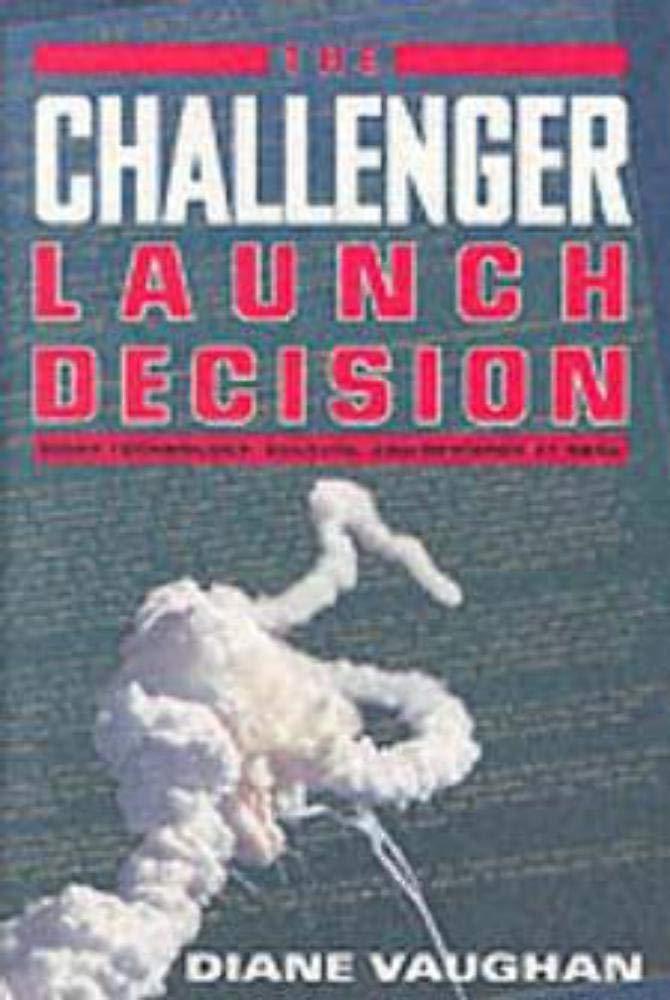
The Challenger Launch Decision: Risky Technology, Culture, and Deviance at NASA
by Diane Vaughan
ISBN 13: 978-0226851761
Book description

When the Space Shuttle Challenger exploded on January 28, 1986, millions of Americans became bound together in a single, historic moment. Many still vividly remember exactly where they were and what they were doing when they heard about the tragedy. In The Challenger Launch Decision, Diane Vaughan recreates the steps leading up to that fateful decision, contradicting conventional interpretations to prove that what occurred at NASA was not skulduggery or misconduct but a disastrous mistake. Journalists and investigators have historically cited production problems and managerial wrong-doing as the reasons behind the disaster. The Presidential Commission uncovered a flawed decision-making process at the space agency as well, citing a well-documented history of problems with the O-ring and a dramatic last-minute protest by engineers over the Solid Rocket Boosters as evidence of managerial neglect. Why did NASA managers, who not only had all the information prior to the launch but also were warned against it, decide to proceed? In retelling how the decision unfolded through the eyes of the managers and the engineers, Vaughan uncovers an incremental descent into poor judgment, supported by a culture of high-risk technology. She reveals how and why NASA insiders, when repeatedly faced with evidence that something was wrong, normalized the deviance so that it became acceptable to them. No safety rules were broken. No single individual was at fault. Instead, the cause of the disaster is a story not of evil but of the banality of organizational life. This powerful work explains why the Challenger tragedy must be reexamined and offers an unexpected warning about the hidden hazards of living in this technological age.



Recommended on 2 episodes:

David Robinson Oct. 7, 2026 View episode
Last week, David Robinson resigned from OpenAI. He’d been in charge of writing the safety reports for new models and came to believe that OpenAI and the broader artificial intelligence industry lack the safety culture necessary to protect the world from what they’re building. Robinson has an unusual background for an A.I. frontier lab staffer. He’s a Rhodes scholar and Yale Law graduate, he founded a civil rights nonprofit and he advised the Biden White House. He did not come up in the hothouse of Silicon Valley. And when he joined OpenAI in 2023, he says, he saw A.I. as a useful tool, not as a technology that could pose catastrophic risks. That’s changed. In Robinson’s first interview since leaving OpenAI, he tells me why. (The New York Times has sued OpenAI and Microsoft claiming copyright infringement. The companies have denied those claims.)

Gloria Mark Jan. 5, 2024 View episode
I’m convinced that attention is the most important human faculty. Your life, after all, is just the sum total of the things you’ve paid attention to. And we lament our attention problems all the time: how distracted we are, how drained we feel, how hard it is to stay focused or present. And yet, while there’s no shortage of advice on how to improve our sleep hygiene, or spending, or physical fitness, there’s hardly any good information about how to build and replenish our capacity for paying attention. So for the start of the new year, I wanted to have a conversation with Gloria Mark, a professor at the University of California, Irvine, author of the book “Attention Span,” and one of the few people who’s deeply studied the way our attention works, how that’s been changing, and what we can do to stop frittering our attention away.
by @zachbellay