From this episode
Recommended books
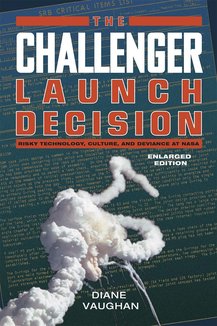
When the Space Shuttle Challenger exploded on January 28, 1986, millions of Americans became bound together in a single, historic moment. Many still vividly remember exactly where they were and what they were doing when they heard about the tragedy.
When the Space Shuttle Challenger exploded on January 28, 1986, millions of Americans became bound together in a single, historic moment. Many still vividly remember exactly where they were and what they were doing when they heard about the tragedy. Diane Vaughan recreates the steps leading up to that fateful decision, contradicting conventional interpretations to prove that what occurred at NASA was not skullduggery or misconduct but a disastrous mistake. Why did NASA managers, who not only had all the information prior to the launch but also were warned against it, decide to proceed? In retelling how the decision unfolded through the eyes of the managers and the engineers, Vaughan uncovers an incremental descent into poor judgment, supported by a culture of high-risk technology. She reveals how and why NASA insiders, when repeatedly faced with evidence that something was wrong, normalized the deviance so that it became acceptable to them. In a new preface, Vaughan reveals the ramifications for this book and for her when a similar decision-making process brought down NASA's Space Shuttle Columbia in 2003.
Find this book on:


The Undoing Project: A Friendship That Changed Our Minds
Author:
Michael Lewis
“Brilliant. .
“Brilliant. . . . Lewis has given us a spectacular account of two great men who faced up to uncertainty and the limits of human reason.” ―William Easterly, Wall Street Journal Forty years ago, Israeli psychologists Daniel Kahneman and Amos Tversky wrote a series of breathtakingly original papers that invented the field of behavioral economics. One of the greatest partnerships in the history of science, Kahneman and Tversky’s extraordinary friendship incited a revolution in Big Data studies, advanced evidence-based medicine, led to a new approach to government regulation, and made much of Michael Lewis’s own work possible. In The Undoing Project, Lewis shows how their Nobel Prize–winning theory of the mind altered our perception of reality.
Find this book on:
The God Equation: The Quest for a Theory of Everything
Author:
Michio Kaku
#1 NEW YORK TIMES BESTSELLER • The epic story of the greatest quest in all of science—the holy grail of physics that would explain the creation of the universe—from renowned theoretical physicist and author of The Future of the Mind and The Future of Humanity. When Newton discovered the law of gravity, he unified the rules governing the heavens and the Earth.
#1 NEW YORK TIMES BESTSELLER • The epic story of the greatest quest in all of science—the holy grail of physics that would explain the creation of the universe—from renowned theoretical physicist and author of The Future of the Mind and The Future of Humanity. When Newton discovered the law of gravity, he unified the rules governing the heavens and the Earth. Since then, physicists have been placing new forces into ever-grander theories. But perhaps the ultimate challenge is achieving a monumental synthesis of the two remaining theories—relativity and the quantum theory. This would be the crowning achievement of science, a profound merging of all the forces of nature into one beautiful, magnificent equation to unlock the deepest mysteries in science: What happened before the Big Bang? What lies on the other side of a black hole? Are there other universes and dimensions? Is time travel possible? Why are we here? Kaku also explains the intense controversy swirling around this theory, with Nobel laureates taking opposite sides on this vital question. It is a captivating, gripping story; what’s at stake is nothing less than our conception of the universe. Written with Kaku’s trademark enthusiasm and clarity, this epic and engaging journey is the story of The God Equation .
Find this book on:
Episode overview
I’m convinced that attention is the most important human faculty. Your life, after all, is just the sum total of the things you’ve paid attention to. And we lament our attention problems all the time: how distracted we are, how drained we feel, how hard it is to stay focused or present. And yet, while there’s no shortage of advice on how to improve our sleep hygiene, or spending, or physical fitness, there’s hardly any good information about how to build and replenish our capacity for paying attention.
So for the start of the new year, I wanted to have a conversation with Gloria Mark, a professor at the University of California, Irvine, author of the book “Attention Span,” and one of the few people who’s deeply studied the way our attention works, how that’s been changing, and what we can do to stop frittering our attention away.