Recommended Books
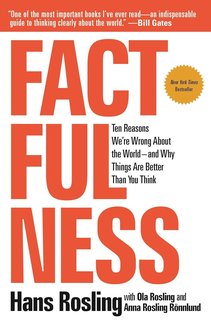
Factfulness: Ten Reasons We're Wrong About the World--and Why Things Are Better Than You Think
Authors:
Hans Rosling
,
Anna Rosling Rönnlund
,
Ola Rosling
ISBN 13:
978-1250123824
INSTANT NEW YORK TIMES BESTSELLER “One of the most important books I’ve ever read―an indispensable guide to thinking clearly about the world.” – Bill Gates “Hans Rosling tells the story of ‘the secret silent miracle of human progress’ as only he can. But Factfulness does much more than that. It also explains why progress is so often secret and silent and teaches readers how to see it clearly.” ― Melinda Gates " Factfulness by Hans Rosling, an outstanding international public health expert, is a hopeful book about the potential for human progress when we work off facts rather than our inherent biases." - Former U.S. President Barack Obama Factfulnes s: The stress-reducing habit of only carrying opinions for which you have strong supporting facts. When asked simple questions about global trends― what percentage of the world’s population live in poverty; why the world’s population is increasing; how many girls finish school ―we systematically get the answers wrong. So wrong that a chimpanzee choosing answers at random will consistently outguess teachers, journalists, Nobel laureates, and investment bankers. In Factfulness , Professor of International Health and global TED phenomenon Hans Rosling, together with his two long-time collaborators, Anna and Ola, offers a radical new explanation of why this happens . They reveal the ten instincts that distort our perspective ―from our tendency to divide the world into two camps (usually some version of us and them ) to the way we consume media (where fear rules) to how we perceive progress (believing that most things are getting worse). Our problem is that we don’t know what we don’t know, and even our guesses are informed by unconscious and predictable biases. It turns out that the world, for all its imperfections, is in a much better state than we might think. That doesn’t mean there aren’t real concerns. But when we worry about everything all the time instead of embracing a worldview based on facts, we can lose our ability to focus on the things that threaten us most. Inspiring and revelatory, filled with lively anecdotes and moving stories, Factfulness is an urgent and essential book that will change the way you see the world and empower you to respond to the crises and opportunities of the future. --- “This book is my last battle in my life-long mission to fight devastating ignorance…Previously I armed myself with huge data sets, eye-opening software, an energetic learning style and a Swedish bayonet for sword-swallowing. It wasn’t enough. But I hope this book will be.” Hans Rosling, February 2017.


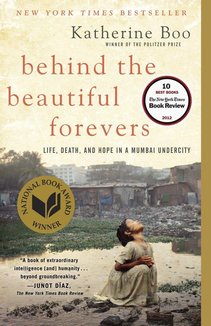
Behind the Beautiful Forevers: Life, Death, and Hope in a Mumbai Undercity
Author:
Katherine Boo
ISBN 13:
978-0812979329
NEW YORK TIMES BESTSELLER • NATIONAL BOOK AWARD WINNER • ONE OF TIME ’S TEN BEST NONFICTION BOOKS OF THE DECADE • ONE OF THE NEW YORK TIMES ’S 100 BEST BOOKS OF THE 21ST CENTURY “Inspiring . . . extraordinary . . . [Katherine Boo] shows us how people in the most desperate circumstances can find the resilience to hang on to their humanity. Just as important, she makes us care.”— People “ A tour de force of social justice reportage and a literary masterpiece.”—Judges, PEN/John Kenneth Galbraith Award ONE OF THE TEN BEST BOOKS OF THE YEAR BY The New York Times • The Washington Post • O: The Oprah Magazine • USA Today • New York • The Miami Herald • San Francisco Chronicle • Newsday In this breathtaking book by Pulitzer Prize winner Katherine Boo, a bewildering age of global change and inequality is made human through the dramatic story of families striving toward a better life in Annawadi, a makeshift settlement in the shadow of luxury hotels near the Mumbai airport. As India starts to prosper, the residents of Annawadi are electric with hope. Abdul, an enterprising teenager, sees “a fortune beyond counting” in the recyclable garbage that richer people throw away. Meanwhile Asha, a woman of formidable ambition, has identified a shadier route to the middle class. With a little luck, her beautiful daughter, Annawadi’s “most-everything girl,” might become its first female college graduate. And even the poorest children, like the young thief Kalu, feel themselves inching closer to their dreams. But then Abdul is falsely accused in a shocking tragedy; terror and global recession rock the city; and suppressed tensions over religion, caste, sex, power, and economic envy turn brutal. With intelligence, humor, and deep insight into what connects people to one another in an era of tumultuous change, Behind the Beautiful Forevers, based on years of uncompromising reporting, carries the reader headlong into one of the twenty-first century’s hidden worlds—and into the hearts of families impossible to forget. WINNER OF: The PEN Nonfiction Award • The Los Angeles Times Book Prize • The American Academy of Arts and Letters Award • The New York Public Library’s Helen Bernstein Book Award NAMED ONE OF THE BEST BOOKS OF THE YEAR BY The New Yorker • People • Entertainment Weekly • The Wall Street Journal • The Boston Globe • The Economist • Financial Times • Foreign Policy • The Seattle Times • The Nation • St. Louis Post-Dispatch • The Denver Post • Minneapolis Star Tribune • The Week • Kansas City Star • Slate • Publishers Weekly
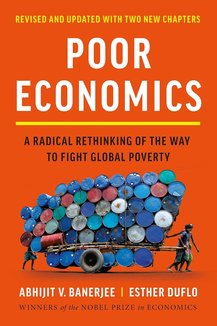
Poor Economics: A Radical Rethinking of the Way to Fight Global Poverty
Authors:
Abhijit V. Banerjee
,
Esther Duflo
ISBN 13:
978-1541706187
In this new edition of their classic work, the winners of the Nobel Prize in Economics upend the most common assumptions about how economics works, providing a “rich and humane” ( Financial Times ) examination of how poor people actually live Why do the poor borrow to save? Why do they miss out on free lifesaving immunizations but pay for unnecessary drugs? Why do children from poor families attend school but fail to learn anything? In Poor Economics , Abhijit V. Banerjee and Esther Duflo, two Nobel Prize–winning MIT professors, answer these questions based on years of field research from around the world. Together, they investigate what the lives and choices of the poor tell us about how to fight global poverty, from why microfinance is useful without being the miracle some hoped it would be to why the poor don’t want health insurance. Throughout, they reveal that even as many magic bullets of yesterday have ended up as today’s failed ideas, there is a path forward through this challenge. Updated with significant new material based on insights from the last decade of research, Poor Economics is a radical and hopeful rethinking of the economics of poverty and an intimate view of the life of the poor around the world.