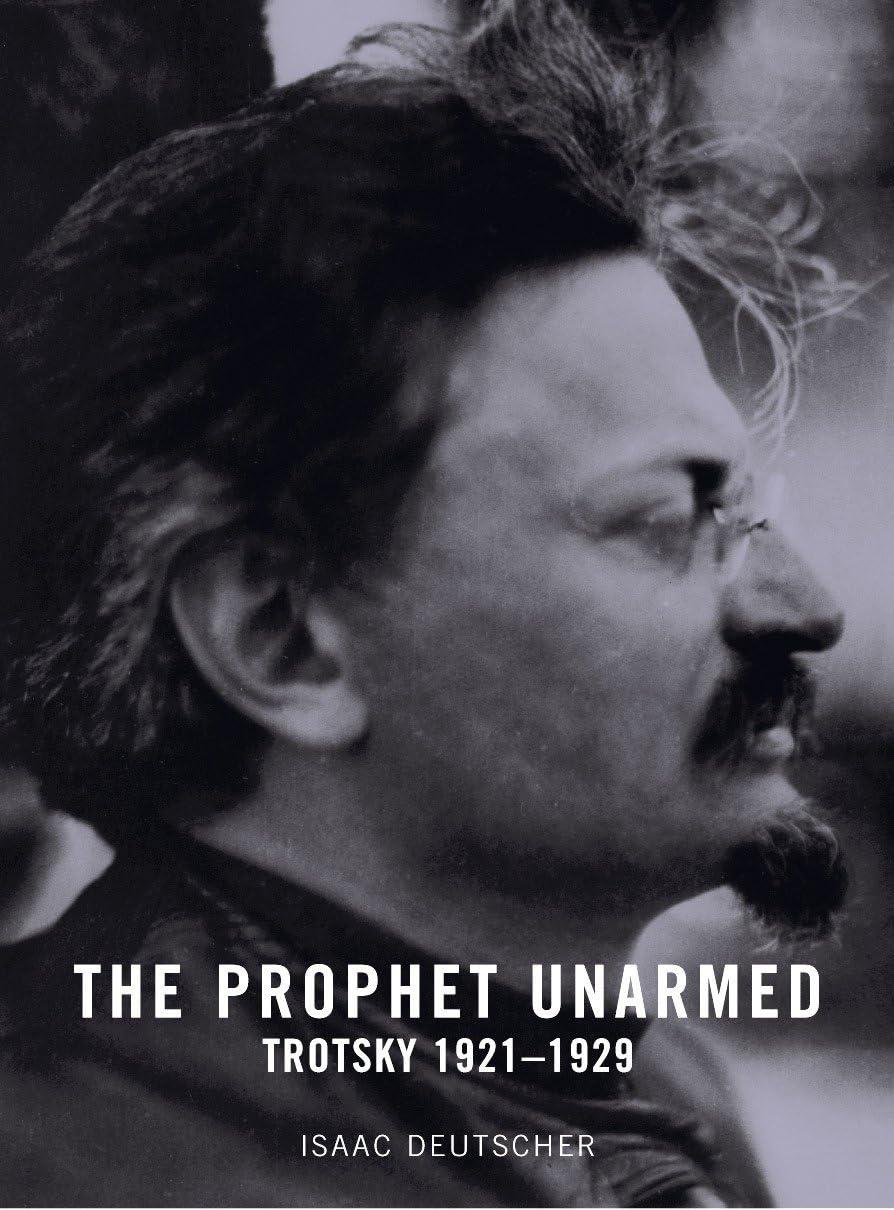
The Prophet Unarmed: Trotsky 1921-1929
by Isaac Deutscher
ISBN 13: 978-1859844465
Book description

Few political figures of the twentieth century have aroused as much controversy as the Russian revolutionary Leon Trotsky. Trotsky’s extraordinary life and extensive writings have left an indelible mark on revolutionary conscience, yet there was a danger that his name would disappear from history. Originally published in 1954, Deutscher’s magisterial three-volume biography was the first major publication to counter the powerful Stalinist propaganda machine. In this definitive biography Trotsky emerges in his real stature, as the most heroic, and ultimately tragic, character of the Russian Revolution. This second volume of the trilogy, first published in 1959, is a self-contained account of the great struggle between Stalin and Trotsky that followed the end of the civil war in Russia in 1921 and the death of Lenin. From the narrative of Trostsky’s uncompromising opposition to Stalin’s policies emerge character studies of the important Soviet leaders; a brilliant portrait of Trotsky the man of ideas, the Marxist philosopher and literary critic; and a new assessment of the causes of defeat which led to his expulsion from the party, his exile, and his banishment from Russia.

Recommended on 1 episode:

Anton Jäger Sept. 8, 2026 View episode
Behind the intense political movements of the last decade, from Trumpism to wokeness and back again, there’s a strange and erratic rhythm. Movements saturate the culture seemingly overnight, only to evaporate or spark backlash just as rapidly. We’re extremely politically engaged, yet we’ve rarely felt so powerless to create lasting policy change. I haven’t seen many very successful attempts to explain what is driving this volatility. But one concept that has taken off recently, and captures what so many of us are feeling, is “hyperpolitics.” The idea comes from Anton Jäger, a historian and contributing writer to New York Times Opinion. In his book “Hyperpolitics: Extreme Politicization Without Political Consequences,” Jäger theorizes what it means to live in a moment marked by hyper-engagement — high voter turnout, mass protests, trends that flare up and fade with extreme rapidity — yet where institutional trust is low, institutional relationships are decayed and people are disconnected from the structures that make political efforts stick. I think Jäger’s theory cuts to the core of this political era. So I invited him on the show to break down what hyperpolitics is, how we got here and what it actually takes to build lasting change today.
by @zachbellay