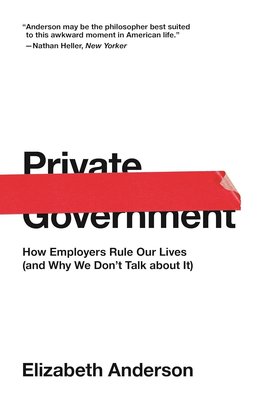
Why our workplaces are authoritarian private governments―and why we can’t see it One in four American workers says their workplace is a “dictatorship.” Yet that number almost certainly would be higher if we recognized employers for what they are―private governments with sweeping authoritarian power over our lives. Many employers minutely regulate workers’ speech, clothing, and manners on the job, and employers often extend their authority to the off-duty lives of workers, who can be fired for their political speech, recreational activities, diet, and almost anything else employers care to govern. In this compelling book, Elizabeth Anderson examines why, despite all this, we continue to talk as if free markets make workers free, and she proposes a better way to think about the workplace, opening up space for discovering how workers can enjoy real freedom.
Since 2021, Democrats have controlled the House, the Senate and the presidency, and they’ve used that power to pass consequential legislation, from the American Rescue Plan to the Inflation Reduction Act. That state of affairs was exceptional: In the 50 years between 1970 and 2020, the U.S. House, Senate and presidency were only under unified party control for 14 years. Divided government has become the norm in American politics. And since Republicans won back the House in November, it is about to become the reality once again.
But that doesn’t mean policymaking is going to stop — far from it. As America’s national politics have become more and more gridlocked in recent decades, many consequential policy decisions have been increasingly pushed down to the state level. The ability to receive a legal abortion or use recreational marijuana; how easy it is to join a union, purchase a firearm or vote in elections; the tax rates we pay and the kind of health insurance we have access to: These decisions are being determined at the state level to an extent not seen since before the civil rights revolution of the mid-twentieth century.
Jake Grumbach is a political scientist at the University of Washington and the author of the book “Laboratories Against Democracy: How National Parties Transformed State Politics.” In it, Grumbach tracks this shift in policymaking to the states and explores its implications for American politics. Our national mythologies present state government as less polarizing, more accountable to voters and a hedge against anti-democratic forces amassing too much power. But, as Grumbach shows, in an era of national political media, parties and identities, the truth is a lot more complicated.
So this conversation is a guide to the level of government that we tend to pay the least attention to, even as it shapes our lives more than any other.