
From this episode
Recommended books
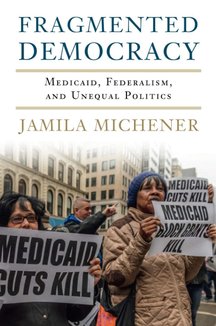
Fragmented Democracy: Medicaid, Federalism, and Unequal Politics
Author:
Jamila Michener
Medicaid is the single largest public health insurer in the United States, covering upwards of 70 million Americans. Crucially, Medicaid is also an intergovernmental program that yokes poverty to federalism: the federal government determines its broad contours, while states have tremendous discretion over how Medicaid is designed and implemented.
Medicaid is the single largest public health insurer in the United States, covering upwards of 70 million Americans. Crucially, Medicaid is also an intergovernmental program that yokes poverty to federalism: the federal government determines its broad contours, while states have tremendous discretion over how Medicaid is designed and implemented. Where some locales are generous and open handed, others are tight-fisted and punitive. In Fragmented Democracy, Jamila Michener demonstrates the consequences of such disparities for democratic citizenship. Unpacking how federalism transforms Medicaid beneficiaries' interpretations of government and structures their participation in politics, the book examines American democracy from the vantage point(s) of those who are living in or near poverty, (disproportionately) Black or Latino, and reliant on a federated government for vital resources.
Find this book on:


Why our workplaces are authoritarian private governments―and why we can’t see it One in four American workers says their workplace is a “dictatorship.” Yet that number almost certainly would be higher if we recognized employers for what they are―private governments with sweeping authoritarian power over our lives. Many employers minutely regulate workers’ speech, clothing, and manners on the job, and employers often extend their authority to the off-duty lives of workers, who can be fired for their political speech, recreational activities, diet, and almost anything else employers care to govern.
Why our workplaces are authoritarian private governments―and why we can’t see it One in four American workers says their workplace is a “dictatorship.” Yet that number almost certainly would be higher if we recognized employers for what they are―private governments with sweeping authoritarian power over our lives. Many employers minutely regulate workers’ speech, clothing, and manners on the job, and employers often extend their authority to the off-duty lives of workers, who can be fired for their political speech, recreational activities, diet, and almost anything else employers care to govern. In this compelling book, Elizabeth Anderson examines why, despite all this, we continue to talk as if free markets make workers free, and she proposes a better way to think about the workplace, opening up space for discovering how workers can enjoy real freedom.
Find this book on:
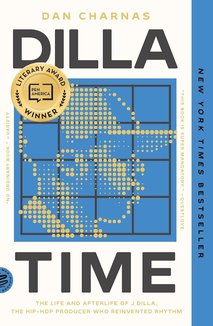
Dilla Time
Author:
Dan Charnas
WINNER OF THE PEN/ JACQUELINE BOGRAD WELD AWARD FOR BIOGRAPHY NEW YORK TIMES BESTSELLER “This book is a must for everyone interested in illuminating the idea of unexplainable genius.” ―QUESTLOVE Equal parts biography, musicology, and cultural history, Dilla Time chronicles the life and legacy of J Dilla, a musical genius who transformed the sound of popular music for the twenty-first century. He wasn’t known to mainstream audiences, even though he worked with renowned acts like D’Angelo and Erykah Badu and influenced the music of superstars like Michael Jackson and Janet Jackson.
WINNER OF THE PEN/ JACQUELINE BOGRAD WELD AWARD FOR BIOGRAPHY NEW YORK TIMES BESTSELLER “This book is a must for everyone interested in illuminating the idea of unexplainable genius.” ―QUESTLOVE Equal parts biography, musicology, and cultural history, Dilla Time chronicles the life and legacy of J Dilla, a musical genius who transformed the sound of popular music for the twenty-first century. He wasn’t known to mainstream audiences, even though he worked with renowned acts like D’Angelo and Erykah Badu and influenced the music of superstars like Michael Jackson and Janet Jackson. He died at the age of thirty-two, and in his lifetime he never had a pop hit. Yet since his death, J Dilla has become a demigod: revered by jazz musicians and rap icons from Robert Glasper to Kendrick Lamar; memorialized in symphonies and taught at universities. And at the core of this adulation is innovation: a new kind of musical time-feel that he created on a drum machine, but one that changed the way “traditional” musicians play. In Dilla Time , Dan Charnas chronicles the life of James DeWitt Yancey, from his gifted childhood in Detroit, to his rise as a Grammy-nominated hip-hop producer, to the rare blood disease that caused his premature death; and follows the people who kept him and his ideas alive. He also rewinds the histories of American rhythms: from the birth of soul in Dilla’s own “Motown,” to funk, techno, and disco. Here, music is a story of Black culture in America and of what happens when human and machine times are synthesized into something new. Dilla Time is a different kind of book about music, a visual experience with graphics that build those concepts step by step for fans and novices alike, teaching us to “see” and feel rhythm in a unique and enjoyable way. Dilla’s beats, startling some people with their seeming “sloppiness,” were actually the work of a perfectionist almost spiritually devoted to his music. This is the story of the man and his machines, his family, friends, partners, and celebrity collaborators. Culled from more than 150 interviews about one of the most important and influential musical figures of the past hundred years, Dilla Time is a book as delightfully detail-oriented and unique as J Dilla’s music itself.
Find this book on:
Episode overview
Since 2021, Democrats have controlled the House, the Senate and the presidency, and they’ve used that power to pass consequential legislation, from the American Rescue Plan to the Inflation Reduction Act. That state of affairs was exceptional: In the 50 years between 1970 and 2020, the U.S. House, Senate and presidency were only under unified party control for 14 years. Divided government has become the norm in American politics. And since Republicans won back the House in November, it is about to become the reality once again.
But that doesn’t mean policymaking is going to stop — far from it. As America’s national politics have become more and more gridlocked in recent decades, many consequential policy decisions have been increasingly pushed down to the state level. The ability to receive a legal abortion or use recreational marijuana; how easy it is to join a union, purchase a firearm or vote in elections; the tax rates we pay and the kind of health insurance we have access to: These decisions are being determined at the state level to an extent not seen since before the civil rights revolution of the mid-twentieth century.
Jake Grumbach is a political scientist at the University of Washington and the author of the book “Laboratories Against Democracy: How National Parties Transformed State Politics.” In it, Grumbach tracks this shift in policymaking to the states and explores its implications for American politics. Our national mythologies present state government as less polarizing, more accountable to voters and a hedge against anti-democratic forces amassing too much power. But, as Grumbach shows, in an era of national political media, parties and identities, the truth is a lot more complicated.
So this conversation is a guide to the level of government that we tend to pay the least attention to, even as it shapes our lives more than any other.