
From this episode
Recommended books
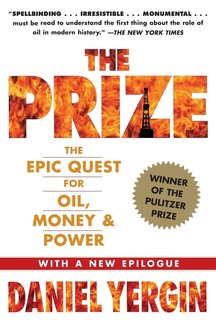
The Prize: The Epic Quest for Oil, Money & Power
Author:
Daniel Yergin
Winner of the Pulitzer Prize and hailed as “the best history of oil ever written” by Business Week, Daniel Yergin’s “spellbinding…irresistible” ( The New York Times ) account of the global pursuit of oil, money, and power addresses the ongoing energy crisis. Now with an epilogue that speaks directly to the current energy crisis, The Prize recounts the panoramic history of the world’s most important resource—oil.
Winner of the Pulitzer Prize and hailed as “the best history of oil ever written” by Business Week, Daniel Yergin’s “spellbinding…irresistible” ( The New York Times ) account of the global pursuit of oil, money, and power addresses the ongoing energy crisis. Now with an epilogue that speaks directly to the current energy crisis, The Prize recounts the panoramic history of the world’s most important resource—oil. Daniel Yergin’s timeless book chronicles the struggle for wealth and power that has surrounded oil for decades and that continues to fuel global rivalries, shake the world economy, and transform the destiny of men and nations. This updated edition categorically proves the unwavering significance of oil throughout the twentieth century and into the twenty-first by tracing economic and political clashes over precious “black gold.” With his far-reaching insight and in-depth research, Yergin is uniquely positioned to address the present battle over energy which undoubtedly ranks as one of the most vital issues of our time. The canvas of his narrative history is enormous—from the drilling of the first well in Pennsylvania through two great world wars to the Iraqi invasion of Kuwait, Operation Desert Storm, and both the Iraq War and current climate change. The definitive work on the subject of oil, The Prize is a book of extraordinary breadth, riveting excitement, and great value—crucial to our understanding of world politics and the economy today—and tomorrow.
Find this book on:


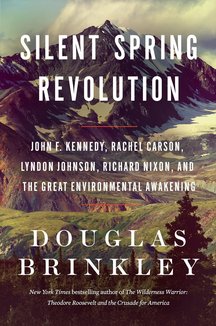
New York Times bestselling author and acclaimed presidential historian Douglas Brinkley chronicles the rise of environmental activism during the Long Sixties (1960-1973), telling the story of an indomitable generation that saved the natural world under the leadership of John F. Kennedy, Lyndon Johnson, and Richard Nixon.
New York Times bestselling author and acclaimed presidential historian Douglas Brinkley chronicles the rise of environmental activism during the Long Sixties (1960-1973), telling the story of an indomitable generation that saved the natural world under the leadership of John F. Kennedy, Lyndon Johnson, and Richard Nixon. With the detonation of the Trinity explosion in the New Mexico desert in 1945, the United States took control of Earth’s destiny for the first time. After the Truman administration dropped atomic bombs on Japan to end World War II, a grim new epoch had arrived. During the early Cold War years, the federal government routinely detonated nuclear devices in the Nevada desert and the Marshall Islands. Not only was nuclear fallout a public health menace, but entire ecosystems were contaminated with radioactive materials. During the 1950s, an unprecedented postwar economic boom took hold, with America becoming the world’s leading hyperindustrial and military giant. But with this historic prosperity came a heavy cost: oceans began to die, wilderness vanished, the insecticide DDT poisoned ecosystems, wildlife perished, and chronic smog blighted major cities. In Silent Spring Revolution , Douglas Brinkley pays tribute to those who combated the mauling of the natural world in the Long Sixties: Rachel Carson (a marine biologist and author), David Brower (director of the Sierra Club), Barry Commoner (an environmental justice advocate), Coretta Scott King (an antinuclear activist), Stewart Udall (the secretary of the interior), William O. Douglas (Supreme Court justice), Cesar Chavez (a labor organizer), and other crusaders are profiled with verve and insight. Carson’s book Silent Spring , published in 1962, depicted how detrimental DDT was to living creatures. The exposé launched an ecological revolution that inspired such landmark legislation as the Wilderness Act (1964), the Clean Air Acts (1963 and 1970), and the Endangered Species Acts (1966, 1969, and 1973). In intimate detail, Brinkley extrapolates on such epic events as the Donora (Pennsylvania) smog incident, JFK’s Limited Nuclear Test Ban Treaty, Great Lakes preservation, the Santa Barbara oil spill, and the first Earth Day. With the United States grappling with climate change and resource exhaustion, Douglas Brinkley’s meticulously researched and deftly written Silent Spring Revolution reminds us that a new generation of twenty-first-century environmentalists can save the planet from ruin. Silent Spring Revolution features two 8-page color photo inserts.
Find this book on:
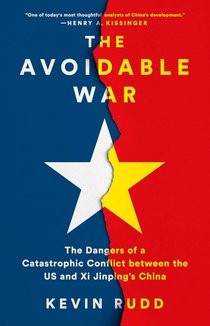
A war between China and the US would be catastrophic, deadly, and destructive. Unfortunately, it is no longer unthinkable.
A war between China and the US would be catastrophic, deadly, and destructive. Unfortunately, it is no longer unthinkable. The relationship between the US and China, the world’s two superpowers, is peculiarly volatile. It rests on a seismic fault—of cultural misunderstanding, historical grievance, and ideological incompatibility. No other nations are so quick to offend and be offended. Their militaries play a dangerous game of chicken, corporations steal intellectual property, intelligence satellites peer, and AI technicians plot. The capacity for either country to cross a fatal line grows daily. Kevin Rudd, a former Australian prime minister who has studied, lived in, and worked with China for more than forty years, is one of the very few people who can offer real insight into the mindsets of the leadership whose judgment will determine if a war will be fought. The Avoidable War demystifies the actions of both sides, explaining and translating them for the benefit of the other. Geopolitical disaster is still avoidable, but only if these two giants can find a way to coexist without betraying their core interests through what Rudd calls “managed strategic competition.” Should they fail, down that path lies the possibility of a war that could rewrite the future of both countries, and the world.
Find this book on:
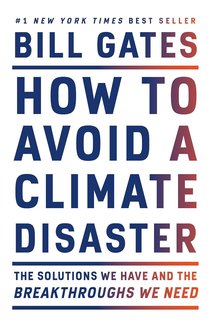
#1 NEW YORK TIMES BEST SELLER • In this urgent, authoritative book, Bill Gates sets out a wide-ranging, practical—and accessible— plan for how the world can get to zero greenhouse gas emissions in time to avoid a climate catastrophe. Bill Gates has spent a decade investigating the causes and effects of climate change.
#1 NEW YORK TIMES BEST SELLER • In this urgent, authoritative book, Bill Gates sets out a wide-ranging, practical—and accessible— plan for how the world can get to zero greenhouse gas emissions in time to avoid a climate catastrophe. Bill Gates has spent a decade investigating the causes and effects of climate change. With the help of experts in the fields of physics, chemistry, biology, engineering, political science, and finance, he has focused on what must be done in order to stop the planet's slide to certain environmental disaster. In this book, he not only explains why we need to work toward net-zero emissions of greenhouse gases, but also details what we need to do to achieve this profoundly important goal. He gives us a clear-eyed description of the challenges we face. Drawing on his understanding of innovation and what it takes to get new ideas into the market, he describes the areas in which technology is already helping to reduce emissions, where and how the current technology can be made to function more effectively, where breakthrough technologies are needed, and who is working on these essential innovations. Finally, he lays out a concrete, practical plan for achieving the goal of zero emissions—suggesting not only policies that governments should adopt, but what we as individuals can do to keep our government, our employers, and ourselves accountable in this crucial enterprise. As Bill Gates makes clear, achieving zero emissions will not be simple or easy to do, but if we follow the plan he sets out here, it is a goal firmly within our reach.
Find this book on:
Episode overview
The global decarbonization effort is colliding headfirst with the realities of great power politics. China currently controls more than 75 percent of the world’s electric vehicle battery and solar photovoltaic manufacturing supply chains. It also processes the bulk of the so-called critical minerals, like lithium, cobalt and graphite, that are essential to building out clean energy technologies. There is no clean energy revolution without China.
What would happen if China decided to weaponize its clean energy resources in the same way Russia recently weaponized its oil and gas? Is it possible for the U.S. to end its energy dependency on China by investing in clean energy at home? What does this geopolitical reality mean for the prospect of meeting the world’s climate goals?
Over the past few years, Jason Bordoff and Meghan O’Sullivan have been at the forefront of mapping out the ways decarbonization will upend the world’s economic and geopolitical order. Bordoff is the founding director of the Center on Global Energy Policy at Columbia University and a former senior director for energy and climate change for the National Security Council under Barack Obama. O’Sullivan is the director of the Belfer Center for Science and International Affairs at the Harvard Kennedy School and a former deputy national security adviser in the George W. Bush administration.
In Bordoff and O’Sullivan’s view, decarbonization won’t just affect what kinds of cars we drive or how we power our homes. It will transform everything from the nature of international markets and trade relations to the global balance of military and diplomatic power. And it will create new economic superpowers, new alliances and new sources of geopolitical conflict in the process.
This conversation explores the contours of this transformation and what it will mean for the future of the climate and world politics.