
From this episode
Recommended books
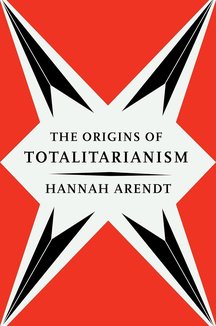
The Origins of Totalitarianism
Author:
Hannah Arendt
Hannah Arendt's definitive work on totalitarianism—an essential component of any study of twentieth-century political history—now with a new introduction by Anne Applebaum Hannah Arendt’s definitive work , The Origins of Totalitarianism, is an essential component of any study of twentieth-century political history. It begins with the rise of anti-Semitism in central and western Europe in the 1800s and continues with an examination of European colonial imperialism from 1884 to the outbreak of World War I.
Hannah Arendt's definitive work on totalitarianism—an essential component of any study of twentieth-century political history—now with a new introduction by Anne Applebaum Hannah Arendt’s definitive work , The Origins of Totalitarianism, is an essential component of any study of twentieth-century political history. It begins with the rise of anti-Semitism in central and western Europe in the 1800s and continues with an examination of European colonial imperialism from 1884 to the outbreak of World War I. This edition includes an introduction by Anne Applebaum – a leading voice on authoritarianism and Russian history – who fears that “once again, we are living in a world that Arendt would recognize.” Hannah Arendt explores the institutions and operations of totalitarian movements, focusing on the two genuine forms of totalitarian government in our time, Nazi Germany and Stalinist Russia, which she adroitly recognizes were two sides of the same coin, rather than opposing philosophies of Right and Left. From this vantage point, she discusses the evolution of classes into masses, the role of propaganda in dealing with the nontotalitarian world, the use of terror, and the nature of isolation and loneliness as preconditions for total domination.
Find this book on:


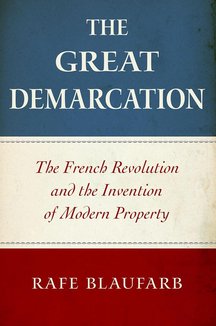
The Great Demarcation: The French Revolution and the Invention of Modern Property
Author:
Rafe Blaufarb
What does it mean to own something? What sorts of things can be owned, and what cannot?
What does it mean to own something? What sorts of things can be owned, and what cannot? How does one relinquish ownership? What are the boundaries between private and public property? Over the course of a decade, the French Revolution grappled with these questions. Punctuated by false starts, contingencies, and unexpected results, this process laid the foundations of the Napoleonic Code and modern notions of property. As Rafe Blaufarb demonstrates in this ambitious work, the French Revolution remade the system of property-holding that had existed in France before 1789. The revolutionary changes aimed at two fundamental goals: the removal of formal public power from the sphere of property and the excision of property from the realm of sovereignty. The revolutionaries accomplished these two aims by abolishing privately-owned forms of power, such as jurisdictional lordship and venal public office, and by dismantling the Crown domain, thus making the state purely sovereign. This brought about a Great Demarcation: a radical distinction between property and power from which flowed the critical distinctions between the political and the social, state and society, sovereignty and ownership, the public and private. It destroyed the conceptual basis of the Old Regime, laid the foundation of France's new constitutional order, and crystallized modern ways of thinking about polities and societies. By tracing how the French Revolution created a new legal and institutional reality, The Great Demarcation shows how the revolutionary transformation of Old Regime property helped inaugurate political modernity
Find this book on:
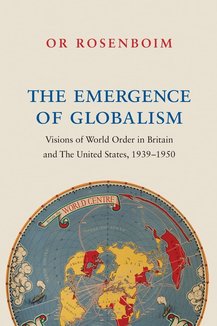
How competing visions of world order in the 1940s gave rise to the modern concept of globalism During and after the Second World War, public intellectuals in Britain and the United States grappled with concerns about the future of democracy, the prospects of liberty, and the decline of the imperial system. Without using the term "globalization," they identified a shift toward technological, economic, cultural, and political interconnectedness and developed a "globalist" ideology to reflect this new postwar reality.
How competing visions of world order in the 1940s gave rise to the modern concept of globalism During and after the Second World War, public intellectuals in Britain and the United States grappled with concerns about the future of democracy, the prospects of liberty, and the decline of the imperial system. Without using the term "globalization," they identified a shift toward technological, economic, cultural, and political interconnectedness and developed a "globalist" ideology to reflect this new postwar reality. The Emergence of Globalism examines the competing visions of world order that shaped these debates and led to the development of globalism as a modern political concept. Shedding critical light on this neglected chapter in the history of political thought, Or Rosenboim describes how a transnational network of globalist thinkers emerged from the traumas of war and expatriation in the 1940s and how their ideas drew widely from political philosophy, geopolitics, economics, imperial thought, constitutional law, theology, and philosophy of science. She presents compelling portraits of Raymond Aron, Owen Lattimore, Lionel Robbins, Barbara Wootton, Friedrich Hayek, Lionel Curtis, Richard McKeon, Michael Polanyi, Lewis Mumford, Jacques Maritain, Reinhold Niebuhr, H. G. Wells, and others. Rosenboim shows how the globalist debate they embarked on sought to balance the tensions between a growing recognition of pluralism on the one hand and an appreciation of the unity of humankind on the other. An engaging look at the ideas that have shaped today's world, The Emergence of Globalism is a major work of intellectual history that is certain to fundamentally transform our understanding of the globalist ideal and its origins.
Find this book on:
Episode overview
The French economist Thomas Piketty is arguably the world’s greatest chronicler of economic inequality. For decades now, he has collected huge data sets documenting the share of income and wealth that has flowed to the top 1 percent. And the culmination of much of that work, his 2013 book “Capital in the Twenty-First Century,” quickly became one of the most widely read and cited economic texts in recent history.
Piketty’s new book, “A Brief History of Equality,” is perhaps his most optimistic work. In it, he chronicles the immense social progress that the U.S. and Europe have achieved over the past few centuries in the form of rising educational attainment, life expectancy and incomes. Of course, those societies still contain huge inequalities of wealth. But in Piketty’s view, this outcome isn’t an inevitability; it’s the product of policy choices that we collectively make — and could choose to make differently. And to that end, Piketty proposes a truly radical policy agenda — a universal minimum inheritance of around $150,000 per person, worker control over the boards of corporations and “confiscatory” levels of wealth and income taxation — that he calls “participatory socialism.”
So this conversation isn’t just about the current state of inequality; it’s about the kind of policies — and politics — it would take to solve that inequality. We discuss why wealth is a far more accurate indicator of social power than income, the quality of the historical data that Piketty’s work relies on, why Piketty believes the welfare state — not capitalism itself — is the most important driver of human progress, why representative democracy hasn’t led to more economic redistribution, whether equality is really the best metric to measure human progress in the first place, how Piketty would pay for his universal inheritance proposal, whether the levels of taxation he is proposing would stifle innovation and wreck the economy, why he believes it would be better for societies — and economic productivity — for workers to have a much larger say in how companies are governed, how Piketty thinks about the prospect of inflation and more.