Recommended Books
Dollars and Dominion: US Bankers and the Making of a Superpower (America in the World)
Author:
Professor Mary Bridges
ISBN 13:
978-0691248134
How the creation of a new banking infrastructure in the early twentieth century established the United States as a global financial power The dominance of US multinational businesses today can seem at first like an inevitable byproduct of the nation’s superpower status. In Dollars and Dominion , Mary Bridges tells a different origin story. She explores the ramshackle beginnings of US financial power overseas, showing that US bankers in the early twentieth century depended on the US government, European know-how, and last-minute improvisation to sustain their work abroad. Bridges focuses on an underappreciated piece of the nation’s financial infrastructure—the overseas branch bank—as a brick-and-mortar foundation for expanding US commercial influence. Bridges explores how bankers sorted their new communities into “us”—potential clients—and “them”—local populations, who often existed on the periphery of the banking world. She argues that US bankers mapped their new communities by creating foreign credit information—and by using a financial asset newly enabled by the Federal Reserve System, the bankers’ acceptance, in the process. In doing so, they constructed a new architecture of US trade finance that relied on long-standing inequalities and hierarchies of privilege. Thus, racialized, class-based, and gendered ideas became baked into the financial infrastructure. Contrary to conventional wisdom, there was nothing inevitable or natural about the rise of US finance capitalism. Bridges shows that US foreign banking was a bootstrapped project that began as a side hustle of Gilded Age tycoons and sustained itself by relying on the power of the US state, copying the example of British foreign bankers, and building alliances with local elites. In this way, US bankers constructed a flexible and durable new infrastructure to support the nation’s growing global power.


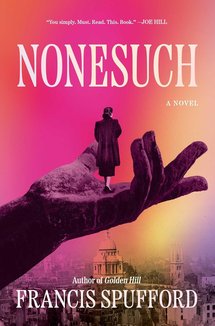
Nonesuch: A Novel
Author:
Francis Spufford
ISBN 13:
978-1668214374
A spellbinding tale about an ambitious young woman who must thwart an occult plot by time-traveling fascists during the chaos of the London Blitz—from “one of our most powerful writers of wayward historical fiction” ( The Washington Post ). Following the acclaim of his previous novels Golden Hill and Cahokia Jazz , Francis Spufford delivers a masterpiece of literary fantasy, hailed by Joe Hill as “a book that scoops up all the wonder and hope and pleasure of the Narnia novels, and pours it into a story for grown-ups.” It’s the summer of 1939, and the air in London is thick with the tension of impending war. Iris Hawkins, a fiery young financial secretary, has a chance encounter with Geoff, a genius engineer from the new technology of television. What was supposed to be one night of abandon draws her instead into a nightmare of otherworldly pursuit—into a reality where time bends, spirits can be summoned, and history hangs by a thread. Soon there are Nazi planes droning overhead. In a time when death falls randomly from above each night, when the streets are darker than the wildest forest and all the men are away in uniform, the defense of the city is in the hands of its women. But Iris has more to contend with than just the terrors of the Blitz. Over the rooftops of burning London, in the twisted passages between past and present, through the vast night sky and across the tiny screens of early television, a fascist fanatic is travelling with a gun in her hand, and only Iris can stop her from altering the course of history forever. Both a thrilling page-turner and a profound exploration of ambition, love, and the fight against tyranny, Nonesuch is a story that is as enchanting as it is urgent. Packed with twists, tension, and wonder, it is a triumph of storytelling.
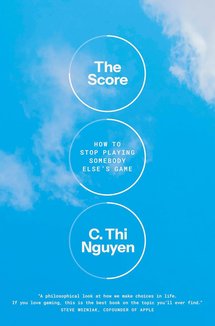
The Score: How to Stop Playing Somebody Else's Game
Author:
C. Thi Nguyen
ISBN 13:
978-0593655658
“Mind-expanding . . . The Score is so exuberant and readable that the depth and seriousness of its insights almost sneak up on you.” —Jennifer Szalai, The New York Times “Brilliant and wildly original . . . The Score is socially attentive, historically literate and imbued with sensual glee.” —Becca Rothfeld, The Washington Post “I give this excellent book five stars.” — Stuart Jeffries, Financial Times A philosophy of games to help us win back control over what we value The philosopher C. Thi Nguyen—one of the leading experts on the philosophy of games and the philosophy of data—takes us deep into the heart of games, and into the depths of bureaucracy, to see how scoring systems shape our desires. Games are the most important art form of our era. They embody the spirit of free play. They show us the subtle beauty of action everywhere in life in video games, sports, and boardgames—but also cooking, gardening, fly-fishing, and running. They remind us that it isn’t always about outcomes, but about how glorious it feels to be doing the thing. And the scoring systems help get us there, by giving us new goals to try on. Scoring systems are also at the center of our corporations and bureaucracies—in the form of metrics and rankings. They tell us exactly how to measure our success. They encourage us to outsource our values to an external authority. And they push on us to value simple, countable things. Metrics don’t capture what really matters; they only capture what’s easy to measure. The price of that clarity is our independence. The Score asks us is this the game you really want to be playing?