From this episode
Recommended books
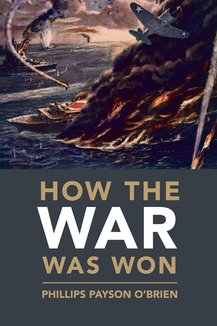
How the War Was Won: Air-Sea Power and Allied Victory in World War II (Cambridge Military Histories)
Author:
Phillips Payson O'Brien
World War II is usually seen as a titanic land battle, decided by mass armies, most importantly those on the Eastern Front. Phillips Payson O'Brien shows us the war in a completely different light.
World War II is usually seen as a titanic land battle, decided by mass armies, most importantly those on the Eastern Front. Phillips Payson O'Brien shows us the war in a completely different light. In this compelling new history of the Allied path to victory, he argues that in terms of production, technology and economic power, the war was far more a contest of air and sea than of land supremacy. He shows how the Allies developed a predominance of air and sea power which put unbearable pressure on Germany and Japan's entire war-fighting machine from Europe and the Mediterranean to the Pacific. Air and sea power dramatically expanded the area of battle and allowed the Allies to destroy over half of the Axis' equipment before it had even reached the traditional 'battlefield'. Battles such as El Alamein, Stalingrad and Kursk did not win World War II; air and sea power did.
Find this book on:



Ninth House (Ninth House Series, 1)
Author:
Leigh Bardugo
"The best fantasy novel I’ve read in years, because it’s about real people... Impossible to put down." ―Stephen King The smash New York Times bestseller from Leigh Bardugo, a mesmerizing tale of power, privilege, and dark magic set among the Ivy League elite.
"The best fantasy novel I’ve read in years, because it’s about real people... Impossible to put down." ―Stephen King The smash New York Times bestseller from Leigh Bardugo, a mesmerizing tale of power, privilege, and dark magic set among the Ivy League elite. Goodreads Choice Award Winner Locus Finalist Galaxy “Alex” Stern is the most unlikely member of Yale’s freshman class. Raised in the Los Angeles hinterlands by a hippie mom, Alex dropped out of school early and into a world of shady drug-dealer boyfriends, dead-end jobs, and much, much worse. In fact, by age twenty, she is the sole survivor of a horrific, unsolved multiple homicide. Some might say she’s thrown her life away. But at her hospital bed, Alex is offered a second chance: to attend one of the world’s most prestigious universities on a full ride. What’s the catch, and why her? Still searching for answers, Alex arrives in New Haven tasked by her mysterious benefactors with monitoring the activities of Yale’s secret societies. Their eight windowless “tombs” are the well-known haunts of the rich and powerful, from high-ranking politicos to Wall Street’s biggest players. But their occult activities are more sinister and more extraordinary than any paranoid imagination might conceive. They tamper with forbidden magic. They raise the dead. And, sometimes, they prey on the living. Don't miss the highly-anticipated sequel, Hell Bent .
Find this book on:
Episode overview
In recent months, the story of the U.S. economy has changed significantly. The January Consumer Price Index showed that annual inflation slowed for the seventh straight month. That month, the economy also added over half a million jobs, and unemployment reached 3.4 percent, its lowest level since 1969. In light of these trends, comparisons to the 1970s stagflation crisis have weakened, and the possibility of a “soft landing” looks increasingly likely.
But that doesn’t mean we’ve achieved victory. While the headline inflation numbers have looked promising, the devil is in the details. Answers to questions like how fast inflation has actually slowed, whether that slowdown will continue, how likely a future recession is, and how the Fed should act all next come down to which statistics and indicators you are looking at.
So I decided to bring on the Times Opinion columnist and Nobel laureate economist Paul Krugman to break down the data and what it says about inflation moving forward. We also discuss the debt ceiling crisis, why the Republican Party has failed to embrace a coherent economic agenda, whether the Biden administration’s industrial policy efforts could undermine its climate objectives, the 20th-century economics book that best explains why the United States has gotten so bad at building things, why Krugman — a longtime advocate of free trade — has come around to embrace greater protectionism, why he believes China’s economic ascendence is no longer inevitable, whether A.I. will replace huge numbers of white collar workers and more.