
From this episode
Recommended books
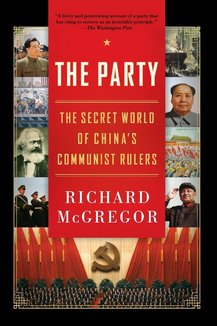
“A masterful depiction of the party today. .
“A masterful depiction of the party today. . . . McGregor illuminates the most important of the contradictions and paradoxes. . . . An entertaining and insightful portrait of China’s secretive rulers.” —The Economist “Few outsiders have any realistic sense of the innards, motives, rivalries, and fears of the Chinese Communist leadership. But we all know much more than before, thanks to Richard McGregor’s illuminating and richly-textured look at the people in charge of China’s political machinery. . . . Invaluable.” — James Fallows, National Correspondent for The Atlantic In this provocative and illuminating account, Financial Times reporter Richard McGregor offers a captivating portrait of China’s Communist Party, its grip on power and control over China, and its future. China’s political and economic growth in the past three decades has been one of astonishing, epochal dimensions. The most remarkable part of this transformation, however, has been left largely untold—the central role of the Chinese Communist Party. McGregor delves deeply into China’s inner sanctum for the first time, showing how the Communist Party controls the government, courts, media, and military and keeps all corruption accusations against its members in-house. The Party’s decisions have a global impact, yet the CCP remains a deeply secretive body, hostile to the law and unaccountable to anyone or anything other than its own internal tribunals. It is the world’s only geopolitical rival of the United States, and is primed to think the worst of the West.
Find this book on:


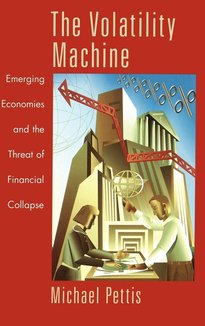
The Volatility Machine: Emerging Economics and the Threat of Financial Collapse
Author:
Michael Pettis
This book presents a radically different argument for what has caused, and likely will continue to cause, the collapse of emerging market economies. Pettis combines the insights of economic history, economic theory, and finance theory into a comprehensive model for understanding sovereign liability management and the causes of financial crises.
This book presents a radically different argument for what has caused, and likely will continue to cause, the collapse of emerging market economies. Pettis combines the insights of economic history, economic theory, and finance theory into a comprehensive model for understanding sovereign liability management and the causes of financial crises. He examines recent financial crises in emerging market countries along with the history of international lending since the 1820s to argue that the process of international lending is driven primarily by external events and not by local politics and/or economic policies. He draws out the corporate finance implications of this approach to argue that most of the current analyses of the recent financial crises suffered by Latin America, Asia, and Russia have largely missed the point. He then develops a sovereign finance model, analogous to corporate finance, to understand the capital structure needs of emerging market countries. Using this model, he finally puts into perspective the recent crises, a new sovereign liability management theory, the implications of the model for sovereign debt restructurings, and the new financial architecture. Bridging the gap between finance specialists and traders, on the one hand, and economists and policy-makers on the other, The Volatility Machine is critical reading for anyone interested in where the international economy is going over the next several years.
Find this book on:
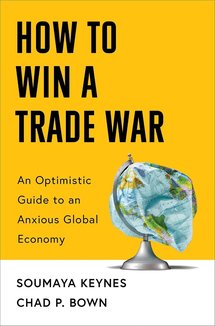
How to Win a Trade War: An Optimistic Guide to an Anxious Global Economy
Authors:
Soumaya Keynes,
Chad P Bown
An irreverent and invaluable guide to our new era of economic competition, written by Financial Times columnist and podcaster Soumaya Keynes and Chad P. Bown of the Peterson Institute for International Economics.
An irreverent and invaluable guide to our new era of economic competition, written by Financial Times columnist and podcaster Soumaya Keynes and Chad P. Bown of the Peterson Institute for International Economics. We used to take trade for granted. Trillions of dollars of goods and services crossed borders each year, made possible by a global, rules-based system. Nobody paid too much attention to supply chains: they just worked. Now we are in an era of trade conflict and can no longer avoid the fight. Trump’s latest tariff announcement can jolt markets, push prices up, and sour decades-long alliances. China’s export restrictions on rare earths could bring the West’s car production to a halt. Curbs on trade in cutting-edge chips could determine who wins the AI race. Keynes and Bown argue that the rules of the game have been abandoned, and a different strategy is needed. Yearning for the old approach to start working again isn’t an option. Countries must adapt, which means learning from history, economics, and from each other—including China. The stakes couldn't be higher. The authors explore the history, the players, and the rules of trade, and consider how we can prepare for what the future might hold. What would all-out economic warfare look like? Could trade wars lead to hot wars? What can the West learn from China? Accessible and leavened with an appealing wit, this book explains how to win a trade war, where “winning” might mean minimizing the losses, and the weapons that we wield—subsidies, stockpiles, export restrictions and, of course, tariffs—have the potential to hurt us, too. How to Win a Trade War is the guide to one of the global economy’s biggest challenges.
Find this book on:
Episode overview
Brad Setser follows Chinese trade closer than just about anyone else on earth, and he thinks we’re in the early days of a China Shock 2.0.
The first China Shock was when China came to dominate low-end manufacturing in the 2000s, filling American shelves with cheap clothes, toys and electronics, while devastating American factory towns. This new China Shock could be even more destabilizing. China now dominates advanced manufacturing: electric vehicles, batteries, solar panels. It’s outcompeting nearly all high-end manufacturing around the world, and other countries are just starting to feel the pain. And China isn’t slowing down. It’s moving into software, too. Its frontier A.I. models are neck and neck with American ones.
China’s success poses a serious threat to the economies and domestic politics of countries around the world. So what should those countries do about it?
Setser is a senior fellow at the Council on Foreign Relations.He served in top trade and economic roles in the Biden and Obama administrations. And he is widely cited across the field as one of the top analysts of China’s economy and trade practices.