
From this episode
Recommended books

The Tea Party and the Remaking of Republican Conservatism
Authors:
Theda Skocpol,
Vanessa Williamson
This revised edition features a new afterword, updated through the 2016 election. On February 19, 2009, CNBC commentator Rick Santelli delivered a dramatic rant against Obama administration programs to shore up the plunging housing market.
This revised edition features a new afterword, updated through the 2016 election. On February 19, 2009, CNBC commentator Rick Santelli delivered a dramatic rant against Obama administration programs to shore up the plunging housing market. Invoking the Founding Fathers and ridiculing "losers" who could not pay their mortgages, Santelli called for "Tea Party" protests. Over the next two years, conservative activists took to the streets and airways, built hundreds of local Tea Party groups, and weighed in with votes and money to help right-wing Republicans win electoral victories in 2010. In this penetrating new study, Harvard University's Theda Skocpol and Vanessa Williamson go beyond images of protesters in Colonial costumes to provide a nuanced portrait of the Tea Party. What they find is sometimes surprising. Drawing on grassroots interviews and visits to local meetings in several regions, they find that older, middle-class Tea Partiers mostly approve of Social Security, Medicare, and generous benefits for military veterans. Their opposition to "big government" entails reluctance to pay taxes to help people viewed as undeserving "freeloaders" - including immigrants, lower income earners, and the young. At the national level, Tea Party elites and funders leverage grassroots energy to further longstanding goals such as tax cuts for the wealthy, deregulation of business, and privatization of the very same Social Security and Medicare programs on which many grassroots Tea Partiers depend. Elites and grassroots are nevertheless united in hatred of Barack Obama and determination to push the Republican Party sharply to the right. The Tea Party and the Remaking of Republican Conservatism combines fine-grained portraits of local Tea Party members and chapters with an overarching analysis of the movement's rise, impact, and likely fate.
Find this book on:

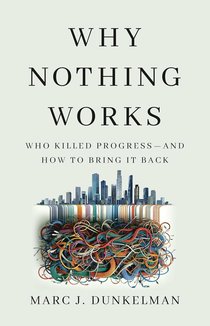
Why Nothing Works: Who Killed Progress―and How to Bring It Back
Author:
Marc J. Dunkelman
A provocative exploration about the architecture of power, the forces that stifle us from getting things done, and how we can restore confidence in democratically elected government. America was once a country that did big things—we built the world’s greatest rail network, a vast electrical grid, interstate highways, abundant housing, the Social Security system, the Tennessee Valley Authority, and more.
A provocative exploration about the architecture of power, the forces that stifle us from getting things done, and how we can restore confidence in democratically elected government. America was once a country that did big things—we built the world’s greatest rail network, a vast electrical grid, interstate highways, abundant housing, the Social Security system, the Tennessee Valley Authority, and more. But today, even while facing a host of pressing challenges—a housing shortage, a climate crisis, a dilapidated infrastructure—we feel stuck, unable to move the needle. Why? America is today the victim of a vetocracy that allows nearly anyone to stifle progress. While conservatives deserve some blame, progressives have overlooked an unlikely culprit: their own fears of “The Establishment.” A half-century ago, progressivism’s designs on getting stuff done were eclipsed by a desire to box in government. Reformers put speaking truth to power ahead of exercising that power for good. The ensuing gridlock has pummeled faith in public institutions of all sorts, stifled the movement’s ability to deliver on its promises, and, most perversely, opened the door for MAGA-style populism. A century ago, Americans were similarly frustrated—and progressivism pointed the way out. The same can happen again. Marc J. Dunkelman vividly illustrates what progressives must do if they are going to break through today’s paralysis and restore, once again, confidence in democratically elected government. To get there, reformers will need to acknowledge where they’ve gone wrong. Progressivism’s success moving forward hinges on the movement’s willingness to rediscover its roots.
Find this book on:

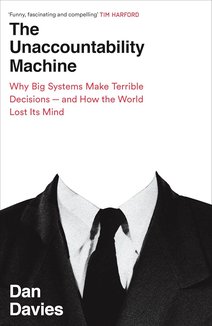
'Entertaining, insightful ... compelling' Financial Times 'A clear and compelling account of how decision-making works, or rather doesn't, in the twenty-first century.
'Entertaining, insightful ... compelling' Financial Times 'A clear and compelling account of how decision-making works, or rather doesn't, in the twenty-first century. It will make you look at the world differently' Stephen Bush When we avoid taking a decision, what happens to it? In The Unaccountability Machine, Dan Davies examines why markets, institutions and even governments systematically generate outcomes that everyone involved claims not to want. He casts new light on the writing of Stafford Beer, a legendary economist who argued in the 1950s that we should regard organisations as artificial intelligences, capable of taking decisions that are distinct from the intentions of their members. Management cybernetics was Beer's science of applying self-regulation in organisational settings, but it was largely ignored - with the result being the political and economic crises that that we see today. With his signature blend of cynicism and journalistic rigour, Davies looks at what's gone wrong, and what might have been, had the world listened to Stafford Beer when it had the chance.
Find this book on:
Episode overview
The core conflict in our politics right now is over institutions. Democrats defend them, while Republicans distrust them, and seek, in some cases, to eliminate them.
This is really bad. It’s bad for institutions when Republicans are elected, because of the damage they might inflict. And it’s bad for institutions when Democrats are elected, because when you’re so committed to protecting something, it’s hard to be clear-eyed or honest about all the ways it’s failing. And when Democrats won’t admit to the problems that so many Americans can see and feel, that creates a huge opening for the right. So, what are Democrats missing?
Steven Teles is a political scientist and director of the Center for Economy and Society at Johns Hopkins, and a senior fellow at the Niskanen Center. Jennifer Pahlka is the founder of Code for America and the author of one of my favorite books on why government doesn’t deliver, “Recoding America: Why Government is Failing in the Digital Age and How We Can Do Better.” She’s also a senior fellow at Niskanen.
In this conversation, we discuss how and why the country has become polarized over institutions; the ways this was supercharged during the pandemic; the reasons government agencies are so focused on process, often at the expense of outcomes; how a second Trump administration will probably distract from some much needed institutional reforms; and more.
This episode contains strong language.