From this episode
Recommended books
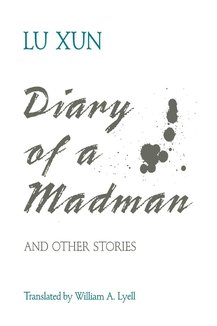
Diary of a Madman, and other stories
Authors:
Lu Xun,
William A. Lyell
"Here at last is an accurate and enjoyable rendering of Lu Xun's fiction in an American English idiom that masterfully captures the sardonic wit, melancholy pathos, and ironic vision of China's first truly modern writer." -Michael S. Duke, University of British Columbia The inventor of the modern Chinese short story, Lu Xun is universally regarded as twentieth century China’s greatest writer.
"Here at last is an accurate and enjoyable rendering of Lu Xun's fiction in an American English idiom that masterfully captures the sardonic wit, melancholy pathos, and ironic vision of China's first truly modern writer." -Michael S. Duke, University of British Columbia The inventor of the modern Chinese short story, Lu Xun is universally regarded as twentieth century China’s greatest writer. This long awaited volume presents new translations of all Lu Xun’s stories, including his first, “Remembrances of the Past,” written in classical Chinese. These new renderings faithfully convey both the brilliant style and the pungent expression for which Lu Xun is famous. Also included are a substantial introduction by the translator and sufficient annotation to make the stories fully accessible, enabling readers approaching Lu Xun for the first time to appreciate why these stories occupy a permanent place not only in Chinese literature but in world literature as well.
Find this book on:


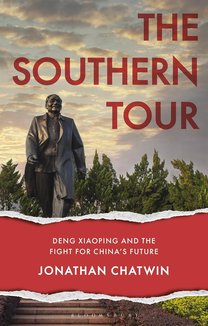
Southern Tour, The: Deng Xiaoping and the Fight for China's Future (Asian Arguments)
Authors:
Jonathan Chatwin,
Paul French
A History Today Book of the Year 2024 On a freezing January afternoon in 1992, Deng Xiaoping, China's former paramount leader and now a revered elder statesman, set off on a month long trip around China's south in defence of the reforms he had set in motion to open up China's economy and transform the country into the political and economic powerhouse we know today. In this book Jonathan Chatwin pursues the story of Deng's legendary "Southern Tour" and examines its legacies in the country today.
A History Today Book of the Year 2024 On a freezing January afternoon in 1992, Deng Xiaoping, China's former paramount leader and now a revered elder statesman, set off on a month long trip around China's south in defence of the reforms he had set in motion to open up China's economy and transform the country into the political and economic powerhouse we know today. In this book Jonathan Chatwin pursues the story of Deng's legendary "Southern Tour" and examines its legacies in the country today. Chatwin recounts the crucial debates and disagreements that characterised Chinese politics in the aftermath of the brutal crackdown of the Tiananmen protests of 1989, and the decisive influence of Deng's journey in establishing an economic blueprint for the 1990s and beyond. He explores a nation which has been transformed by large-scale urbanisation - exemplified by the mega-cities of southern China that Deng visited and endorsed - but whose leadership is now conflicted by the pursuit of wealth that Deng legitimized. Drawing on historical and contemporary eyewitness accounts, and the author's own 3000 mile journey in Deng's footsteps, The Southern Tour brings to life the story of China's transformation into a 21st-century superpower.
Find this book on:
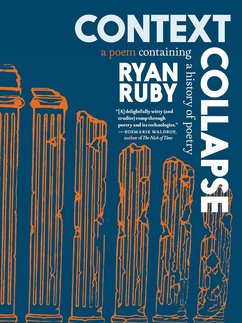
Context Collapse: A Poem Containing a History of Poetry
Author:
Ryan Ruby
Literary critic Ryan Ruby uncovers the secret history of poetry in a mock-academic verse essay filled with wit and wisdom. One of Publishers Weekly 's Best Books of 2024 Prophet.
Literary critic Ryan Ruby uncovers the secret history of poetry in a mock-academic verse essay filled with wit and wisdom. One of Publishers Weekly 's Best Books of 2024 Prophet. Entertainer. Courtier. Criminal. Revolutionary. Critic. Scholar. Nobody. Epic in sweep, Context Collapse is the secret history of the poet—from Bronze Age Greece and Renaissance Italy to the cafés of Grub Street and the Latin Quarter, from the creative writing departments of the American Midwest to the boardrooms of Silicon Valley. Cheekily introducing academic discourse, media studies, cybersemiotics, literary sociology, and heterodox economics into his blank verse study of poetry, Ruby traces the always delicate dance between poets, their publishers, and their audiences, and shows how, time and time again, the social, technological, and aesthetic experiments that appear in poetic language have prefigured radical changes to the ways of life of millions of people. It is precisely to poets to whom we ought to turn to catch a glimpse, as Shelley once put it, of the “gigantic shadows futurity casts on the present.”
Find this book on:
Episode overview
The old world order is dying. What new world order — if any — is struggling to be born?
I can’t think of a week when it felt clearer that an era was coming to an end. Whatever people thought America was, at least for a couple of decades, it’s something else now. The killing of Alex Pretti and the fact that it was recorded on video that plainly contradicted the Trump administration’s initial narrative made that clear. Mark Carney, the prime minister of Canada, also drove home that point when he declared at the World Economic Forum in Davos, Switzerland, that the world was in the midst of a “rupture.”
What do people think of America now in Europe? In China? And if American hegemony is coming to an end, what comes after that?
Adam Tooze is a historian at Columbia University and a chronicler of crises. The Guardian recently called him “the crisis whisperer.” He’s written a number of books about the times when systems fall apart and new orders emerge, including “Crashed: How a Decade of Financial Crises Changed the World.” And on his Substack, Chartbook, he tracks the unfolding crises and power shifts, in particular the rise of China. He also had a front-row seat to the chaos of Davos last week, moderating a panel that included Howard Lutnick, the commerce secretary.
I wanted to talk to Tooze about what he saw at the World Economic Forum, how the world’s understanding of the U.S. is changing and how he’s making sense of this moment.