
From this episode
Recommended books
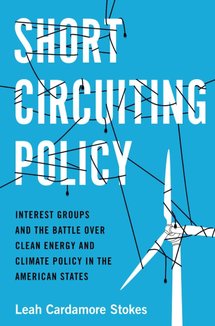
In 1999, Texas passed a landmark clean energy law, beginning a groundswell of new policies that promised to make the US a world leader in renewable energy. As Leah Stokes shows in Short Circuiting Policy , however, that policy did not lead to momentum in Texas, which failed to implement its solar laws or clean up its electricity system.
In 1999, Texas passed a landmark clean energy law, beginning a groundswell of new policies that promised to make the US a world leader in renewable energy. As Leah Stokes shows in Short Circuiting Policy , however, that policy did not lead to momentum in Texas, which failed to implement its solar laws or clean up its electricity system. Examining clean energy laws in Texas, Kansas, Arizona, and Ohio over a thirty-year time frame, Stokes argues that organized combat between advocate and opponent interest groups is central to explaining why states are not on track to address the climate crisis. She tells the political history of our energy institutions, explaining how fossil fuel companies and electric utilities have promoted climate denial and delay. Stokes further explains the limits of policy feedback theory, showing the ways that interest groups drive retrenchment through lobbying, public opinion, political parties and the courts. More than a history of renewable energy policy in modern America, Short Circuiting Policy offers a bold new argument about how the policy process works, and why seeming victories can turn into losses when the opposition has enough resources to roll back laws.
Find this book on:



The Lorax (Classic Seuss)
Author:
Dr. Seuss
Celebrate Earth Day with Dr. Seuss and the Lorax in this classic picture book about sustainability and protecting the environment!
Celebrate Earth Day with Dr. Seuss and the Lorax in this classic picture book about sustainability and protecting the environment! I am the Lorax. I speak for the trees. Dr. Seuss’s beloved story teaches kids to treat the planet with kindness and stand up and speak up for others. Experience the beauty of the Truffula Trees and the danger of taking our earth for granted in a story that is timely, playful, and hopeful. The book’s final pages teach us that just one small seed, or one small child, can make a difference. Printed on recycled paper, this book is the perfect gift for Earth Day and for any child—or child at heart—who is interested in recycling, advocacy, and the environment, or just loves nature and playing outside. Unless someone like you cares a whole awful lot, nothing is going to get better. It’s not.
Find this book on:
Under a White Sky: The Nature of the Future
Author:
Elizabeth Kolbert
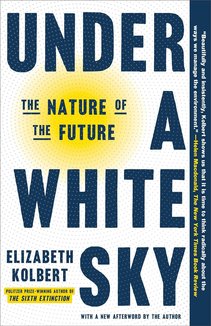
NATIONAL BESTSELLER • The Pulitzer Prize–winning author of The Sixth Extinction returns to humanity’s transformative impact on the environment, now asking: After doing so much damage, can we change nature, this time to save it? RECOMMENDED BY PRESIDENT OBAMA AND BILL GATES • SHORTLISTED FOR THE WAINWRIGHT PRIZE FOR WRITING • ONE OF THE TEN BEST BOOKS OF THE YEAR: The Washington Post • ONE OF THE BEST BOOKS OF THE YEAR: Time, Esquire, Publishers Weekly, Kirkus Reviews • “Beautifully and insistently, Kolbert shows us that it is time to think radically about the ways we manage the environment.”—Helen Macdonald, The New York Times With a new afterword by the author That man should have dominion “over all the earth, and over every creeping thing that creepeth upon the earth” is a prophecy that has hardened into fact.
NATIONAL BESTSELLER • The Pulitzer Prize–winning author of The Sixth Extinction returns to humanity’s transformative impact on the environment, now asking: After doing so much damage, can we change nature, this time to save it? RECOMMENDED BY PRESIDENT OBAMA AND BILL GATES • SHORTLISTED FOR THE WAINWRIGHT PRIZE FOR WRITING • ONE OF THE TEN BEST BOOKS OF THE YEAR: The Washington Post • ONE OF THE BEST BOOKS OF THE YEAR: Time, Esquire, Publishers Weekly, Kirkus Reviews • “Beautifully and insistently, Kolbert shows us that it is time to think radically about the ways we manage the environment.”—Helen Macdonald, The New York Times With a new afterword by the author That man should have dominion “over all the earth, and over every creeping thing that creepeth upon the earth” is a prophecy that has hardened into fact. So pervasive are human impacts on the planet that it’s said we live in a new geological epoch: the Anthropocene. In Under a White Sky, Elizabeth Kolbert takes a hard look at the new world we are creating. Along the way, she meets biologists who are trying to preserve the world’s rarest fish, which lives in a single tiny pool in the middle of the Mojave; engineers who are turning carbon emissions to stone in Iceland; Australian researchers who are trying to develop a “super coral” that can survive on a hotter globe; and physicists who are contemplating shooting tiny diamonds into the stratosphere to cool the earth. One way to look at human civilization, says Kolbert, is as a ten-thousand-year exercise in defying nature. In The Sixth Extinction, she explored the ways in which our capacity for destruction has reshaped the natural world. Now she examines how the very sorts of interventions that have imperiled our planet are increasingly seen as the only hope for its salvation. By turns inspiring, terrifying, and darkly comic, Under a White Sky is an utterly original examination of the challenges we face.
Find this book on:
Ministry for the Future
Author:
Kim Stanley Robinson
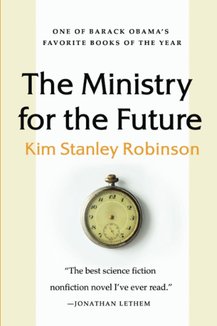
ONE OF BARACK OBAMA’S FAVORITE BOOKS OF THE YEAR “The best science-fiction nonfiction novel I’ve ever read.” —Jonathan Lethem "If I could get policymakers, and citizens, everywhere to read just one book this year, it would be Kim Stanley Robinson’s The Ministry for the Future. " —Ezra Klein ( Vox ) The Ministry for the Future is a masterpiece of the imagination, using fictional eyewitness accounts to tell the story of how climate change will affect us all.
ONE OF BARACK OBAMA’S FAVORITE BOOKS OF THE YEAR “The best science-fiction nonfiction novel I’ve ever read.” —Jonathan Lethem "If I could get policymakers, and citizens, everywhere to read just one book this year, it would be Kim Stanley Robinson’s The Ministry for the Future. " —Ezra Klein ( Vox ) The Ministry for the Future is a masterpiece of the imagination, using fictional eyewitness accounts to tell the story of how climate change will affect us all. Its setting is not a desolate, postapocalyptic world, but a future that is almost upon us. Chosen by Barack Obama as one of his favorite books of the year, this extraordinary novel from visionary science fiction writer Kim Stanley Robinson will change the way you think about the climate crisis. "One hopes that this book is read widely—that Robinson’s audience, already large, grows by an order of magnitude. Because the point of his books is to fire the imagination."― New York Review of Books "If there’s any book that hit me hard this year, it was Kim Stanley Robinson’s The Ministry for the Futur e, a sweeping epic about climate change and humanity’s efforts to try and turn the tide before it’s too late." ― Polygon (Best of the Year) "Masterly." — New Yorker "[ The Ministry for the Future ] struck like a mallet hitting a gong, reverberating through the year ... it’s terrifying, unrelenting, but ultimately hopeful. Robinson is the SF writer of my lifetime, and this stands as some of his best work. It’s my book of the year." — Locus "Science-fiction visionary Kim Stanley Robinson makes the case for quantitative easing our way out of planetary doom." ― Bloomberg Green
Find this book on:
Episode overview
Last week, freezing temperatures overwhelmed the Texas power grid, setting off rolling blackouts that left millions without power during an intense winter storm. But this story is a lot bigger than Texas: Our world is built around a model of the climate from the 19th and 20th centuries. Global warming is going to crack that model apart, and with it, much of the physical and political infrastructure civilization relies on.
At the same time, there’s good news on the climate front, too. The Biden administration has rejoined the Paris climate accords, pushed through a blitz of executive orders on the environment, and is planning a multitrillion-dollar climate bill. China has also set newly ambitious targets for decarbonization. Renewable energy is getting cheaper, faster, than almost anyone dared hope. And if you follow climate models, you know the most catastrophic outcomes have become less likely in recent years.
I wanted to have a conversation about both the emergency in Texas, and the broader picture on climate. Leah Stokes is a political scientist at University of California, Santa Barbara, and author of the excellent book “Short Circuiting Policy,” which, among other things, explores Texas’ surprising history with renewables. David Wallace-Wells is an editor at large at New York magazine and author of "The Uninhabitable Earth," one of the most sobering, disquieting portraits of our future — though he is, as you’ll hear in this discussion, getting a bit more optimistic.
We discuss whether the Texas crisis is going to be the new normal worldwide, the harrowing implications of how Texas Republicans have responded, why liberals should be cheering on Elon Musk, the difficulties liberal states are having on climate policy, the obstacles to decarbonization, the horrifying truth of what “adapting” to climate change will actually entail, why air pollution alone is a public health crisis worth solving, whether nuclear energy is the answer, and much more. I learned so much getting to sit in on this conversation. You will, too.
Mentioned in this episode:
“Migration towards Bangladesh coastlines projected to increase with sea level rise through 2100” by AR Bell, et al.
“Inequity in consumption of goods and services adds to racial–ethnic disparities in air pollution exposure” by Christopher W. Tessum, et al.
“Wildfire Exposure Increases Pro-Environment Voting within Democratic but Not Republican Areas” by Chad Hazlett and Matto Mildenberger
“Prisoners of the Wrong Dilemma: Why Distributive Conflict, Not Collective Action, Characterizes the Politics of Climate Change” by Michaël Aklin and Matto Mildenberger