
From this episode
Recommended books

The Story of a New Name: A Novel (Neapolitan Novels, 2)
Authors:
Elena Ferrante,
Ann Goldstein
A novel in the bestselling quartet about two very different women and their complex friendship: “Everyone should read anything with Ferrante’s name on it” ( The Boston Globe ). The follow-up to My Brilliant Friend , The Story of a New Name continues the epic New York Times –bestselling literary quartet that has inspired an HBO series, and returns us to the world of Lila and Elena, who grew up together in post-WWII Naples, Italy.
A novel in the bestselling quartet about two very different women and their complex friendship: “Everyone should read anything with Ferrante’s name on it” ( The Boston Globe ). The follow-up to My Brilliant Friend , The Story of a New Name continues the epic New York Times –bestselling literary quartet that has inspired an HBO series, and returns us to the world of Lila and Elena, who grew up together in post-WWII Naples, Italy. In The Story of a New Name , Lila has recently married and made her entrée into the family business; Elena, meanwhile, continues her studies and her exploration of the world beyond the neighborhood that she so often finds stifling. Marriage appears to have imprisoned Lila, and the pressure to excel is at times too much for Elena. Yet the two young women share a complex and evolving bond that is central to their emotional lives and a source of strength in the face of life’s challenges. In these Neapolitan Novels, Elena Ferrante, “one of the great novelists of our time” ( The New York Times ), gives us a poignant and universal story about friendship and belonging, a meditation on love and jealousy, freedom and commitment—at once a masterfully plotted page-turner and an intense, generous-hearted family saga. “Imagine if Jane Austen got angry and you’ll have some idea of how explosive these works are.”— The Australian “Brilliant . . . captivating and insightful . . . the richness of her storytelling is likely to please fans of Sara Gruen and Silvia Avallone.”— Booklist (starred review)
Find this book on:


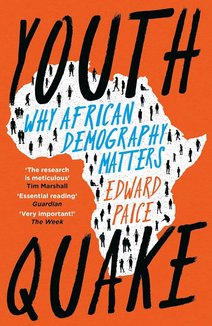
Youthquake: Why African Demography Should Matter to the World
Author:
Edward Paice
A riveting study of Africa's demographics – its youth and growth – and what they mean for the continent, today and into the future. 'The population surge in Africa since the 1950s is as fascinating as it is jaw-dropping...
A riveting study of Africa's demographics – its youth and growth – and what they mean for the continent, today and into the future. 'The population surge in Africa since the 1950s is as fascinating as it is jaw-dropping... The consequences may defy prediction with any degree of certainty, but there can be no doubt that they will be momentous.' Edward Paice, Director of Africa Research Institute Africa's population growth in the last 50 years has been unprecedented. By mid-century, the continent will make up a quarter of the global population, compared to one-tenth in 1980. By the end of the century, the proportion could be as much as 40 per cent. This is a mega-trend that should not be ignored. Africa's youth is the most striking aspect of its demography. As the rest of the world ages, and the population of many countries starts to shrink, almost 60 per cent of Africa's population is younger than 25 years old. This 'youthquake' will have immense consequences for the social, economic and political reality in Africa. Edward Paice presents a detailed, nuanced analysis of the varied demography of Africa. He rejects the fanciful over-optimism of some commentators and doom-laden prophecies of others, while scrutinising received wisdom, and carefully considering the ramifications of the youthquake for Africa and the world.
Find this book on:
Episode overview
“There are moments when history making creeps up on you,” writes the economic historian Adam Tooze. “This is one of those moments.”
Countries across the world are raising interest rates at unprecedented speeds. That global monetary tightening is colliding with spiking food and energy prices, financial market instability, high levels of emerging market debt and economies still struggling to recover from the Covid pandemic. Alone, each of these factors would warrant concern; combined, they could be catastrophic.
We’re already beginning to see what happens as these dynamics intersect: Britain just experienced a bond market meltdown that threatened one of the most advanced financial systems in the world. Developing countries like Sri Lanka, Argentina and Pakistan are experiencing political and economic crises. The World Bank believes we could be headed for a severe global recession.
Tooze is the director of the European Institute at Columbia University and the author of multiple histories of financial crises and near crises and of the excellent Chartbook newsletter. He believes this particular confluence of high inflation, rising interest rates and high levels of debt points to an economic “polycrisis” unlike any the world has seen. And he and others have argued that the U.S. Fed’s decision to raise interest rates is a core driver of that crisis.
So this is a conversation about the fragile, uncertain future of the global economy at this history-making moment and the Fed’s role in it. We discuss what the British financial market meltdown means for the rest of the world, how the interest rate hikes in rich countries export inflation to other countries, the looming possibility of a global recession, why Tooze believes something could break in the global financial system, why countries in South Asia are experiencing a particularly severe form of “polycrisis,” how the Fed should weigh its mandate to bring down inflation against the global consequences of its actions, why he believes analogies to the American inflationary period of the 1970s are misguided and more.