
From this episode
Recommended books
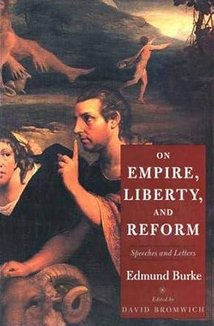
On Empire, Liberty, and Reform: Speeches and Letters
Authors:
Edmund Burke,
Professor David Bromwich
The great British statesman Edmund Burke had a genius for political argument, and his impassioned speeches and writings shaped English public life in the second half of the eighteenth century. This anthology of Burke's speeches, letters and pamphlets, selected, introduced and annotated by David Bromwich, shows Burke to be concerned with not only preserving but also reforming the British empire.
The great British statesman Edmund Burke had a genius for political argument, and his impassioned speeches and writings shaped English public life in the second half of the eighteenth century. This anthology of Burke's speeches, letters and pamphlets, selected, introduced and annotated by David Bromwich, shows Burke to be concerned with not only preserving but also reforming the British empire. Bromwich includes eighteen works of Burke, all but one in its complete form. These writings, among them the Speech on Conciliation with the American Colonies, A Letter to the Sheriffs of Bristol, the Speech at Guildhall Previous to the Election of 1780, the Speech on Fox's India Bill, A Letter to a Noble Lord, and several private letters, demonstrate the depth of Burke's efforts to reform the empire in India, America and Ireland. On these various fronts he defended the human rights of native peoples, the respect owed to partners in trade, and the civil liberties that the empire was losing at home while extending its power abroad.
Find this book on:


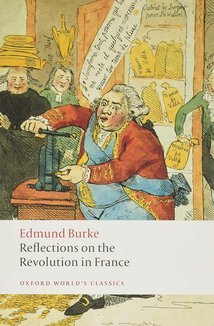
Reflections on the Revolution in France (Oxford World's Classics)
Authors:
L. G. Mitchell,
Edmund Burke,
Jesse Norman
This new and up-to-date edition of a book that has been central to political philosophy, history, and revolutionary thought for two hundred years offers readers a dire warning of the consequences that follow the mismanagement of change. Written for a generation presented with challenges of terrible proportions--the Industrial, American, and French Revolutions, to name the most obvious--Burke's Reflections of the Revolution in France displays an acute awareness of how high political stakes can be, as well as a keen ability to set contemporary problems within a wider context of political theory.
This new and up-to-date edition of a book that has been central to political philosophy, history, and revolutionary thought for two hundred years offers readers a dire warning of the consequences that follow the mismanagement of change. Written for a generation presented with challenges of terrible proportions--the Industrial, American, and French Revolutions, to name the most obvious--Burke's Reflections of the Revolution in France displays an acute awareness of how high political stakes can be, as well as a keen ability to set contemporary problems within a wider context of political theory. About the Series: For over 100 years Oxford World's Classics has made available the broadest spectrum of literature from around the globe. Each affordable volume reflects Oxford's commitment to scholarship, providing the most accurate text plus a wealth of other valuable features, including expert introductions by leading authorities, voluminous notes to clarify the text, up-to-date bibliographies for further study, and much more.
Find this book on:

The American Crisis: Classic Literature
Author:
Thomas Paine
The American Crisis is a series of pamphlets that Thomas Paine published from 1776 to 1783 during the American Revolution. The pamphlets were considered key in boosting the morale of soldiers early on during the war.
The American Crisis is a series of pamphlets that Thomas Paine published from 1776 to 1783 during the American Revolution. The pamphlets were considered key in boosting the morale of soldiers early on during the war.
Find this book on:
Conservatism: An Invitation to the Great Tradition
Author:
Roger Scruton
“…one of the most eloquent and even moving evocations of the conservative tradition in Western politics, philosophy and culture I have ever read…the ideal primer for those who are new to conservative ideas…” ―Richard Aldous, Wall Street Journal A brief magisterial introduction to the conservative tradition by one of Britain’s leading intellectuals. In Conservatism , Roger Scruton offers the reader an invitation into the world of political philosophy by explaining the history and evolution of the conservative movement over the centuries.
“…one of the most eloquent and even moving evocations of the conservative tradition in Western politics, philosophy and culture I have ever read…the ideal primer for those who are new to conservative ideas…” ―Richard Aldous, Wall Street Journal A brief magisterial introduction to the conservative tradition by one of Britain’s leading intellectuals. In Conservatism , Roger Scruton offers the reader an invitation into the world of political philosophy by explaining the history and evolution of the conservative movement over the centuries. With the clarity and authority of a gifted teacher, he discusses the ideology's perspective on civil society, the rule of law, freedom, morality, property, rights, and the role of the state. In a time when many claim that conservatives lack a unified intellectual belief system, this book makes a very strong case to the contrary, one that politically-minded readers will find compelling and refreshing. Scruton analyzes the origins and development of conservatism through the philosophies and thoughts of John Locke, Thomas Hobbes, Adam Smith and Milton Friedman, among others. He shows how conservative ideas have influenced the political sector through the careers of a diverse cast of politicians, such as Thomas Jefferson, Benjamin Disraeli, Ronald Reagan and Margaret Thatcher. He also takes a close look at the changing relationship between conservative politics, capitalism, and free markets in both the UK and the US. This clear, incisive guide is essential reading for anyone wishing to understand Western politics and policies, now and over the last three centuries.
Find this book on:
The progressive economics writer redefines the national conversation about American freedom “Mike Konczal [is] one of our most powerful advocates of financial reform‚ [a] heroic critic of austerity‚ and a huge resource for progressives.”—Paul Krugman Health insurance, student loan debt, retirement security, child care, work-life balance, access to home ownership—these are the issues driving America’s current political debates. And they are all linked, as this brilliant and timely book reveals, by a single question: should we allow the free market to determine our lives?
The progressive economics writer redefines the national conversation about American freedom “Mike Konczal [is] one of our most powerful advocates of financial reform‚ [a] heroic critic of austerity‚ and a huge resource for progressives.”—Paul Krugman Health insurance, student loan debt, retirement security, child care, work-life balance, access to home ownership—these are the issues driving America’s current political debates. And they are all linked, as this brilliant and timely book reveals, by a single question: should we allow the free market to determine our lives? In the tradition of Naomi Klein’s The Shock Doctrine , noted economic commentator Mike Konczal answers this question with a resounding no. Freedom from the Market blends passionate political argument and a bold new take on American history to reveal that, from the earliest days of the republic, Americans have defined freedom as what we keep free from the control of the market. With chapters on the history of the Homestead Act and land ownership, the eight-hour work day and free time, social insurance and Social Security, World War II day cares, Medicare and desegregation, free public colleges, intellectual property, and the public corporation, Konczal shows how citizens have fought to ensure that everyone has access to the conditions that make us free. At a time when millions of Americans—and more and more politicians—are questioning the unregulated free market, Freedom from the Market offers a new narrative, and new intellectual ammunition, for the fight that lies ahead.
Find this book on:
Social Democratic Capitalism
Author:
Lane Kenworthy
This is an open access title available under the terms of a CC BY-NC-ND 4.0 International license. It is free to read at Oxford Scholarship Online and offered as a free PDF download from OUP and selected open access locations.
This is an open access title available under the terms of a CC BY-NC-ND 4.0 International license. It is free to read at Oxford Scholarship Online and offered as a free PDF download from OUP and selected open access locations. What configuration of institutions and policies is most conducive to human flourishing? The historical and comparative evidence suggests that the answer is social democratic capitalism - a democratic political system, a capitalist economy, good elementary and secondary schooling, a big welfare state, pro-employment public services, and moderate regulation of product and labor markets. In Social Democratic Capitalism , Lane Kenworthy shows that this system improves living standards for the least well-off, enhances economic security, and boosts equality of opportunity. And it does so without sacrificing other things we want in a good society, from liberty to economic growth to health and happiness. Its chief practitioners have been the Nordic nations. The Nordics have gone farther than other rich democratic countries in coupling a big welfare state with public services that promote high employment and modest product- and labor-market regulations. Many believe this system isn't transferable beyond Scandinavia, but Kenworthy shows that social democratic capitalism and its successes can be replicated in other affluent nations, including the United States. Today, the U.S. lags behind other countries in economic security, opportunity, and shared prosperity. If the U.S. were to expand its existing social programs and add some additional ones, many ordinary Americans would have better lives. Kenworthy argues that, despite formidable political obstacles, the U.S. is likely to move toward social democratic capitalism in coming decades. As a country gets richer, he explains, it becomes more willing to spend more in order to safeguard against risk and enhance fairness. With social democratic capitalism as his blueprint, he lays out a detailed policy agenda that could alleviate many of America's problems.
Find this book on:
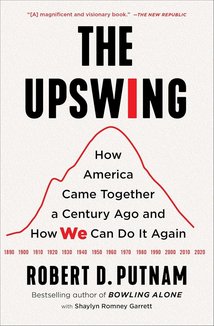
The Upswing: How America Came Together a Century Ago and How We Can Do It Again
Authors:
Robert D. Putnam,
Shaylyn Romney Garrett
From the author of Bowling Alone and Our Kids , a “sweeping yet remarkably accessible” ( The Wall Street Journal ) analysis that “offers superb, often counterintuitive insights” ( The New York Times ) to demonstrate how we have gone from an individualistic “I” society to a more communitarian “We” society and then back again, and how we can learn from that experience to become a stronger more unified nation. Deep and accelerating inequality; unprecedented political polarization; vitriolic public discourse; a fraying social fabric; public and private narcissism—Americans today seem to agree on only one thing: This is the worst of times.
From the author of Bowling Alone and Our Kids , a “sweeping yet remarkably accessible” ( The Wall Street Journal ) analysis that “offers superb, often counterintuitive insights” ( The New York Times ) to demonstrate how we have gone from an individualistic “I” society to a more communitarian “We” society and then back again, and how we can learn from that experience to become a stronger more unified nation. Deep and accelerating inequality; unprecedented political polarization; vitriolic public discourse; a fraying social fabric; public and private narcissism—Americans today seem to agree on only one thing: This is the worst of times. But we’ve been here before. During the Gilded Age of the late 1800s, America was highly individualistic, starkly unequal, fiercely polarized, and deeply fragmented, just as it is today. However as the twentieth century opened, America became—slowly, unevenly, but steadily—more egalitarian, more cooperative, more generous; a society on the upswing, more focused on our responsibilities to one another and less focused on our narrower self-interest. Sometime during the 1960s, however, these trends reversed, leaving us in today’s disarray. In a “magnificent and visionary book” ( The New Republic ) drawing on his inimitable combination of statistical analysis and storytelling, Robert Putnam analyzes a remarkable confluence of trends that brought us from an “I” society to a “We” society and then back again. He draws on inspiring lessons for our time from an earlier era, when a dedicated group of reformers righted the ship, putting us on a path to becoming a society once again based on community. This is Putnam’s most “remarkable” ( Science ) work yet, a fitting capstone to a brilliant career.
Find this book on:
Episode overview
"I don’t think conservatism can do its job in a free society in opposition to the institutions of that society,” Yuval Levin told me. “I think it can only function in defense of them.”
Levin is the director of social, cultural and constitutional studies at the American Enterprise Institute, as well as the author of a number of great books, most recently, “A Time to Build.” I wanted to talk to him about a very specific question, though: What will the Republican Party become? Levin is one of its most thoughtful and sober analysts — a temperament that may, I realize, make him unsuited to interpreting its current incarnation, in which a majority of House Republicans voted to reject the results of the 2020 presidential election and one of them is, well, Marjorie Taylor Greene.
But Levin’s diagnosis is interesting. Histories of the modern Republican Party often place Ronald Reagan at their center. That is, in Levin’s view, a mistake. “I think Reagan is better understood as a detour from a history that is otherwise a story of a constant struggle between populism and conservatism,” he said. Donald Trump was an inheritor of a tradition that stretches long before him — Pat Buchanan’s tradition, and Strom Thurmond’s tradition. He didn’t form a new Republican Party; he allowed a long-existing part to express itself.
Behind that lie institutional changes both in the Republican Party and in the broader structure of American politics. That’s why I wanted to talk to Levin for this episode of “The Ezra Klein Show”: He, like me, thinks in terms of institutions. “The question for us in the coming years is whether we can move a little more in the direction of a politics of ‘what does government do,’ and less of a politics of ‘who rules,’” he says.
That’s exactly the right question, in my view. But we have very different views of what kinds of institutional changes would get us there. I’d like to see a more democratized, majoritarian system. Levin would, among other things, add a filibuster to the House.
So this is more than just a conversation about how to fix the Republican Party. It’s a conversation about how to fix American politics — how to recenter it on policy that changes people’s lives, rather than symbolic clashes that merely harden our hearts.
Mentioned in this episode:
“Big Tech, Big Government: The Challenges of Regulating Internet Platforms,” National Affairs, Winter 2021
The Working Class Republican: Ronald Reagan and the Return of Blue-Collar Conservatism by Henry Olsen
"Democrats, Here’s How to Lose in 2022. And Deserve It." by Ezra Klein