
From this episode
Recommended books
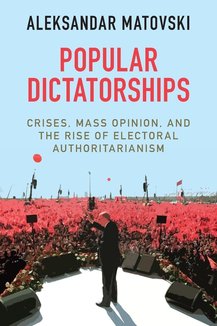
Popular Dictatorships
Author:
Aleksandar Matovski
Electoral autocracies – regimes that adopt democratic institutions but subvert them to rule as dictatorships – have become the most widespread, resilient and malignant non-democracies today. They have consistently ruled over a third of the countries in the world, including geopolitically significant states like Russia, Turkey, Venezuela, Egypt, Indonesia, Nigeria and Pakistan.
Electoral autocracies – regimes that adopt democratic institutions but subvert them to rule as dictatorships – have become the most widespread, resilient and malignant non-democracies today. They have consistently ruled over a third of the countries in the world, including geopolitically significant states like Russia, Turkey, Venezuela, Egypt, Indonesia, Nigeria and Pakistan. Challenging conventional wisdom, Popular Dictators shows that the success of electoral authoritarianism is not due to these regimes' superior capacity to repress, bribe, brainwash and manipulate their societies into submission, but is actually a product of their genuine popular appeal in countries experiencing deep political, economic and security crises. Promising efficient, strong-armed rule tempered by popular accountability, elected strongmen attract mass support in societies traumatized by turmoil, dysfunction and injustice, allowing them to rule through the ballot box. Popular Dictators argues that this crisis legitimation strategy makes electoral authoritarianism the most significant threat to global peace and democracy.
Find this book on:


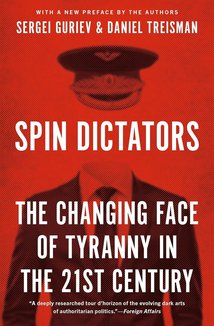
Spin Dictators: The Changing Face of Tyranny in the 21st Century
Authors:
Sergei Guriev,
Daniel Treisman
A New Yorker Best Book of the Year A Foreign Affairs Best Book of the Year An Atlantic Best Book of the Year A Financial Times Best Politics Book of the Year How a new breed of dictators holds power by manipulating information and faking democracy Hitler, Stalin, and Mao ruled through violence, fear, and ideology. But in recent decades a new breed of media-savvy strongmen has been redesigning authoritarian rule for a more sophisticated, globally connected world.
A New Yorker Best Book of the Year A Foreign Affairs Best Book of the Year An Atlantic Best Book of the Year A Financial Times Best Politics Book of the Year How a new breed of dictators holds power by manipulating information and faking democracy Hitler, Stalin, and Mao ruled through violence, fear, and ideology. But in recent decades a new breed of media-savvy strongmen has been redesigning authoritarian rule for a more sophisticated, globally connected world. In place of overt, mass repression, rulers such as Vladimir Putin, Recep Tayyip Erdogan, and Viktor Orbán control their citizens by distorting information and simulating democratic procedures. Like spin doctors in democracies, they spin the news to engineer support. Uncovering this new brand of authoritarianism, Sergei Guriev and Daniel Treisman explain the rise of such “spin dictators,” describing how they emerge and operate, the new threats they pose, and how democracies should respond. Spin Dictators traces how leaders such as Singapore’s Lee Kuan Yew and Peru’s Alberto Fujimori pioneered less violent, more covert, and more effective methods of monopolizing power. They cultivated an image of competence, concealed censorship, and used democratic institutions to undermine democracy, all while increasing international engagement for financial and reputational benefits. The book reveals why most of today’s authoritarians are spin dictators—and how they differ from the remaining “fear dictators” such as Kim Jong-un and Bashar al-Assad, as well as from masters of high-tech repression like Xi Jinping. Offering incisive portraits of today’s authoritarian leaders, Spin Dictators explains some of the great political puzzles of our time—from how dictators can survive in an age of growing modernity to the disturbing convergence and mutual sympathy between dictators and populists like Donald Trump.
Find this book on:
The Origins of Totalitarianism
Author:
Hannah Arendt
Hannah Arendt's definitive work on totalitarianism—an essential component of any study of twentieth-century political history—now with a new introduction by Anne Applebaum Hannah Arendt’s definitive work , The Origins of Totalitarianism, is an essential component of any study of twentieth-century political history. It begins with the rise of anti-Semitism in central and western Europe in the 1800s and continues with an examination of European colonial imperialism from 1884 to the outbreak of World War I.
Hannah Arendt's definitive work on totalitarianism—an essential component of any study of twentieth-century political history—now with a new introduction by Anne Applebaum Hannah Arendt’s definitive work , The Origins of Totalitarianism, is an essential component of any study of twentieth-century political history. It begins with the rise of anti-Semitism in central and western Europe in the 1800s and continues with an examination of European colonial imperialism from 1884 to the outbreak of World War I. This edition includes an introduction by Anne Applebaum – a leading voice on authoritarianism and Russian history – who fears that “once again, we are living in a world that Arendt would recognize.” Hannah Arendt explores the institutions and operations of totalitarian movements, focusing on the two genuine forms of totalitarian government in our time, Nazi Germany and Stalinist Russia, which she adroitly recognizes were two sides of the same coin, rather than opposing philosophies of Right and Left. From this vantage point, she discusses the evolution of classes into masses, the role of propaganda in dealing with the nontotalitarian world, the use of terror, and the nature of isolation and loneliness as preconditions for total domination.
Find this book on:
Episode overview
As we approach the 2022 midterms, the outlook for American democracy doesn’t appear promising. An increasingly Trumpist, anti-democratic Republican Party is poised to take over at least one chamber of Congress. And the Democratic Party, facing an inflationary economy and with an unpopular president in office, looks helpless to stop them.
But the United States isn’t alone in this regard. Over the course of 2022, Italy elected a far-right prime minister from a party with Fascist roots, a party founded by neo-Nazis and skinheads won the second-highest number of seats in Sweden’s Parliament, Viktor Orban’s Fidesz party in Hungary won its fourth consecutive election by a landslide, Marine Le Pen won 41 percent of the vote in the final round of France’s presidential elections and — just this past weekend — Jair Bolsonaro came dangerously close to winning re-election in Brazil.
Why are these populist uprisings happening simultaneously, in countries with such diverse cultures, economies and political systems?
Pippa Norris is a political scientist at Harvard’s Kennedy School of Government, where she has taught for three decades. In that time, she’s written dozens of books on topics ranging from comparative political institutions to right-wing parties and the decline of religion. And in 2019 she and Ronald Inglehart published “Cultural Backlash: Trump, Brexit and Authoritarian Populism,” which gives the best explanation of the far right’s rise that I’ve read.
We discuss what Norris calls the “silent revolution in cultural values” that has occurred across advanced democracies in recent decades, why the best predictor of support for populist parties is the generation people were born into, why the “transgressive aesthetic” of leaders like Donald Trump and Jair Bolsonaro is so central to their appeal, how demographic and cultural “tipping points” have produced conservative backlashes across the globe, the difference between “demand-side” and “supply-side” theories of populist uprising, the role that economic anxiety and insecurity play in fueling right-wing backlashes, why delivering economic benefits might not be enough for mainstream leaders to stave off populist challenges and more.