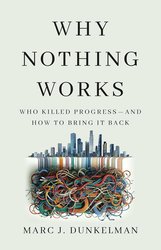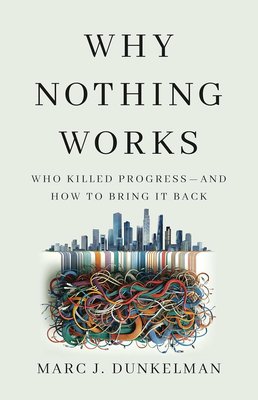
Why Nothing Works: Who Killed Progress―and How to Bring It Back
by Marc J. Dunkelman
ISBN 13: 978-1541700215
Book description

A provocative exploration about the architecture of power, the forces that stifle us from getting things done, and how we can restore confidence in democratically elected government. America was once a country that did big things—we built the world’s greatest rail network, a vast electrical grid, interstate highways, abundant housing, the Social Security system, the Tennessee Valley Authority, and more. But today, even while facing a host of pressing challenges—a housing shortage, a climate crisis, a dilapidated infrastructure—we feel stuck, unable to move the needle. Why? America is today the victim of a vetocracy that allows nearly anyone to stifle progress. While conservatives deserve some blame, progressives have overlooked an unlikely culprit: their own fears of “The Establishment.” A half-century ago, progressivism’s designs on getting stuff done were eclipsed by a desire to box in government. Reformers put speaking truth to power ahead of exercising that power for good. The ensuing gridlock has pummeled faith in public institutions of all sorts, stifled the movement’s ability to deliver on its promises, and, most perversely, opened the door for MAGA-style populism. A century ago, Americans were similarly frustrated—and progressivism pointed the way out. The same can happen again. Marc J. Dunkelman vividly illustrates what progressives must do if they are going to break through today’s paralysis and restore, once again, confidence in democratically elected government. To get there, reformers will need to acknowledge where they’ve gone wrong. Progressivism’s success moving forward hinges on the movement’s willingness to rediscover its roots.


Recommended on 5 episodes:
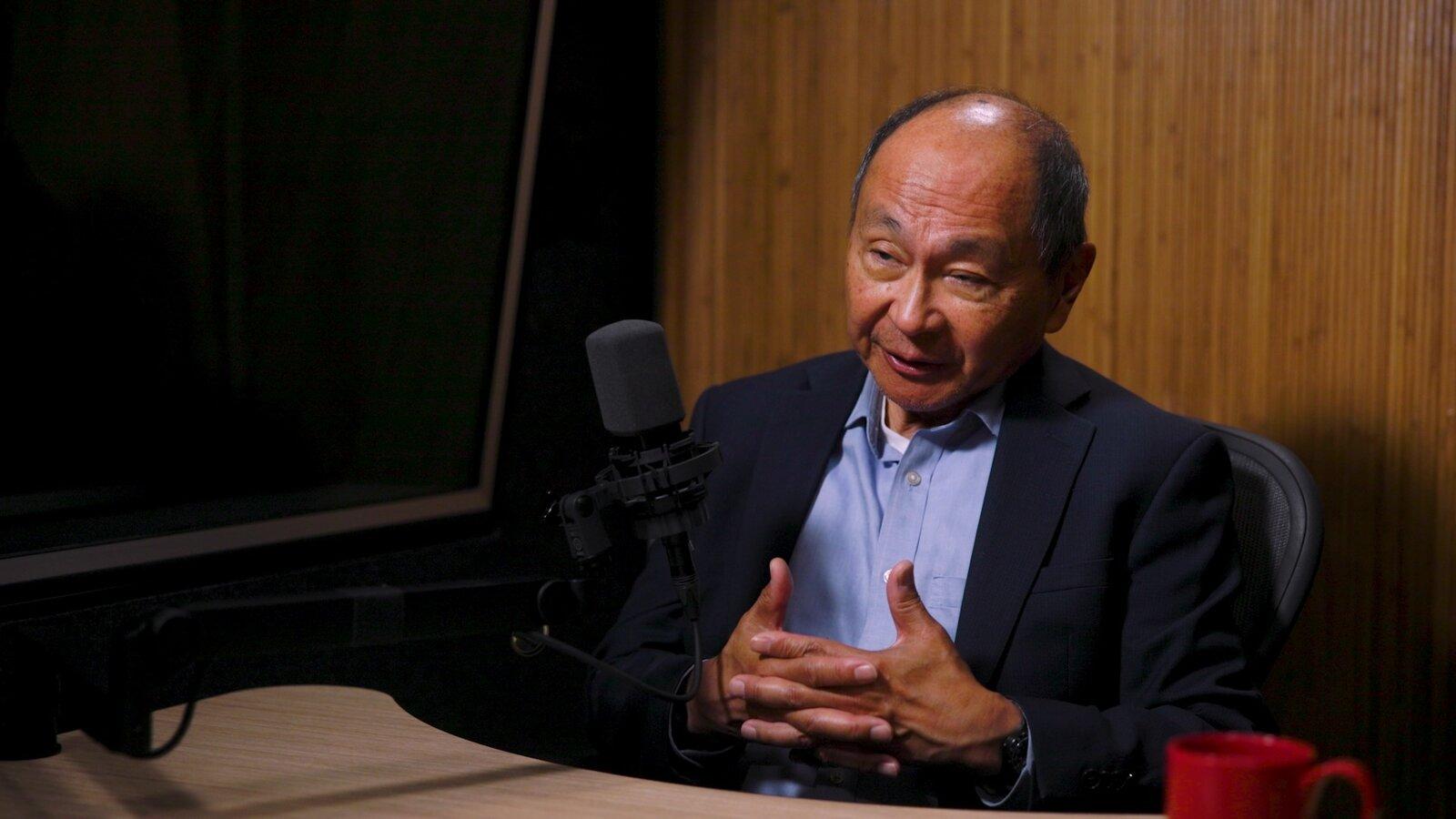
Francis Fukuyama Sept. 11, 2026 View episode
Francis Fukuyama's “The End of History and the Last Man” is one of the most insightful books for understanding the strangeness and instability of this political moment. Fukuyama wrote his landmark book more than 30 years ago, and it’s typically remembered as a triumphalist argument, heralding the permanent victory of liberal democracy at the end of the Cold War. But that’s not quite right. Fukuyama also talked about the serious weaknesses he saw in liberal democracy — how it may not fully satisfy the human soul — and his warnings feel very prescient now.  So I wanted to have Fukuyama on the show to talk through the ideas in his book and how he sees them today, at a time when liberal democracy seems increasingly imperiled around the world. Fukuyama is a political scientist at Stanford University and the author of a number of other great books of political theory, as well as a new memoir, “In the Realm of the Last Man.”

Xavier Becerra, Matt Mahan, Katie Porter, Tom Steyer, Antonio Villaraigosa May 12, 2026 View episode
On Friday, I moderated a forum with the top Democratic candidates for California governor, focusing on the state’s housing crisis. California’s current governor, Gavin Newsom, came into office in 2019 promising to build millions of homes. And in the years since, dozens of pro-housing laws have passed, designed to cut red tape and spur more construction. And yet the number of homes being built in California is basically the same as when he took office, and the state’s housing crisis remains, arguably, the worst in the country. So I wanted to know what the next governor would do about it. We taped this at the Calvin Simmons Theater in Oakland, Calif. The candidates on the stage were Xavier Becerra, a former attorney general of California and health and human services secretary under President Joe Biden; Matt Mahan, the mayor of San Jose and a tech entrepreneur; Katie Porter, a former U.S. representative; Tom Steyer, a former San Francisco hedge fund manager, a climate activist and a philanthropist; and Antonio Villaraigosa, a former mayor of Los Angeles and speaker of the California State Assembly. This panel was recorded live. The Times did not fact-check candidates’ remarks.

Jesse Jenkins, Jane Flegal July 25, 2025 View episode
Biden passed the most ambitious climate legislation in American history. Trump just shredded it. What does that mean for the future of renewable energy in America? Where does the climate movement go from here? And is it too late for us to avert climate catastrophe? To answer these questions, I invited onto the show two climate experts: Jesse Jenkins, who is a leading climate modeler and a professor at Princeton University, where he runs the Princeton ZERO Lab, and Jane Flegal, who is the executive director of the Blue Horizons Foundation and served on the Biden administration’s climate policy team. We discuss how far Trump’s policies have set us back, the lessons the climate movement should learn from this loss and what the next wave of climate politics may look like.

Matthew Yglesias, Dara Lind Jan. 25, 2025 View episode
On the first day of President Trump’s second term, he signed a record 26 executive orders. Some of them were really big. Others feel more likely messaging memos. And still others are bound to be held up in the courts. So what does it all amount to? What exactly in America has changed? In a former life, I co-hosted a podcast called “The Weeds” with other policy wonks at Vox, including Dara Lind and Matthew Yglesias. We’ve since gone our separate ways; Lind is currently a senior fellow at the American Immigration Council, and Yglesias is the author of the Substack newsletter Slow Boring. But since this was such a big policy week, I wanted to get some of the band back together. In this conversation, we discuss how much Trump’s immigration orders will actually change our immigration system; whether any of Trump’s orders address Americans’ concerns over prices; how serious Trump actually is about tariffs; and more.

Jennifer Pahlka, Steven Teles Nov. 22, 2024 View episode
The core conflict in our politics right now is over institutions. Democrats defend them, while Republicans distrust them, and seek, in some cases, to eliminate them. This is really bad. It’s bad for institutions when Republicans are elected, because of the damage they might inflict. And it’s bad for institutions when Democrats are elected, because when you’re so committed to protecting something, it’s hard to be clear-eyed or honest about all the ways it’s failing. And when Democrats won’t admit to the problems that so many Americans can see and feel, that creates a huge opening for the right. So, what are Democrats missing? Steven Teles is a political scientist and director of the Center for Economy and Society at Johns Hopkins, and a senior fellow at the Niskanen Center. Jennifer Pahlka is the founder of Code for America and the author of one of my favorite books on why government doesn’t deliver, “Recoding America: Why Government is Failing in the Digital Age and How We Can Do Better.” She’s also a senior fellow at Niskanen. In this conversation, we discuss how and why the country has become polarized over institutions; the ways this was supercharged during the pandemic; the reasons government agencies are so focused on process, often at the expense of outcomes; how a second Trump administration will probably distract from some much needed institutional reforms; and more. This episode contains strong language.
by @zachbellay