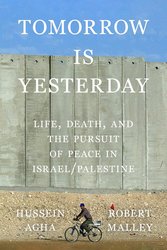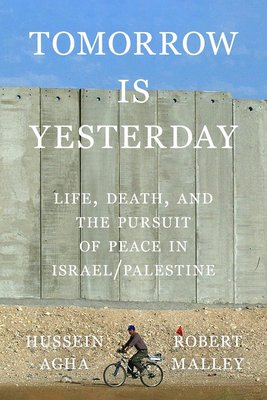
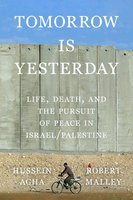
Tomorrow Is Yesterday: Life, Death, and the Pursuit of Peace in Israel/Palestine
by Hussein Agha, Robert Malley, Hussein Agha and Robert Malley
ISBN 13: 978-0374617127
Book description

A Best Book of 2025 The New Yorker • Foreign Affairs • NPR • Foreign Policy • Responsible Statecraft Two insiders explain why the Israeli – Palestinian peace process failed, and anticipate what lies ahead. On October 7, 2023, Hamas fighters killed more than eleven hundred Israelis and took more than two hundred hostages, prompting an Israeli response that has in turn taken tens of thousands of lives and devastated the Gaza Strip. Why did this happen, and can anything be done to grant peace and justice to Israelis and Palestinians alike? In Tomorrow Is Yesterday , veteran negotiators Hussein Agha and Robert Malley offer a personal and bracing perspective on how the hopes of the Oslo Peace Process became the horrors of the present. Drawing on their experience advising the Palestinian leadership (Arafat and Abbas) and US presidents (Clinton, Obama, and Biden) and their participation in secret talks over decades, Agha and Malley offer candid portraits of leading figures and an interpretation of the conflict that exposes the delusions of all sides. They stress that the two-state solution became a global goal only when it was no longer viable; that U.S. officials preferred technical schemes to a frank reckoning with the past; that Hamas’s onslaught and Israel’s war of destruction were not historical exceptions but historical reenactments; and that the gaps separating Israelis and Palestinians have less to do with territorial allocation than with history and emotions.


Recommended on 4 episodes:
Marc Lynch, Shibley Telhami April 14, 2026 View episode
For decades, most discussions of Israel and Palestine were framed around the eventual creation of a two-state solution. That effort has been dead for years. What has emerged in its place is what the political scientists Marc Lynch and Shibley Telhami call the “one-state reality.” Their book on this — edited with Michael Barnett and Nathan Brown — came out before Oct. 7, 2023. Since Oct. 7, that reality has become further entrenched: There’s been a record pace of settlement construction in the West Bank. Israel now occupies more than half the territory of Gaza. And Israel’s push into Lebanon has displaced more than a million people. So what does it mean to reckon with Israel’s one-state reality — to see the facts on the ground rather than the frames of the past? Shibley Telhami is the Anwar Sadat professor for peace and development at the University of Maryland, College Park. Marc Lynch is the director of the Project on Middle East Political Science at George Washington University. Lynch is the author, most recently, of “America’s Middle East: The Ruination of a Region.”

Masha Gessen Jan. 10, 2026 View episode
The shocking events of January have sent a message: America works differently now. M. Gessen is a Times Opinion columnist and the author of books about living under autocracy, including the National Book Award-winning “The Future Is History.” They have been a clear, relentless and perceptive voice on what it means and what it is like to live in a country that is turning into a different kind of regime. And they wrote an essay this week on the seizure of the president of Venezuela, calling it, “a blow — quite likely fatal — to the new world order of law, justice and human rights that was heralded in the wake of World War II.”

Chris Hayes June 28, 2025 View episode
Zohran Mamdani created a new anti-establishment playbook – in his use of social video, his focus on affordability and his position on Israel.   His assumed victory in New York City’s Democratic mayoral primary, trouncing the former governor Andrew Cuomo, was one of the biggest political upsets in years. And while the electorate in this case is pretty specific, I think it still points to some tectonic changes in Democratic politics.  My friend Chris Hayes, the host of MSNBC’s “All In With Chris Hayes,” came on the show earlier this year to talk about his book “The Sirens’ Call,” which is all about how social media and the new attention economy are shaping politics. So I wanted to bring him back for a sequel, to get “The Sirens’ Call” take on Mamdani’s victory, and Hayes’s insights as a born-and-raised New Yorker, with a deep feel for both the city’s politics and the broader Democratic Party. This episode contains strong language.

Aaron David Miller June 25, 2025 View episode
For decades, Israel has wanted American support to bomb Iranian nuclear sites. But U.S. presidents, both Republican and Democrat, have resisted — until President Trump. So, what changed? And what are the likely consequences of that decision? Aaron David Miller is a senior fellow at the Carnegie Endowment for International Peace and a longtime diplomat in the region. He joins me to discuss recent events and how the latest attacks on Iran have changed the balance of power in the Middle East. This episode contains strong language.
by @zachbellay