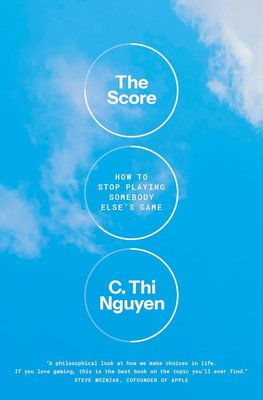


“Mind-expanding . . . The Score is so exuberant and readable that the depth and seriousness of its insights almost sneak up on you.” —Jennifer Szalai, The New York Times “Brilliant and wildly original . . . The Score is socially attentive, historically literate and imbued with sensual glee.” —Becca Rothfeld, The Washington Post “I give this excellent book five stars.” — Stuart Jeffries, Financial Times A philosophy of games to help us win back control over what we value The philosopher C. Thi Nguyen—one of the leading experts on the philosophy of games and the philosophy of data—takes us deep into the heart of games, and into the depths of bureaucracy, to see how scoring systems shape our desires. Games are the most important art form of our era. They embody the spirit of free play. They show us the subtle beauty of action everywhere in life in video games, sports, and boardgames—but also cooking, gardening, fly-fishing, and running. They remind us that it isn’t always about outcomes, but about how glorious it feels to be doing the thing. And the scoring systems help get us there, by giving us new goals to try on. Scoring systems are also at the center of our corporations and bureaucracies—in the form of metrics and rankings. They tell us exactly how to measure our success. They encourage us to outsource our values to an external authority. And they push on us to value simple, countable things. Metrics don’t capture what really matters; they only capture what’s easy to measure. The price of that clarity is our independence. The Score asks us is this the game you really want to be playing?