Recommended Books
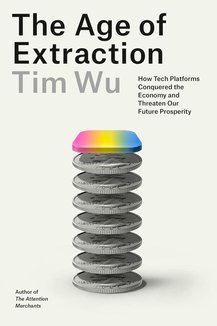
The Age of Extraction: How Tech Platforms Conquered the Economy and Threaten Our Future Prosperity
Author:
Tim Wu
ISBN 13:
978-0593321249
A NEW YORKER BEST BOOK OF 2025 • Tech platforms manipulate attention, extract wealth, and deepen inequality. In this new book, Tim Wu ( The Attention Merchants ) explains how we can reclaim control and create a balanced economy that works for everyone. “The magic of Tim Wu’s The Age of Extraction is its simplicity. Wu deftly breaks down one of the greatest challenges of our age—the unaccountable power of tech platforms—into such digestible pieces that the solutions for what to do become dead obvious. Essential reading.”—Karen Hao, author of Empire of AI: Dreams and Nightmares in Sam Altman’s OpenAI "It’s not just in your head—your online life is draining your wallet.... [ The Age of Extraction is] a sharp and eye-opening introduction to how we arrived at platform capitalism—where no good click goes unmonetized.”— Kirkus Reviews Our world is dominated by a handful of tech platforms. They provide great conveniences and entertainment, but also stand as some of the most effective instruments of wealth extraction ever invented, seizing immense amounts of money, data, and attention from all of us. An economy driven by digital platforms and AI influence offers the potential to enrich us, and also threatens to marginalize entire industries, widen the wealth gap, and foster a two-class nation. As technology evolves and our markets adapt, can society cultivate a better life for everyone? Is it possible to balance economic growth and egalitarianism, or are we too far gone? Tim Wu—the preeminent scholar and former White House official who coined the phrase “net neutrality”—explores the rise of platform power and details the risks and rewards of working within such systems. The Age of Extraction tells the story of an Internet that promised widespread wealth and democracy in the 1990s and 2000s, only to create new economic classes and aid the spread of autocracy instead. Wu frames our current moment with lessons from recent history—from generative AI and predictive social data to the antimonopoly and crypto movements—and envisions a future where technological advances can serve the greatest possible good. Concise and hopeful, The Age of Extraction offers consequential proposals for taking back control in order to achieve a better economic balance and prosperity for all.


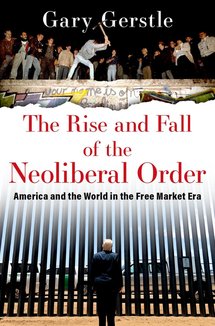
THE RISE AND FALL OF THE NEOLIBERAL ORDER
Author:
GERSTLE
ISBN 13:
978-0197676318
The most sweeping account of how neoliberalism came to dominate American politics for nearly a half century before crashing against the forces of Trumpism on the right and a new progressivism on the left. The epochal shift toward neoliberalism--a web of related policies that, broadly speaking, reduced the footprint of government in society and reassigned economic power to private market forces--that began in the United States and Great Britain in the late 1970s fundamentally changed the world. Today, the word "neoliberal" is often used to condemn a broad swath of policies, from prizing free market principles over people to advancing privatization programs in developing nations around the world. To be sure, neoliberalism has contributed to a number of alarming trends, not least of which has been a massive growth in income inequality. Yet as the eminent historian Gary Gerstle argues in The Rise and Fall of the Neoliberal Order , these indictments fail to reckon with the full contours of what neoliberalism was and why its worldview had such persuasive hold on both the right and the left for three decades. As he shows, the neoliberal order that emerged in America in the 1970s fused ideas of deregulation with personal freedoms, open borders with cosmopolitanism, and globalization with the promise of increased prosperity for all. Along with tracing how this worldview emerged in America and grew to dominate the world, Gerstle explores the previously unrecognized extent to which its triumph was facilitated by the collapse of the Soviet Union and its communist allies. He is also the first to chart the story of the neoliberal order's fall, originating in the failed reconstruction of Iraq and Great Recession of the Bush years and culminating in the rise of Trump and a reinvigorated Bernie Sanders-led American left in the 2010s. An indispensable and sweeping re-interpretation of the last fifty years, this book illuminates how the ideology of neoliberalism became so infused in the daily life of an era, while probing what remains of that ideology and its political programs as America enters an uncertain future.

Crossroads (Key to All Mythologies, 1)
Author:
Jonathan Franzen
ISBN 13:
978-1250858702
Jonathan Franzen’s gift for wedding depth and vividness of character with breadth of social vision has never been more dazzlingly evident than in Crossroads It’s December 23, 1971, and heavy weather is forecast for Chicago. Russ Hildebrandt, the associate pastor of a liberal suburban church, is on the brink of breaking free of a marriage he finds joyless―unless his wife, Marion, who has her own secret life, beats him to it. Their eldest child, Clem, is coming home from college on fire with moral absolutism, having taken an action that will shatter his father. Clem’s sister, Becky, long the social queen of her high-school class, has sharply veered into the counterculture, while their brilliant younger brother Perry, who’s been selling drugs to seventh graders, has resolved to be a better person. Each of the Hildebrandts seeks a freedom that each of the others threatens to complicate. Jonathan Franzen’s novels are celebrated for their unforgettably vivid characters and for their keen-eyed take on contemporary America. Now, in Crossroads , Franzen ventures back into the past and explores the history of two generations. With characteristic humor and complexity, and with even greater warmth, he conjures a world that resonates powerfully with our own. A tour de force of interwoven perspectives and sustained suspense, its action largely unfolding on a single winter day, Crossroads is the story of a Midwestern family at a pivotal moment of moral crisis. Jonathan Franzen’s gift for melding the small picture and the big picture has never been more dazzlingly evident.