
From this episode
Recommended books
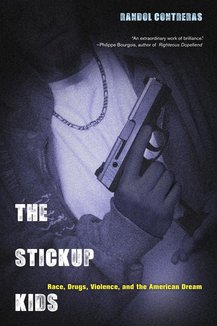
The Stickup Kids: Race, Drugs, Violence, and the American Dream
Author:
Randol Contreras
Randol Contreras came of age in the South Bronx during the 1980s, a time when the community was devastated by cuts in social services, a rise in arson and abandonment, and the rise of crack-cocaine. For this riveting book, he returns to the South Bronx with a sociological eye and provides an unprecedented insider’s look at the workings of a group of Dominican drug robbers.
Randol Contreras came of age in the South Bronx during the 1980s, a time when the community was devastated by cuts in social services, a rise in arson and abandonment, and the rise of crack-cocaine. For this riveting book, he returns to the South Bronx with a sociological eye and provides an unprecedented insider’s look at the workings of a group of Dominican drug robbers. Known on the streets as “Stickup Kids,” these men raided and brutally tortured drug dealers storing large amounts of heroin, cocaine, marijuana, and cash. As a participant observer, Randol Contreras offers both a personal and theoretical account for the rise of the Stickup Kids and their violence. He mainly focuses on the lives of neighborhood friends, who went from being crack dealers to drug robbers once their lucrative crack market opportunities disappeared. The result is a stunning, vivid, on-the-ground ethnographic description of a drug robbery’s violence, the drug market high life, the criminal life course, and the eventual pain and suffering experienced by the casualties of the Crack Era. Provocative and eye-opening, The Stickup Kids urges us to explore the ravages of the drug trade through weaving history, biography, social structure, and drug market forces. It offers a revelatory explanation for drug market violence by masterfully uncovering the hidden social forces that produce violent and self-destructive individuals. Part memoir, part penetrating analysis, this book is engaging, personal, deeply informed, and entirely absorbing.
Find this book on:


The Truly Disadvantaged: The Inner City, the Underclass, and Public Policy, Second Edition
Author:
William Julius Wilson
Renowned American sociologist William Julius Wilson takes a look at the social transformation of inner city ghettos, offering a sharp evaluation of the convergence of race and poverty. Rejecting both conservative and liberal interpretations of life in the inner city, Wilson offers essential information and a number of solutions to policymakers.
Renowned American sociologist William Julius Wilson takes a look at the social transformation of inner city ghettos, offering a sharp evaluation of the convergence of race and poverty. Rejecting both conservative and liberal interpretations of life in the inner city, Wilson offers essential information and a number of solutions to policymakers. The Truly Disadvantaged is a wide-ranging examination, looking at the relationship between race, employment, and education from the 1950s onwards, with surprising and provocative findings. This second edition also includes a new afterword from Wilson himself that brings the book up to date and offers fresh insight into its findings. “ The Truly Disadvantaged should spur critical thinking in many quarters about the causes and possible remedies for inner city poverty. As policymakers grapple with the problems of an enlarged underclass they—as well as community leaders and all concerned Americans of all races—would be advised to examine Mr. Wilson's incisive analysis.”—Robert Greenstein, New York Times Book Review
Find this book on:
Siddhartha
Authors:
Herman Hesse,
Gunther Olesch,
Anke Dreher,
Amy Coulter,
Stefan Langer,
Semyon Chaichenets
When Herman Hesse visited India in the early days of the 20th century, he was captivated by the people, their customs, their culture, and their religion. On returning to Germany, he wrote a masterpiece on a young man's search for identity and meaning in a civilization that has lost its way.
When Herman Hesse visited India in the early days of the 20th century, he was captivated by the people, their customs, their culture, and their religion. On returning to Germany, he wrote a masterpiece on a young man's search for identity and meaning in a civilization that has lost its way. Loosely based on the early life of the Buddha, the book documents the journey of self-discovery and spiritual awakening of a character called Siddhartha. The name Siddhartha was the one the Buddha was known by before his renunciation. Siddhartha in Sanskrit is translated as "Siddha" (achieved) and "artha" (what was searched for). The novel follows Siddhartha from a life of comfort of privilege to his quest for truth in a world plagued by sorrow and suffering. The themes of Siddhartha are universal in that they are an account of a young person’s search for meaning — one that all readers can relate to. As Hesse skillfully takes us on a journey, he uses his poetic prose to challenge our preconceived notions of what a spiritual life and meaningful self-enrichment entail. Blind adherence to all systems of belief is shunned in favor of living in the moment and appreciating its ever-changing nature. Generations of readers have and will continue to find wisdom in the pages of Siddhartha.
Find this book on:
Episode overview
In 2020 the United States experienced a nearly 30 percent rise in homicides from 2019. That’s the single biggest one-year increase since we started keeping national records in 1960. And violence has continued to rise well into 2021.
To deny or downplay the seriousness of this spike is neither morally justified nor politically wise. Violence takes lives, traumatizes children, instills fear, destroys community life and entrenches racial and economic inequality. Public opinion responds in kind: Polling indicates that Americans are increasingly worried about violent crime. And if November’s state and local campaigns were any indication, public safety will be a defining issue in upcoming election cycles.
Liberals and progressives need an answer to the question of how to handle rising violence. But that answer doesn’t need to involve a return to the punitive, tough-on-crime approach that has devastated Black and brown communities for decades and led millions of people to take to the streets in protest last summer.
Patrick Sharkey is a sociologist at Princeton University and the author of “Uneasy Peace: The Great Crime Decline, the Renewal of City Life, and the Next War on Violence.” The central claim of his work is this: Police are effective at reducing violence, but they aren’t the only actors capable of doing so. Sharkey has studied community-based models for addressing violence in places as varied as rural Australia and New York City. As a result, he has developed a compelling, evidence-backed vision of how cities and communities can tackle violent crime without relying heavily on police.
So this conversation is about what an alternative approach to addressing the current homicide spike could look like and all the messy, difficult questions it raises. It also explores the causes of the homicide spike, why Sharkey thinks policing is ultimately an “unsustainable” solution to crime, how New York City managed to reduce gun violence by 50 percent while reducing arrests and prison populations, whether it’s possible to overcome the punitive politics of rising crime, why America has such abnormally high levels of violent crime in the first place and more.