
From this episode
Recommended books
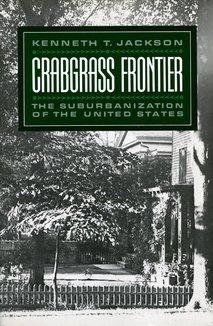
Crabgrass Frontier: The Suburbanization of the United States
Author:
Kenneth T. Jackson
This first full scale history of the development of the American suburb examines how "the good life" in America came to be equated with the a home of one's own surrounded by a grassy yard and located far from the urban workplace. Integrating social history with economic and architectural analysis, and taking into account such factors as the availability of cheap land, inexpensive building methods, and rapid transportation, Kenneth Jackson chronicles the phenomenal growth of the American suburb from the middle of the 19th century to the present day.
This first full scale history of the development of the American suburb examines how "the good life" in America came to be equated with the a home of one's own surrounded by a grassy yard and located far from the urban workplace. Integrating social history with economic and architectural analysis, and taking into account such factors as the availability of cheap land, inexpensive building methods, and rapid transportation, Kenneth Jackson chronicles the phenomenal growth of the American suburb from the middle of the 19th century to the present day. He treats communities in every section of the U.S. and compares American residential patterns with those of Japan and Europe. In conclusion, Jackson offers a controversial prediction: that the future of residential deconcentration will be very different from its past in both the U.S. and Europe.
Find this book on:



Neighborhood Defenders: Participatory Politics and America's Housing Crisis
Authors:
Katherine Levine Einstein,
David M. Glick,
Maxwell Palmer
Since the collapse of the housing market in 2008, demand for housing has consistently outpaced supply in many US communities. The failure to construct sufficient housing - especially affordable housing - in desirable communities and neighborhoods comes with significant social, economic, and environmental costs.
Since the collapse of the housing market in 2008, demand for housing has consistently outpaced supply in many US communities. The failure to construct sufficient housing - especially affordable housing - in desirable communities and neighborhoods comes with significant social, economic, and environmental costs. This book examines how local participatory land use institutions amplify the power of entrenched interests and privileged homeowners. The book draws on sweeping data to examine the dominance of land use politics by 'neighborhood defenders' - individuals who oppose new housing projects far more strongly than their broader communities and who are likely to be privileged on a variety of dimensions. Neighborhood defenders participate disproportionately and take advantage of land use regulations to restrict the construction of multifamily housing. The result is diminished housing stock and higher housing costs, with participatory institutions perversely reproducing inequality.
Find this book on:
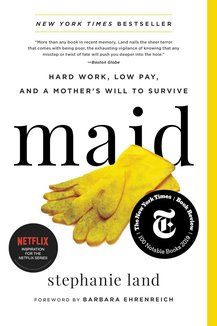
Maid: Hard Work, Low Pay, and a Mother's Will to Survive
Authors:
Stephanie Land,
Barbara Ehrenreich
"A single mother's personal, unflinching look at America's class divide (Barack Obama)," this New York Times bestselling memoir is the inspiration for the Netflix limited series, hailed by Rolling Stone as "a great one." At 28, Stephanie Land's dreams of attending a university and becoming a writer quickly dissolved when a summer fling turned into an unplanned pregnancy. Before long, she found herself a single mother, scraping by as a housekeeper to make ends meet.
"A single mother's personal, unflinching look at America's class divide (Barack Obama)," this New York Times bestselling memoir is the inspiration for the Netflix limited series, hailed by Rolling Stone as "a great one." At 28, Stephanie Land's dreams of attending a university and becoming a writer quickly dissolved when a summer fling turned into an unplanned pregnancy. Before long, she found herself a single mother, scraping by as a housekeeper to make ends meet. Maid is an emotionally raw, masterful account of Stephanie's years spent in service to upper middle class America as a "nameless ghost" who quietly shared in her clients' triumphs, tragedies, and deepest secrets. Driven to carve out a better life for her family, she cleaned by day and took online classes by night, writing relentlessly as she worked toward earning a college degree. She wrote of the true stories that weren't being told: of living on food stamps and WIC coupons, of government programs that barely provided housing, of aloof government employees who shamed her for receiving what little assistance she did. Above all else, she wrote about pursuing the myth of the American Dream from the poverty line, all the while slashing through deep-rooted stigmas of the working poor. Maid is Stephanie's story, but it's not hers alone. It is an inspiring testament to the courage, determination, and ultimate strength of the human spirit. "A single mother's personal, unflinching look at America's class divide, a description of the tightrope many families walk just to get by, and a reminder of the dignity of all work." -PRESIDENT BARACK OBAMA, Obama's Summer Reading List
Find this book on:
Episode overview
America is experiencing a housing crisis — or, more accurately, multiple housing crises. A massive housing shortage in major cities has resulted in skyrocketing rents. Low- and middle-income individuals find themselves priced out of the places with the most opportunity. Homelessness is rampant in cities across the country. Developers often face the steepest obstacles to building in the places where new housing is needed most. And young people are increasingly viewing homeownership, once a vital part of the American dream, as hopelessly out of reach.
These outcomes weren’t inevitable. Plenty of other countries supply their populations with high-quality housing at lower prices. And the solutions here are incredibly simple: Build more housing in places where it’s needed, build cheaper forms of housing, build housing alongside public transit, provide more housing vouchers. So why don’t we act on them?
Jenny Schuetz is a senior fellow at the Brookings Institution and the author of the new book “Fixer Upper: How to Repair America’s Broken Housing Systems,” which is perhaps the best, clearest overview of America’s housing problems to date. We discuss why the states with the highest homelessness rates are all governed by Democrats, the roots of America’s homelessness crisis, why economists believe the U.S. gross domestic product could be over a third — a third! — higher today if American cities had built more housing, why it’s so hard to build housing where it’s needed most, the actual (and often misunderstood) causes of gentrification, why public housing has such a bad reputation in the U.S.; how progressives’ commitment to local democracy and community voice surprisingly lies at the heart of America’s housing crises, why homeownership is still the primary vehicle of wealth accumulation in America (and the toxic impact that has on our politics), what the U.S. can learn from the housing policies of countries like Germany and France, what it would take to build a better politics of housing and much more.