
From this episode
Recommended books
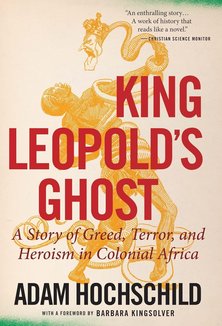
King Leopold's Ghost: A Story of Greed, Terror, and Heroism in Colonial Africa
Author:
Adam Hochschild
The 25th Anniversary Edition, with a foreword by Barbara Kingsolver "An enthralling story . .
The 25th Anniversary Edition, with a foreword by Barbara Kingsolver "An enthralling story . . . A work of history that reads like a novel." — Christian Science Monitor “As Hochschild’s brilliant book demonstrates, the great Congo scandal prefigured our own times . . . This book must be read and reread.” — Los Angeles Times Book Review A National Book Critics Circle Award Finalist * A New York Times Notable Book In the late nineteenth century, as the European powers were carving up Africa, King Leopold II of Belgium carried out a brutal plundering of the territory surrounding the Congo River. Ultimately slashing the area’s population by ten million, he still managed to shrewdly cultivate his reputation as a great humanitarian. A tale far richer than any novelist could invent , King Leopold’s Ghost is the horrifying account of a megalomaniac of monstrous proportions. It is also the deeply moving portrait of those who defied Leopold: African rebel leaders who fought against hopeless odds and a brave handful of missionaries, travelers, and young idealists who went to Africa for work or adventure but unexpectedly found themselves witnesses to a holocaust and participants in the twentieth century’s first great human rights movement.
Find this book on:


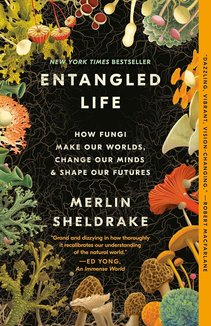
Entangled Life: How Fungi Make Our Worlds, Change Our Minds & Shape Our Futures
Author:
Merlin Sheldrake
NEW YORK TIMES BESTSELLER • A “brilliant [and] entrancing” ( The Guardian ) journey into the hidden lives of fungi—the great connectors of the living world—and their astonishing and intimate roles in human life, with the power to heal our bodies, expand our minds, and help us address our most urgent environmental problems. “Grand and dizzying in how thoroughly it recalibrates our understanding of the natural world.”—Ed Yong, author of An Immense World ONE OF THE BEST BOOKS OF THE YEAR— Time, BBC Science Focus, The Daily Mail, Geographical, The Times, The Telegraph, New Statesman, London Evening Standard, Science Friday When we think of fungi, we likely think of mushrooms.
NEW YORK TIMES BESTSELLER • A “brilliant [and] entrancing” ( The Guardian ) journey into the hidden lives of fungi—the great connectors of the living world—and their astonishing and intimate roles in human life, with the power to heal our bodies, expand our minds, and help us address our most urgent environmental problems. “Grand and dizzying in how thoroughly it recalibrates our understanding of the natural world.”—Ed Yong, author of An Immense World ONE OF THE BEST BOOKS OF THE YEAR— Time, BBC Science Focus, The Daily Mail, Geographical, The Times, The Telegraph, New Statesman, London Evening Standard, Science Friday When we think of fungi, we likely think of mushrooms. But mushrooms are only fruiting bodies, analogous to apples on a tree. Most fungi live out of sight, yet make up a massively diverse kingdom of organisms that supports and sustains nearly all living systems. Fungi provide a key to understanding the planet on which we live, and the ways we think, feel, and behave. In the first edition of this mind-bending book, Sheldrake introduced us to this mysterious but massively diverse kingdom of life. This exquisitely designed volume, abridged from the original, features more than one hundred full-color images that bring the spectacular variety, strangeness, and beauty of fungi to life as never before. Fungi throw our concepts of individuality and even intelligence into question. They are metabolic masters, earth makers, and key players in most of life’s processes. They can change our minds, heal our bodies, and even help us remediate environmental disaster. By examining fungi on their own terms, Sheldrake reveals how these extraordinary organisms—and our relationships with them—are changing our understanding of how life works. Winner of the Wainwright Prize, the Royal Society Science Book Prize, and the Guild of Food Writers Award • Shortlisted for the British Book Award • Longlisted for the Rathbones Folio Prize
Find this book on:
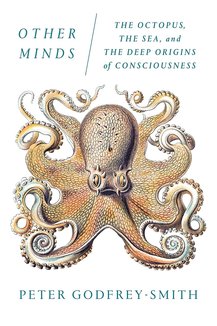
Other Minds: The Octopus, the Sea, and the Deep Origins of Consciousness
Author:
Peter Godfrey-Smith
Philosopher Peter Godfrey-Smith dons a wet suit and journeys into the depths of consciousness in Other Minds Although mammals and birds are widely regarded as the smartest creatures on earth, it has lately become clear that a very distant branch of the tree of life has also sprouted higher intelligence: the cephalopods, consisting of the squid, the cuttlefish, and above all the octopus. In captivity, octopuses have been known to identify individual human keepers, raid neighboring tanks for food, turn off lightbulbs by spouting jets of water, plug drains, and make daring escapes.
Philosopher Peter Godfrey-Smith dons a wet suit and journeys into the depths of consciousness in Other Minds Although mammals and birds are widely regarded as the smartest creatures on earth, it has lately become clear that a very distant branch of the tree of life has also sprouted higher intelligence: the cephalopods, consisting of the squid, the cuttlefish, and above all the octopus. In captivity, octopuses have been known to identify individual human keepers, raid neighboring tanks for food, turn off lightbulbs by spouting jets of water, plug drains, and make daring escapes. How is it that a creature with such gifts evolved through an evolutionary lineage so radically distant from our own? What does it mean that evolution built minds not once but at least twice? The octopus is the closest we will come to meeting an intelligent alien. What can we learn from the encounter? In Other Minds , Peter Godfrey-Smith, a distinguished philosopher of science and a skilled scuba diver, tells a bold new story of how subjective experience crept into being―how nature became aware of itself. As Godfrey-Smith stresses, it is a story that largely occurs in the ocean, where animals first appeared. Tracking the mind’s fitful development, Godfrey-Smith shows how unruly clumps of seaborne cells began living together and became capable of sensing, acting, and signaling. As these primitive organisms became more entangled with others, they grew more complicated. The first nervous systems evolved, probably in ancient relatives of jellyfish; later on, the cephalopods, which began as inconspicuous mollusks, abandoned their shells and rose above the ocean floor, searching for prey and acquiring the greater intelligence needed to do so. Taking an independent route, mammals and birds later began their own evolutionary journeys. But what kind of intelligence do cephalopods possess? Drawing on the latest scientific research and his own scuba-diving adventures, Godfrey-Smith probes the many mysteries that surround the lineage. How did the octopus, a solitary creature with little social life, become so smart? What is it like to have eight tentacles that are so packed with neurons that they virtually “think for themselves”? What happens when some octopuses abandon their hermit-like ways and congregate, as they do in a unique location off the coast of Australia? By tracing the question of inner life back to its roots and comparing human beings with our most remarkable animal relatives, Godfrey-Smith casts crucial new light on the octopus mind―and on our own.
Find this book on:
Episode overview
Historically speaking, we live in an age of extraordinary abundance. We have long since passed the income thresholds when past economists believed our needs would be more than met and we’d be working 15-hour weeks, puzzling over how to spend our free time. And yet, few of us feel able to exult in leisure, and even many of today’s rich toil as if the truest reward for work is more work. Our culture of work would be profoundly puzzling to those who came before us.
James Suzman is an anthropologist who has spent the last 30 years living with and studying the Ju/’hoansi people of southern Africa, one of the world’s enduring hunter-gatherer societies. And that project has given him a unique lens on our modern obsession with work.
As Suzman documents in his new book, “Work: A Deep History From the Stone Age to the Age of Robots,” hunter-gatherer societies like the Ju/’hoansi spent only about 15 hours a week meeting their material needs despite being deeply impoverished by modern standards. But as we’ve gotten richer and invented more technology, we’ve developed a machine for generating new needs, new desires, new forms of status competition.
So this is a conversation about the past, present and future of humanity’s relationship to work and to want. We discuss what economists get wrong about scarcity, the lessons hunter-gatherer societies can teach us about desire, how the advent of farming radically altered people’s conceptions of work and time, whether there’s such a thing as human nature, the dangers of social and economic inequality, the role of advertising in shaping human desires, whether we should have a wealth tax and universal basic income, and much more.