
From this episode
Recommended books

The similarities between madness and modernism are striking: defiance of convention, nihilism, extreme relativism, distortions of time, strange transformations of self, and much more. In this revised edition of a now classic work, Louis Sass, a clinical psychologist, offers a radically new vision of schizophrenia, comparing it with the works of such artists and writers as Kafka, Beckett, and Duchamp, and considering the ideas of philosophers including Nietzsche, Heidegger, Foucault, and Derrida.
The similarities between madness and modernism are striking: defiance of convention, nihilism, extreme relativism, distortions of time, strange transformations of self, and much more. In this revised edition of a now classic work, Louis Sass, a clinical psychologist, offers a radically new vision of schizophrenia, comparing it with the works of such artists and writers as Kafka, Beckett, and Duchamp, and considering the ideas of philosophers including Nietzsche, Heidegger, Foucault, and Derrida. Here is a highly original portrait of the world of insanity, along with a provocative commentary on modernist and postmodernist culture.
Find this book on:


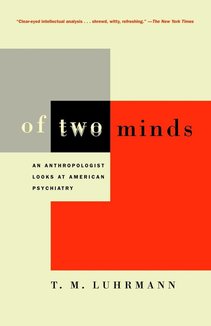
Of Two Minds: An Anthropologist Looks at American Psychiatry
Author:
T.M. Luhrmann
With sharp and soulful insight, T. M.
With sharp and soulful insight, T. M. Luhrmann examines the world of psychiatry, a profession which today is facing some of its greatest challenges from within and without, as it continues to offer hope to many. At a time when mood-altering drugs have revolutionized the treatment of the mentally ill and HMO’s are forcing caregivers to take the pharmacological route over the talking cure, Luhrmann places us at the heart of the matter and allows us to see exactly what is at stake. Based on extensive interviews with patients and doctors, as well as investigative fieldwork in residence programs, private psychiatric hospitals, and state hospitals, Luhrmann’s groundbreaking book shows us how psychiatrists develop and how the enormous ambiguities in the field affect its practitioners and patients.
Find this book on:

The Collected Stories (FSG Classics)
Author:
Grace Paley
This reissue of Grace Paley's classic collection―a finalist for the National Book Award―demonstrates her rich use of language as well as her extraordinary insight into and compassion for her characters, moving from the hilarious to the tragic and back again. Whether writing about the love (and conflict) between parents and children or between husband and wife, or about the struggles of aging single mothers or disheartened political organizers to make sense of the world, she brings the same unerring ear for the rhythm of life as it is actually lived.
This reissue of Grace Paley's classic collection―a finalist for the National Book Award―demonstrates her rich use of language as well as her extraordinary insight into and compassion for her characters, moving from the hilarious to the tragic and back again. Whether writing about the love (and conflict) between parents and children or between husband and wife, or about the struggles of aging single mothers or disheartened political organizers to make sense of the world, she brings the same unerring ear for the rhythm of life as it is actually lived. The Collected Stories is a 1994 National Book Award Finalist for Fiction.
Find this book on:
Episode overview
The National Institute of Mental Health estimates that nearly one in five adults in America lives with a mental illness. And we have plenty of evidence — from suicide rates to the percentage of Americans on psychopharmaceuticals — that our collective mental health is getting worse. But beyond mental health diagnoses lies a whole, complicated landscape of difficult, often painful, mental states that all of us experience at some point in our lives.
Rachel Aviv is a longtime staff writer at The New Yorker and the author of the new book “Strangers to Ourselves: Unsettled Minds and the Stories That Make Us.” Aviv has done some of the best reporting toward answering questions like: How do people cope with their changing — and sometimes truly disturbing — mental states? What can diagnosis capture, and what does it leave out? Why do treatments succeed or fail for different people? And how do all of us tell stories about ourselves — and our minds — that can either trap us in excruciating thought patterns or liberate us?
We discuss why children seeking asylum in Sweden suddenly dropped out mentally and physically from their lives, how mental states like depression and anxiety can be socially contagious, how mental illnesses differ from physical ailments like diabetes and high blood pressure, what Aviv’s own experience with childhood anorexia taught her about psychology and diagnosis, how having too much “insight” into our mental states can sometimes hurt us, how social forces like racism and classism can activate psychological distress, the complicated decisions people make around taking medication or refusing it, how hallucinations can be confused with — or might even count as — a form of spiritual connection, what “depressive realism” says about the state of our society, how we can care for one another both within and beyond the medical establishment, and more.
This episode contains a brief mention of suicidal ideation. If you are having thoughts of suicide, text 988 to reach the Suicide & Crisis Lifeline. A list of additional resources is available at SpeakingOfSuicide.com/resources.