
From this episode
Recommended books
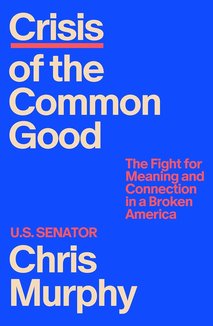
Crisis of the Common Good: The Fight for Meaning and Connection in a Broken America
Author:
Chris Murphy
A New York Times Bestseller A prominent senator assesses the destructive ideas that have seized the American spirit―and shows how the hidden alignments in our politics can free us from their hold. Today, the United States is in a crisis―and it’s not just a political one: over fifty years, the pursuit of profit has undermined virtue and character, while too many of us have become convinced that happiness results from acting as good consumers, rather than as good citizens.
A New York Times Bestseller A prominent senator assesses the destructive ideas that have seized the American spirit―and shows how the hidden alignments in our politics can free us from their hold. Today, the United States is in a crisis―and it’s not just a political one: over fifty years, the pursuit of profit has undermined virtue and character, while too many of us have become convinced that happiness results from acting as good consumers, rather than as good citizens. New technologies threaten essential human capabilities, like friendship, thinking, and creation. And a winner-takes-all mentality has given the rich and well-connected nearly uncontested control of our politics and has corrupted our government. The result: Americans have lost the sense of daily purpose and connection that are vital to happiness, becoming anxious, angry, and adrift. In this vacuum, Donald Trump, feeding off the emptiness and resentment, has come to power. In recent years, Senator Chris Murphy has stepped forward to challenge the Trump administration’s assaults on our democracy. But he also sees that these assaults are a symptom of a deeper crisis: the abandonment of the common good as our country’s organizing principle. In his unflinching new book, he draws on history and political philosophy to expose how six different cults have seized hold of American life and paved the way to our current troubles: a cult of profit that punishes workers, a cult of globalism that weakens communities, a cult of technology that turns us against one another and poisons our young, a cult of consumption that undermines citizenship, a cult of credentialism that devalues those without degrees, and a cult of corruption that threatens democracy. Refusing despair, Murphy offers a new politics of the common good that is both deeply rooted in our past and a radical challenge to the status quo. It is also capable of drawing support across the political spectrum: as Murphy shows, a majority of Americans―including many Trump voters―favor policies that confront these destructive cults by curbing corporate power, controlling predatory technology, enhancing face-to-face connection, granting workers greater control of their lives, and removing big money from our politics. The common good, Murphy shows, is no object of nostalgia; it is a vital principle ready to be claimed today.
Find this book on:


From Life Itself: Turkey, Istanbul, and a Neighborhood in the Age of Erdoğan
Author:
Suzy Hansen
"Rich and complex . .
"Rich and complex . . . [A] beautifully observant book." ―Jennifer Szalai, The New York Times Book Review “A dizzying tour de force . . . From Life Itself leaves the reader with a sense of wonder.” ―Elif Batuman, author of Either/Or and The Idiot One neighborhood in Istanbul: a window on a city, country, region, and world in a state of upheaval. Karagümrük, an Istanbul neighborhood once dominated by Ottoman-era homes, is now known for petty thieves, cheap apartment blocks, and an influx of Syrian refugees. It’s here that Suzy Hansen went looking for the truth behind the Turkish president Recep Tayyip Erdoğan’s authoritarian turn, a catastrophic regional war, and an accelerating geopolitical crisis. She asks: Was Turkey a harbinger of what would soon arise in other countries, the resurgence of authoritarianism? Or do the lives in this neighborhood, and the transformations of Erdoğan’s Turkey, reveal a more complex story? During a decade spent reporting from Karagümrük, Hansen discovered the neighborhood’s secrets and got to know some of its people: Ismail, the longtime muhtar, or neighborhood councilman; Huseyin, a loyalist in Erdoğan’s Islamic nationalist AK Party; and Ebru, a real estate agent and mother with ambitions to unseat Ismail. Through these local perspectives, Hansen connects the events unfolding in Karagümrük to the forces roiling Turkey, the Middle East, and the world, capturing the sweep of the last ten years in microcosm. From the author of the acclaimed Pulitzer Prize finalist Notes on a Foreign Country , From Life Itself is a story for a world out of joint. An absorbing account of one neighborhood in Istanbul that has seen profound change, it offers lessons for all of us who feel the pressure of the disorienting global forces remaking our lives.
Find this book on:

Book of Mercy (Canons)
Author:
Leonard Cohen
The poems in Book of Mercy brim with praise, despair, anger, doubt and trust. Speaking from the heart of the modern world, yet in tones that resonate with an older devotional tradition, these verses give voice to our deepest, most powerful intuitions.Internationally celebrated for his writing and his music, Leonard Cohen is revered as one of the greatest writers, performers, and most consistently daring artists of the last hundred years.
The poems in Book of Mercy brim with praise, despair, anger, doubt and trust. Speaking from the heart of the modern world, yet in tones that resonate with an older devotional tradition, these verses give voice to our deepest, most powerful intuitions.Internationally celebrated for his writing and his music, Leonard Cohen is revered as one of the greatest writers, performers, and most consistently daring artists of the last hundred years.
Find this book on:
Episode overview
The Democratic Party is in the middle of a rupture over foreign policy – with Israel and Palestine at the center.
In recent weeks, the Democratic senators Brian Schatz and Chris Van Hollen both called for a break with the Biden administration’s policies toward Israel. Schatz said the next administration needs “a whole new crop of foreign policy staffers,” while Van Hollen went further, accusing Biden’s senior decision makers of “complicity.” And Gaza has become a central issue splitting Democrats in primaries around the country. It’s become such a profound fault line, it reminds me of how the Iraq war remade the Democratic Party years ago.
And Democrats face huge foreign policy questions beyond Gaza, too. Trump has taken a wrecking ball to the rules-based order, and the American public has become increasingly cynical about U.S. interventions abroad. Do Democrats want to try to restore what came before Trump? Is that even possible? Or is there a vision for something new?
Matt Duss is at the center of foreign policy thinking on the left. He’s the executive vice president at the Center for International Policy, previously served as Senator Bernie Sanders’s foreign policy adviser and is currently advising Representative Alexandria Ocasio-Cortez. So I thought he’d be the perfect person to ask: What would a left foreign policy actually look like? What would it try to do in the world?