From this episode
Recommended books
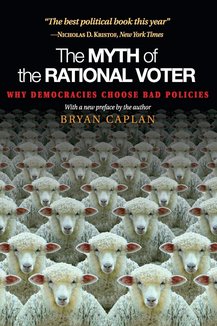
The Myth of the Rational Voter: Why Democracies Choose Bad Policies - New Edition
Author:
Bryan Caplan
The greatest obstacle to sound economic policy is not entrenched special interests or rampant lobbying, but the popular misconceptions, irrational beliefs, and personal biases held by ordinary voters. This is economist Bryan Caplan's sobering assessment in this provocative and eye-opening book.
The greatest obstacle to sound economic policy is not entrenched special interests or rampant lobbying, but the popular misconceptions, irrational beliefs, and personal biases held by ordinary voters. This is economist Bryan Caplan's sobering assessment in this provocative and eye-opening book. Caplan argues that voters continually elect politicians who either share their biases or else pretend to, resulting in bad policies winning again and again by popular demand. Boldly calling into question our most basic assumptions about American politics, Caplan contends that democracy fails precisely because it does what voters want. Through an analysis of Americans' voting behavior and opinions on a range of economic issues, he makes the convincing case that noneconomists suffer from four prevailing biases: they underestimate the wisdom of the market mechanism, distrust foreigners, undervalue the benefits of conserving labor, and pessimistically believe the economy is going from bad to worse. Caplan lays out several bold ways to make democratic government work better--for example, urging economic educators to focus on correcting popular misconceptions and recommending that democracies do less and let markets take up the slack. The Myth of the Rational Voter takes an unflinching look at how people who vote under the influence of false beliefs ultimately end up with government that delivers lousy results. With the upcoming presidential election season drawing nearer, this thought-provoking book is sure to spark a long-overdue reappraisal of our elective system.
Find this book on:


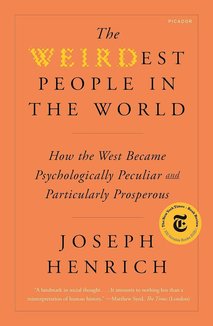
WEIRDest People in the World
Author:
Joseph Henrich
A New York Times Notable Book of 2020 A Bloomberg Best Non-Fiction Book of 2020 A Behavioral Scientist Notable Book of 2020 A Human Behavior & Evolution Society Must-Read Popular Evolution Book of 2020 A bold, epic account of how the co-evolution of psychology and culture created the peculiar Western mind that has profoundly shaped the modern world. Perhaps you are WEIRD: raised in a society that is Western, Educated, Industrialized, Rich, and Democratic.
A New York Times Notable Book of 2020 A Bloomberg Best Non-Fiction Book of 2020 A Behavioral Scientist Notable Book of 2020 A Human Behavior & Evolution Society Must-Read Popular Evolution Book of 2020 A bold, epic account of how the co-evolution of psychology and culture created the peculiar Western mind that has profoundly shaped the modern world. Perhaps you are WEIRD: raised in a society that is Western, Educated, Industrialized, Rich, and Democratic. If so, you’re rather psychologically peculiar. Unlike much of the world today, and most people who have ever lived, WEIRD people are highly individualistic, self-obsessed, control-oriented, nonconformist, and analytical. They focus on themselves―their attributes, accomplishments, and aspirations―over their relationships and social roles. How did WEIRD populations become so psychologically distinct? What role did these psychological differences play in the industrial revolution and the global expansion of Europe during the last few centuries? In The WEIRDest People in the World , Joseph Henrich draws on cutting-edge research in anthropology, psychology, economics, and evolutionary biology to explore these questions and more. He illuminates the origins and evolution of family structures, marriage, and religion, and the profound impact these cultural transformations had on human psychology. Mapping these shifts through ancient history and late antiquity, Henrich reveals that the most fundamental institutions of kinship and marriage changed dramatically under pressure from the Roman Catholic Church. It was these changes that gave rise to the WEIRD psychology that would coevolve with impersonal markets, occupational specialization, and free competition―laying the foundation for the modern world. Provocative and engaging in both its broad scope and its surprising details, The WEIRDest People in the World explores how culture, institutions, and psychology shape one another, and explains what this means for both our most personal sense of who we are as individuals and also the large-scale social, political, and economic forces that drive human history. Includes black-and-white illustrations.
Find this book on:
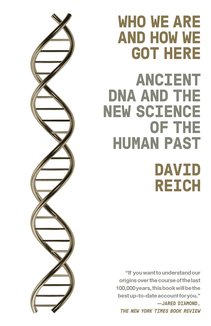
A groundbreaking book about how ancient DNA has profoundly changed our understanding of human history. Geneticists like David Reich have made astounding advances in the field of genomics, which is proving to be as important as archeology, linguistics, and written records as a means to understand our ancestry.
A groundbreaking book about how ancient DNA has profoundly changed our understanding of human history. Geneticists like David Reich have made astounding advances in the field of genomics, which is proving to be as important as archeology, linguistics, and written records as a means to understand our ancestry. In Who We Are and How We Got Here , Reich allows readers to discover how the human genome provides not only all the information a human embryo needs to develop but also the hidden story of our species. Reich delves into how the genomic revolution is transforming our understanding of modern humans and how DNA studies reveal deep inequalities among different populations, between the sexes, and among individuals. Provocatively, Reich’s book suggests that there might very well be biological differences among human populations but that these differences are unlikely to conform to common stereotypes. Drawing upon revolutionary findings and unparalleled scientific studies, Who We Are and How We Got Here is a captivating glimpse into humankind—where we came from and what that says about our lives today.
Find this book on:
Episode overview
Should we be celebrating a Biden boom? Lamenting inflation and its consequences? Both?
We know how to talk about booms, like the ’90s. We know how to talk about busts, like after the financial crisis. We know how to talk about stagnation. What we don’t know how to talk about is contradictory extremes coexisting together. But that’s the economy we have right now. And a lot rides on figuring out how to balance those extremes. Because if we solve inflation while killing the labor market, we’ll have blown a hole in our foot to save our hand.
And so I wanted to talk today to Jason Furman, an economist at Harvard and the chair of Barack Obama’s Council of Economic Advisers from 2013 to 2017. What I appreciate about Jason is he doesn’t pretend the economy is only one thing or there’s only one lens for looking at it. He’s an unusually multimodeled thinker.
We discuss whether families and workers are making it out ahead given the dual realities of rising wages and rising prices, why so many economists and forecasters got this economy wrong, to what extent the Biden stimulus is responsible for both the booming economy and spiking inflation, whether the economic lessons of the financial crisis were overlearned, why Furman thinks supply-chain issues are “overrated” as a cause of inflation, what the Great Resignation misses, how the Biden administration should restructure its Build Back Better bill, and more.