
From this episode
Recommended books
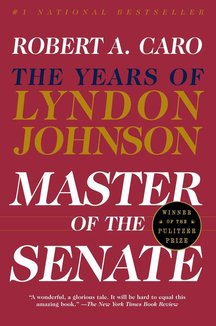
Master Of The Senate: The Years of Lyndon Johnson
Author:
Robert A. Caro
Master of the Senate, Book Three of The Years of Lyndon Johnson, carries Johnson’s story through one of its most remarkable periods: his twelve years, from 1949 to 1960, in the United States Senate. At the heart of the book is its unprecedented revelation of how legislative power works in America, how the Senate works, and how Johnson, in his ascent to the presidency, mastered the Senate as no political leader before him had ever done.
Master of the Senate, Book Three of The Years of Lyndon Johnson, carries Johnson’s story through one of its most remarkable periods: his twelve years, from 1949 to 1960, in the United States Senate. At the heart of the book is its unprecedented revelation of how legislative power works in America, how the Senate works, and how Johnson, in his ascent to the presidency, mastered the Senate as no political leader before him had ever done. It was during these years that all Johnson’s experience—from his Texas Hill Country boyhood to his passionate representation in Congress of his hardscrabble constituents to his tireless construction of a political machine—came to fruition. Caro introduces the story with a dramatic account of the Senate itself: how Daniel Webster, Henry Clay, and John C. Calhoun had made it the center of governmental energy, the forum in which the great issues of the country were thrashed out. And how, by the time Johnson arrived, it had dwindled into a body that merely responded to executive initiatives, all but impervious to the forces of change. Caro anatomizes the genius for political strategy and tactics by which, in an institution that had made the seniority system all-powerful for a century and more, Johnson became Majority Leader after only a single term-the youngest and greatest Senate Leader in our history; how he manipulated the Senate’s hallowed rules and customs and the weaknesses and strengths of his colleagues to change the “unchangeable” Senate from a loose confederation of sovereign senators to a whirring legislative machine under his own iron-fisted control. Caro demonstrates how Johnson’s political genius enabled him to reconcile the unreconcilable: to retain the support of the southerners who controlled the Senate while earning the trust—or at least the cooperation—of the liberals, led by Paul Douglas and Hubert Humphrey, without whom he could not achieve his goal of winning the presidency. He shows the dark side of Johnson’s ambition: how he proved his loyalty to the great oil barons who had financed his rise to power by ruthlessly destroying the career of the New Dealer who was in charge of regulating them, Federal Power Commission Chairman Leland Olds. And we watch him achieve the impossible: convincing southerners that although he was firmly in their camp as the anointed successor to their leader, Richard Russell, it was essential that they allow him to make some progress toward civil rights. In a breathtaking tour de force, Caro details Johnson’s amazing triumph in maneuvering to passage the first civil rights legislation since 1875. Master of the Senate, told with an abundance of rich detail that could only have come from Caro’s peerless research, is both a galvanizing portrait of the man himself—the titan of Capital Hill, volcanic, mesmerizing—and a definitive and revelatory study of the workings and personal and legislative power.
Find this book on:


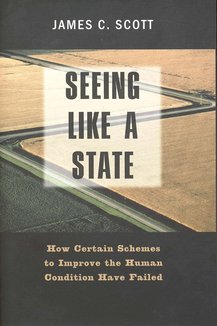
Seeing like a State: How Certain Schemes to Improve the Human Condition Have Failed
Author:
James C. Scott
“Illuminating and beautifully written, this book calls into sharp relief the nature of the world we now inhabit.”— New Yorker “A magisterial critique of top-down social planning.”—Jennifer Schuessler, New York Times “One of the most profound and illuminating studies of this century to have been published in recent decades.”—John Gray, New York Times Book Review Compulsory ujamaa villages in Tanzania, collectivization in Russia, Le Corbusier’s urban planning theory realized in Brasília, the Great Leap Forward in China, agricultural “modernization” in the Tropics—the twentieth century has been racked by grand utopian schemes that have inadvertently brought death and disruption to millions. Why do well-intentioned plans for improving the human condition go tragically awry?
“Illuminating and beautifully written, this book calls into sharp relief the nature of the world we now inhabit.”— New Yorker “A magisterial critique of top-down social planning.”—Jennifer Schuessler, New York Times “One of the most profound and illuminating studies of this century to have been published in recent decades.”—John Gray, New York Times Book Review Compulsory ujamaa villages in Tanzania, collectivization in Russia, Le Corbusier’s urban planning theory realized in Brasília, the Great Leap Forward in China, agricultural “modernization” in the Tropics—the twentieth century has been racked by grand utopian schemes that have inadvertently brought death and disruption to millions. Why do well-intentioned plans for improving the human condition go tragically awry? In this wide-ranging and original book, James C. Scott analyzes failed cases of large-scale authoritarian plans in a variety of fields. Centrally managed social plans misfire, Scott argues, when they impose schematic visions that do violence to complex interdependencies that are not—and cannot—be fully understood. Further, the success of designs for social organization depends upon the recognition that local, practical knowledge is as important as formal, epistemic knowledge. The author builds a persuasive case against “development theory” and imperialistic state planning that disregards the values, desires, and objections of its subjects. He identifies and discusses four conditions common to all planning disasters: administrative ordering of nature and society by the state; a “high-modernist ideology” that places confidence in the ability of science to improve every aspect of human life; a willingness to use authoritarian state power to effect large- scale interventions; and a prostrate civil society that cannot effectively resist such plans.
Find this book on:

Salt: A World History
Author:
Mark Kurlansky
NEW YORK TIMES BESTSELLER | THE BOOK BEHIND THE VIRAL TIKTOK One tiny rock. One epic history.
NEW YORK TIMES BESTSELLER | THE BOOK BEHIND THE VIRAL TIKTOK One tiny rock. One epic history. "A must-have for any serious cook or foodie."—Anthony Bourdain "This is a "wow!" book: roving, startling, engaging.” — Washington Post “Kurlansky finds the world in a grain of salt.”— New York Times Book Review An unlikely world history from the bestselling author of Milk! and Cod You’ll never look at salt the same way again. The only rock we eat, salt has shaped civilization from the very beginning, and its story is a glittering, often surprising part of the history of humankind. A substance so valuable it served as currency, salt has influenced the establishment of trade routes and cities, provoked and financed wars, secured empires, and inspired revolutions. Populated by colorful characters and filled with an unending series of fascinating details, Salt is a supremely entertaining, multi-layered masterpiece.
Find this book on:
Episode overview
President Trump is very unpopular right now. But polls show the Democratic Party is just as unpopular – if not more so. So what can the party do about it?
But to answer that question, you first have to understand what the Democratic Party is. That is, mechanically, what is it? What powers does it have? When you call the Democratic Party, who picks up the phone? And how can that party, the official party, be reinvented for this era?
Ben Wikler has a unique perspective on this question. He transformed the Democratic Party of Wisconsin into a fund-raising, door-knocking powerhouse when he served as chair from 2019 to 2025. And he’s shared some of his insights from winning elections in a swing state in his new book, “This Is The Plan: How to End America's Meltdown and Save Democracy.”
In this conversation, we discuss Wikler’s vision for a reinvigorated party, as well as the kinds of changes he thinks Democrats need to embrace if they want to build a bigger tent and a national majority.