
From this episode
Recommended books
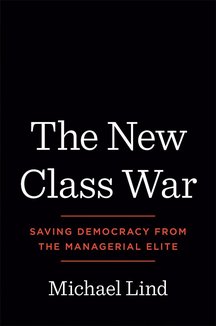
The New Class War: Saving Democracy from the Managerial Elite
Author:
Michael Lind
In both Europe and North America, populist movements have shattered existing party systems and thrown governments into turmoil. The embattled establishment claims that these populist insurgencies seek to overthrow liberal democracy.
In both Europe and North America, populist movements have shattered existing party systems and thrown governments into turmoil. The embattled establishment claims that these populist insurgencies seek to overthrow liberal democracy. The truth is no less alarming but is more complex: Western democracies are being torn apart by a new class war. In this controversial and groundbreaking new analysis, Michael Lind, one of America’s leading thinkers, debunks the idea that the insurgencies are primarily the result of bigotry, traces how the breakdown of mid-century class compromises between business and labor led to the conflict, and reveals the real battle lines. On one side is the managerial overclass—the university-credentialed elite that clusters in high-income hubs and dominates government, the economy and the culture. On the other side is the working class of the low-density heartlands—mostly, but not exclusively, native and white. The two classes clash over immigration, trade, the environment, and social values, and the managerial class has had the upper hand. As a result of the half-century decline of the institutions that once empowered the working class, power has shifted to the institutions the overclass controls: corporations, executive and judicial branches, universities, and the media. The class war can resolve in one of three ways: • The triumph of the overclass, resulting in a high-tech caste system. • The empowerment of populist, resulting in no constructive reforms • A class compromise that provides the working class with real power Lind argues that Western democracies must incorporate working-class majorities of all races, ethnicities, and creeds into decision making in politics, the economy, and culture. Only this class compromise can avert a never-ending cycle of clashes between oligarchs and populists and save democracy.
Find this book on:


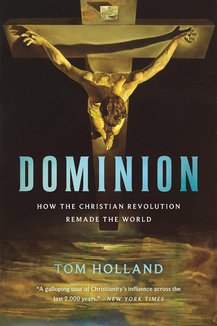
Dominion
Author:
Tom Holland
A “marvelous” ( Economist ) account of how the Christian Revolution forged the Western imagination. Crucifixion, the Romans believed, was the worst fate imaginable, a punishment reserved for slaves.
A “marvelous” ( Economist ) account of how the Christian Revolution forged the Western imagination. Crucifixion, the Romans believed, was the worst fate imaginable, a punishment reserved for slaves. How astonishing it was, then, that people should have come to believe that one particular victim of crucifixion-an obscure provincial by the name of Jesus-was to be worshipped as a god. Dominion explores the implications of this shocking conviction as they have reverberated throughout history. Today, the West remains utterly saturated by Christian assumptions. As Tom Holland demonstrates, our morals and ethics are not universal but are instead the fruits of a very distinctive civilization. Concepts such as secularism, liberalism, science, and homosexuality are deeply rooted in a Christian seedbed. From Babylon to the Beatles, Saint Michael to #MeToo, Dominion tells the story of how Christianity transformed the modern world.
Find this book on:
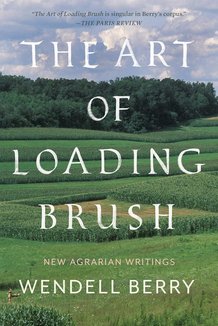
The Art of Loading Brush: New Agrarian Writings
Author:
Wendell Berry
" The Art of Loading Brush is singular in Berry's corpus." ― The Paris Review Wendell Berry's profound critique of American culture has entered its sixth decade, and in this gathering he reaches with deep devotion toward a long view of agrarian philosophy. The Art of Loading Brush is an energetic mix of essays, stories, and a poem, which explore agrarian ideals as they present themselves historically and as they might apply to our work today.
" The Art of Loading Brush is singular in Berry's corpus." ― The Paris Review Wendell Berry's profound critique of American culture has entered its sixth decade, and in this gathering he reaches with deep devotion toward a long view of agrarian philosophy. The Art of Loading Brush is an energetic mix of essays, stories, and a poem, which explore agrarian ideals as they present themselves historically and as they might apply to our work today. Filled with insights and new revelations from a mind thorough in its considerations and careful in its presentations, The Art of Loading Brush is a necessary and timely collection.
Find this book on:
Episode overview
“It begun to dawn on many conservatives that in spite of apparent electoral victories that have occurred regularly since the Reagan years, they have consistently lost, and lost overwhelmingly to progressive forces,” Patrick Deneen writes in a recent essay titled “Abandoning Defensive Crouch Conservatism.” He goes on to argue that conservatives need to reject liberal values like free speech, religious liberty and pluralism, abandon their defensive posturing and use the power of the state to actively fight back against what he calls “liberal totalitarianism.”
To progressive ears, these kinds of statements can be baffling; after all, Republicans currently control a majority of state legislatures, governorships and the Supreme Court, and they are poised to make gains in the midterm elections this fall. But even so, there’s a pervasive feeling among conservatives that progressives are using their unprecedented institutional power — in universities, in Hollywood, in the mainstream media, in the C-suites of tech companies — to wage war on traditional ways of life. And many of them have come to believe that the only viable response is to fight back against these advances at all costs. It’s impossible to understand the policies, leaders, rhetoric and tactics of the populist right without first trying to inhabit this worldview.
That is why, for this second conversation in our series “The Rising Right,” I wanted to speak with Deneen. He is a professor of political science at the University of Notre Dame, and his 2018 book, “Why Liberalism Failed,” has become a touchstone within the conservative intelligentsia and was even fairly well received by liberals. But since then, Deneen’s writing has come to express something closer to total political war. And with three other professors, he recently started a Substack newsletter, “The Postliberal Order,” to build the kind of intellectual and political project needed to fight that war.
This is a conversation about what Deneen’s “postliberal” political project looks like — and the tensions and contradictions it reveals about the modern populist right. We discuss (and debate) Deneen’s view that conservatives keep losing, why he believes the left is hostile to the family, whether America needs stricter divorce laws, what the post-liberal right would actually do with power, the virtues and vices of policy analysis, whether post-liberals have built their core arguments around an invented straw man liberalism, Joe Biden’s agenda for families and much more.