From this episode
Recommended books
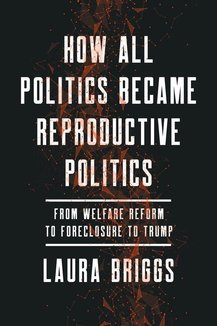
Today all politics are reproductive politics, argues esteemed feminist critic Laura Briggs. From longer work hours to the election of Donald Trump, our current political crisis is above all about reproduction.
Today all politics are reproductive politics, argues esteemed feminist critic Laura Briggs. From longer work hours to the election of Donald Trump, our current political crisis is above all about reproduction. Households are where we face our economic realities as social safety nets get cut and wages decline. Briggs brilliantly outlines how politicians’ racist accounts of reproduction—stories of Black “welfare queens” and Latina “breeding machines"—were the leading wedge in the government and business disinvestment in families. With decreasing wages, rising McJobs, and no resources for family care, our households have grown ever more precarious over the past forty years in sharply race-and class-stratified ways. This crisis, argues Briggs, fuels all others—from immigration to gay marriage, anti-feminism to the rise of the Tea Party.
Find this book on:

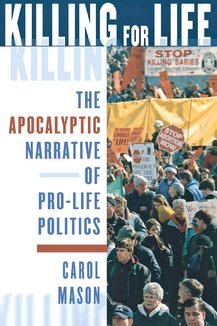
Killing for Life: The Apocalyptic Narrative of Pro-Life Politics
Author:
Carol Mason
How can those who seek to protect the "right to life" defend assassination in the name of saving lives? Carol Mason investigates this seeming paradox by examining pro-life literature―both archival material and writings from the front lines of the conflict.
How can those who seek to protect the "right to life" defend assassination in the name of saving lives? Carol Mason investigates this seeming paradox by examining pro-life literature―both archival material and writings from the front lines of the conflict. Her analysis reveals the apocalyptic thread that is the ideological link between established anti-abortion organizations and the more shadowy pro-life terrorists who subject clinic workers to anthrax scares, bombs, and bullets. The portrayal of abortion as "America's Armageddon" began in the 1960s. In the 1970s, Mason says, Christian politics and the post-Vietnam paramilitary culture popularized the idea that legal abortion is a harbinger of apocalypse. By the 1990s, Mason asserts, even the movement's mainstream had taken up the call, narrating abortion as an apocalyptic battle between so-called Christian and anti-Christian forces. "Pro-life violence of the 1990s signaled a move away from protest and toward retribution," she writes. "Pro-life retribution is seen as a way to restore the order of God. In this light, the phenomenon of killing for 'life' is revealed not as an oxymoron, but as a logical consistency and a political manifestation of religious retribution." Mason's scrutiny of primary sources (direct mail, internal memoranda, personal letters, underground manuals, and pro-life films, magazines, and novels) draws attention to elements of pro-life millennialism. Killing for Life is a powerful indictment of pro-life ideology as a coherent, mass-produced narrative that does not merely condone violence, but anticipates it as part of "God's plan."
Find this book on:

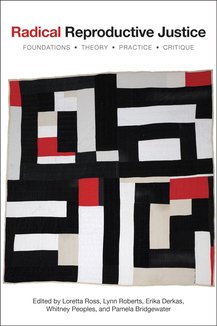
Radical Reproductive Justice: Foundation, Theory, Practice, Critique
Authors:
Dorothy Roberts,
Loretta Ross,
Lynn Roberts,
Erika Derkas,
Whitney Peoples,
Pamela Bridgewater Toure
Practical tools and theoretical frameworks for understanding the fight for reproductive rights, from pregnancy to parenthood and beyond. Expanding the social justice discourse surrounding "reproductive rights" to include issues of environmental justice, incarceration, poverty, disability, and more, this crucial anthology explores the practical applications for activist thought on this ever-urgent issue.
Practical tools and theoretical frameworks for understanding the fight for reproductive rights, from pregnancy to parenthood and beyond. Expanding the social justice discourse surrounding "reproductive rights" to include issues of environmental justice, incarceration, poverty, disability, and more, this crucial anthology explores the practical applications for activist thought on this ever-urgent issue. Radical Reproductive Justice assembles two decades’ of work initiated by SisterSong Women of Color Health Collective, creators of the human rights-based “reproductive justice” framework to move beyond polarized pro-choice/pro-life debates. Rooted in Black feminism and built on intersecting identities, this revolutionary framework asserts a woman's right to have children, to not have children, and to parent and provide for the children they have. “The book is as revolutionary and revelatory as it is vast." —Rewire
Find this book on:
Episode overview
A few weeks ago, the Supreme Court let stand a Texas law creating a system of vigilante legal enforcement against anyone who participates in an abortion after the point of fetal cardiac activity. In effect, Texas’ law bans abortions after about six weeks, which is long before many women even know they’re pregnant. And soon the court will hear arguments on a Mississippi abortion ban that will give the justices the chance to overturn Roe v. Wade directly.
We may be on the precipice of a post-Roe world.
But what does that actually mean? Leslie Reagan is the author of “When Abortion Was a Crime” and “Dangerous Pregnancies.” Reagan has done groundbreaking historical work to reveal what happened when U.S. states began criminalizing abortion in the early 19th century. There are lessons in our past that should inform our future, if we’ll listen.
This is also a particularly personal episode for me.My partner is 33 weeks pregnant. This is our second pregnancy. Both have been unusually dangerous and physically damaging. For the state to say that it will force any people to undergo that against their will is a remarkable assumption of power over individuals. Reagan and I talk about what that means, what the state is saying about the personhood, or lack thereof, of those who become pregnant.