
From this episode
Recommended books

The Myth of the Wrong Body
Authors:
Miquel Misse,
Frances Riddle
The most popular narrative about transsexuality suggests that some people are born in the wrong body – that their bodies do not correspond to their inner experience and that their bodies should therefore be transformed. But in the view of the sociologist and trans activist Miguel Missé, this narrative is a harmful myth.
The most popular narrative about transsexuality suggests that some people are born in the wrong body – that their bodies do not correspond to their inner experience and that their bodies should therefore be transformed. But in the view of the sociologist and trans activist Miguel Missé, this narrative is a harmful myth. It is rooted in a medical paradigm that typically leads to medical intervention – to the use of hormones and surgical operations. By proposing a particular solution (modifying one’s body), doctors and psychiatrists make it difficult for trans people to overcome malaise about their body in other ways and prevent them from recognizing the burden of social norms. Drawing on his own personal experience, Missé makes the case for a different way of thinking about trans embodiment which focuses on gender identity. The trajectory that leads people to become trans is shaped by the rigidity of gender norms, where the only two models available to individuals are the masculine man and the feminine woman. But these are not the only possible choices, and by critically interrogating the rigidity of gender norms, Missé opens up a different way of thinking about being trans, beyond the essentialism of the medical paradigm.
Find this book on:


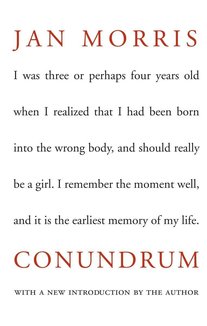
Conundrum (New York Review Books Classics)
Author:
Jan Morris
One of the first-ever books on gender transition, this poignant memoir by a trans woman is “the best first-hand account ever written by a traveler across the boundaries of sex” ( Newsweek ). “A profoundly poetic story.” — The New York Times “An exquisite read.” —Maria Popova, The Marginalian The great travel writer Jan Morris was born James Morris.
One of the first-ever books on gender transition, this poignant memoir by a trans woman is “the best first-hand account ever written by a traveler across the boundaries of sex” ( Newsweek ). “A profoundly poetic story.” — The New York Times “An exquisite read.” —Maria Popova, The Marginalian The great travel writer Jan Morris was born James Morris. James Morris distinguished himself in the British military, became a successful and physically daring reporter, climbed mountains, crossed deserts, and established a reputation as a historian of the British empire. He was happily married, with several children. To all appearances, he was not only a man, but a man’s man. Except that appearances, as James Morris had known from early childhood, can be deeply misleading. James Morris had known all his conscious life that at heart he was a woman. Conundrum , one of the earliest books to discuss transsexuality with honesty and without prurience, tells the story of James Morris’ hidden life and how he decided to bring it into the open, as he resolved first on a hormone treatment and, second, on risky experimental surgery that would turn him into the woman that he truly was.
Find this book on:
Who's Afraid of Gender?
Author:
Judith Butler
National Bestseller. Named a Best Book of 2024 (so far) by NPR, Harper's Bazaar , W , and Esquire, and a Most Anticipated Book of 2024 by The New York Times, The Washington Post, Time, Los Angeles Times, ELLE, Cosmopolitan, Kirkus, Literary Hub, Autostraddle, The Millions, Electric Literature, and them.
National Bestseller. Named a Best Book of 2024 (so far) by NPR, Harper's Bazaar , W , and Esquire, and a Most Anticipated Book of 2024 by The New York Times, The Washington Post, Time, Los Angeles Times, ELLE, Cosmopolitan, Kirkus, Literary Hub, Autostraddle, The Millions, Electric Literature, and them. "A profoundly urgent intervention.” ―Naomi Klein "A timely must-read for anyone actively invested in re-imagining collective futurity.” ―Claudia Rankine From a global icon, a bold, essential account of how a fear of gender is fueling reactionary politics around the world. Judith Butler, the groundbreaking thinker whose iconic book Gender Trouble redefined how we think about gender and sexuality, confronts the attacks on “gender” that have become central to right-wing movements today. Global networks have formed “anti-gender ideology movements” that are dedicated to circulating a fantasy that gender is a dangerous, perhaps diabolical, threat to families, local cultures, civilization―and even “man” himself. Inflamed by the rhetoric of public figures, this movement has sought to nullify reproductive justice, undermine protections against sexual and gender violence, and strip trans and queer people of their rights to pursue a life without fear of violence. The aim of Who’s Afraid of Gender? is not to offer a new theory of gender but to examine how “gender” has become a phantasm for emerging authoritarian regimes, fascist formations, and transexclusionary feminists. In their vital, courageous new book, Butler illuminates the concrete ways that this phantasm of “gender” collects and displaces anxieties and fears of destruction. Operating in tandem with deceptive accounts of “critical race theory” and xenophobic panics about migration, the anti-gender movement demonizes struggles for equality, fuels aggressive nationalism, and leaves millions of people vulnerable to subjugation. An essential intervention into one of the most fraught issues of our moment, Who’s Afraid of Gender? is a bold call to refuse the alliance with authoritarian movements and to make a broad coalition with all those whose struggle for equality is linked with fighting injustice. Imagining new possibilities for both freedom and solidarity, Butler offers us a hopeful work of social and political analysis that is both timely and timeless―a book whose verve and rigor only they could deliver.
Find this book on:
Episode overview
It’s a time of contrast and contradiction for gender queerness in America: At the same time that about 5 percent of Americans under 30 identify as transgender or nonbinary, over 20 states have passed some sort of restriction on gender-affirming care for children. In 2023 alone, over 550 anti-trans bills have been introduced across the country.
The political push and pull can overshadow a broad spectrum of rich questions and possibilities that queer culture opens up — about how we think about identity and social categories, how we structure our communities and support networks, our anxieties about having children who are different from ourselves, how gender norms shape all bodies and how difficult it can be to make big life decisions.
Masha Gessen is a staff writer at The New Yorker who has thought deeply about many of these questions. “Gender is something that happens between me and other people,” they say. In this conversation, the guest host Lydia Polgreen asks Gessen, who identifies as trans and nonbinary, what the social and political shift around gender has looked like to them in the past few decades.
They discuss why gender has captured the conservative imagination, how L.G.B.T.Q. activists have fallen into the “regret trap,” what it means to understand gender expression as a choice rather than something biologically determined, why Gessen prefers a liberatory framework focused on protecting freedoms-to rather than freedoms-from when thinking about L.G.B.T.Q. issues, how gender-affirming care is not just for trans people, how the making of the 1999 movie “The Matrix” reflects the rapid social change around trans visibility in the United States, the anti-L.G.B.T.Q. sentiments that made Gessen decide to leave their home in Russia,how gender conformity is social contagion and more.
This episode was hosted by Lydia Polgreen, a New York Times Opinion columnist and a co-host on the weekly Opinion podcast “Matter of Opinion.” She previously served as the managing director of Gimlet, a podcast studio at Spotify, and as the editor in chief of HuffPost.