
From this episode
Recommended books

Take Back the Game: How Money and Mania Are Ruining Kids' Sports--and Why It Matters
Author:
Linda Flanagan
Longlisted for the Porchlight Business Book Awards 2022 A close look at how big money and high stakes have transformed youth sports, turning once healthy, fun activities for kids into all-consuming endeavors—putting stress on children and families alike Some 75% of American families want their kids to play sports. Athletics are training grounds for character, friendship, and connection; at their best, sports insulate kids from hardship and prepare them for adult life.
Longlisted for the Porchlight Business Book Awards 2022 A close look at how big money and high stakes have transformed youth sports, turning once healthy, fun activities for kids into all-consuming endeavors—putting stress on children and families alike Some 75% of American families want their kids to play sports. Athletics are training grounds for character, friendship, and connection; at their best, sports insulate kids from hardship and prepare them for adult life. But youth sports have changed so dramatically over the last 25 years that they no longer deliver the healthy outcomes everyone wants. Instead, unbeknownst to most parents, kids who play competitive organized sports are more likely to burn out or suffer from overuse injuries than to develop their characters or build healthy habits. What happened to kids' sports? And how can we make them fun again? In Take Back the Game , coach and journalist Linda Flanagan reveals how the youth sports industry capitalizes on parents’ worry about their kids’ futures, selling the idea that more competitive play is essential in the feeding frenzy over access to colleges and universities. Drawing on her experience as a coach and a parent, along with research and expert analysis, Flanagan delves into a national obsession that has: Compelled kids to specialize year-round in one sport. Increased the risk of both physical injury and mental health problems. Encouraged egregious behavior by coaches and parents. Reduced access to sports for low-income families. A provocative and timely entrant into a conversation thousands of parents are having on the sidelines, Take Back the Game uncovers how youth sports became a serious business, the consequences of raising the stakes for kids and parents alike--and the changes we need now.
Find this book on:


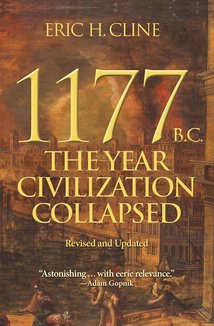
A bold reassessment of what caused the Late Bronze Age collapse In 1177 B.C., marauding groups known only as the "Sea Peoples" invaded Egypt. The pharaoh's army and navy managed to defeat them, but the victory so weakened Egypt that it soon slid into decline, as did most of the surrounding civilizations.
A bold reassessment of what caused the Late Bronze Age collapse In 1177 B.C., marauding groups known only as the "Sea Peoples" invaded Egypt. The pharaoh's army and navy managed to defeat them, but the victory so weakened Egypt that it soon slid into decline, as did most of the surrounding civilizations. After centuries of brilliance, the civilized world of the Bronze Age came to an abrupt and cataclysmic end. Kingdoms fell like dominoes over the course of just a few decades. No more Minoans or Mycenaeans. No more Trojans, Hittites, or Babylonians. The thriving economy and cultures of the late second millennium B.C., which had stretched from Greece to Egypt and Mesopotamia, suddenly ceased to exist, along with writing systems, technology, and monumental architecture. But the Sea Peoples alone could not have caused such widespread breakdown. How did it happen? In this major new account of the causes of this "First Dark Ages," Eric Cline tells the gripping story of how the end was brought about by multiple interconnected failures, ranging from invasion and revolt to earthquakes, drought, and the cutting of international trade routes. Bringing to life the vibrant multicultural world of these great civilizations, he draws a sweeping panorama of the empires and globalized peoples of the Late Bronze Age and shows that it was their very interdependence that hastened their dramatic collapse and ushered in a dark age that lasted centuries. A compelling combination of narrative and the latest scholarship, 1177 B.C. sheds new light on the complex ties that gave rise to, and ultimately destroyed, the flourishing civilizations of the Late Bronze Age―and that set the stage for the emergence of classical Greece.
Find this book on:

In September 1939, when Nazi Germany invaded Poland and initiated World War II, a strong strain of isolationism existed in Congress and across the country. The U.S.
In September 1939, when Nazi Germany invaded Poland and initiated World War II, a strong strain of isolationism existed in Congress and across the country. The U.S. Army stood at fewer than 200,000 men―unprepared to defend the country, much less carry the fight to Europe and the Far East. And yet, less than a year after Pearl Harbor, the American army led the Allied invasion of North Africa, beginning the campaign that would defeat Germany, and the Navy and Marines were fully engaged with Japan in the Pacific. The story of America’s astounding industrial mobilization during World War II has been told. But what has never been chronicled before Paul Dickson’s The Rise of the G. I. Army, 1940-1941 is the extraordinary transformation of America’s military from a disparate collection of camps with dilapidated equipment into a well-trained and spirited army ten times its prior size in little more than eighteen months. From Franklin Roosevelt’s selection of George C. Marshall to be Army Chief of Staff to the remarkable peace-time draft of 1940 and the massive and unprecedented mock battles in Tennessee, Louisiana, and the Carolinas by which the skill and spirit of the Army were forged and out of which iconic leaders like Eisenhower, Bradley, and Clark emerged; Dickson narrates America’s urgent mobilization against a backdrop of political and cultural isolationist resistance and racial tension at home, and the increasingly perceived threat of attack from both Germany and Japan. An important addition to American history, The Rise of the G. I. Army, 1940-1941 is essential to our understanding of America’s involvement in World War II.
Find this book on:
Episode overview
Donald Trump has made inflation a central part of his campaign message. At his rallies, he rails against “the Biden inflation tax” and “crooked Joe’s inflation nightmare,” and promises that in a second Trump term, “inflation will be in full retreat.”
But if you look at Trump’s actual policies, that wouldn’t be the case at all. Trump has a bold, ambitious agenda to make prices much, much higher. He’s proposing a 10 percent tariff on imported goods, and a 60 percent tariff on products from China. He wants to deport huge numbers of immigrants. And he’s made it clear that he’d like to replace the Federal Reserve chair with someone more willing to take orders from him. It’s almost unimaginable to me that you would run on this agenda at a time when Americans are so mad about high prices. But I don’t think people really know that’s what Trump is vowing to do.
So to drill into the weeds of Trump’s plans, I decided to call up an old friend. Matt Yglesias is a Bloomberg Opinion columnist and the author of the Slow Boring newsletter, where he’s been writing a lot about Trump’s proposals. We also used to host a policy podcast together, “The Weeds.”
In this conversation, we discuss what would happen to the economy, especially in terms of inflation, if Trump actually did what he says he wants to do; what we can learn from how Trump managed the economy in his first term; and why more people aren’t sounding the alarm.