From this episode
Recommended books
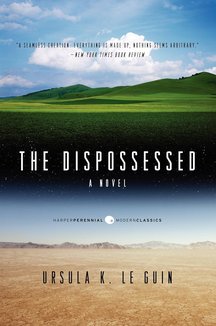
The Dispossessed: A Novel (Hainish Cycle)
Authors:
Ursula K. Le Guin,
Karen Joy Fowler
One of The Atlantic ’s Great American Novels “One of the greats. .
One of The Atlantic ’s Great American Novels “One of the greats. . . . Not just a science fiction writer; a literary icon.” — Stephen King “Engrossing . . . Ursula Le Guin is more than just a writer of adult fantasy and science fiction . . . she is a philosopher; an explorer in the landscapes of the mind.” — Cincinnati Enquirer Ursula K. Le Guin’s Hugo, Locus, and Nebula Award–winning classic, a profound and thoughtful tale of anarchism and capitalism, individualism and collectivism, and one ambitious man’s quest to bridge the ideological chasm separating two worlds. The Dispossessed is the spellbinding story of anarchist Shevek, the “galactically famous scientist,” who single-handedly attempts to reunite two planets cut off from each other by centuries of distrust. Anarres, Shevek’s homeland, is a bleak moon settled by an anarchic utopian civilization, where there is no government, and everyone, at least nominally, is a revolutionary. It has long been isolated from other worlds, including its mother planet, Urras—defined by warring nations, great poverty, and immense wealth. Now Shevek, a brilliant physicist, is determined to unify the two civilizations. In the face of great hostility, outright threats, and the pain of separation from his family, he makes an unprecedented trip to Urras. Greater than any concern for his own wellbeing is the belief that the walls of hatred, distrust, and philosophic division between his planet and the rest of the civilized universe must be torn down. He will seek answers, question the unquestionable, and explore differences in customs and cultures, determined to tear down the walls of hatred that have kept them apart. To visit Urras—to learn, to teach, to share—will require great sacrifice and risks, which Shevek willingly accepts. Almost immediately upon his arrival, he finds not the egotistical philistines he expected, but an intelligent, complex people who warmly welcome him. But soon the ambitious scientist and his gift is seen as a threat, and in the profound conflict that ensues, he must reexamine his beliefs even as he ignites the fires of change.
Find this book on:

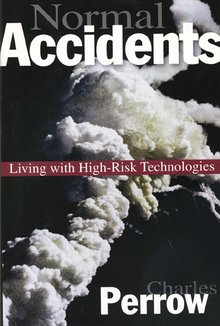
Normal Accidents: Living with High-Risk Technologies
Author:
Charles Perrow
Normal Accidents analyzes the social side of technological risk. Charles Perrow argues that the conventional engineering approach to ensuring safety--building in more warnings and safeguards--fails because systems complexity makes failures inevitable.
Normal Accidents analyzes the social side of technological risk. Charles Perrow argues that the conventional engineering approach to ensuring safety--building in more warnings and safeguards--fails because systems complexity makes failures inevitable. He asserts that typical precautions, by adding to complexity, may help create new categories of accidents. (At Chernobyl, tests of a new safety system helped produce the meltdown and subsequent fire.) By recognizing two dimensions of risk--complex versus linear interactions, and tight versus loose coupling--this book provides a powerful framework for analyzing risks and the organizations that insist we run them. The first edition fulfilled one reviewer's prediction that it "may mark the beginning of accident research." In the new afterword to this edition Perrow reviews the extensive work on the major accidents of the last fifteen years, including Bhopal, Chernobyl, and the Challenger disaster. The new postscript probes what the author considers to be the "quintessential 'Normal Accident'" of our time: the Y2K computer problem.
Find this book on:

Episode overview
As my colleague Ben Smith wrote in an August profile, sociologist Zeynep Tufekci has “made a habit of being right on the big things.” She saw the threat of the coronavirus early and clearly. She saw that the public health community was ignoring the evidence on masking, and raised the alarm persuasively enough that she tipped the Centers for Disease Control and Prevention toward new, lifesaving guidance. Before Tufekci was being prescient about the coronavirus, she was being prescient about disinformation online, about the way social media was changing political organizing, about what election forecasting models could actually tell us, about the rising threat of authoritarianism in America.
Tufekci attributes this track record to “systems thinking,” which she believes holds the key to forming a more accurate understanding of everything from pandemics to social media to the Republican Party. So I asked Tufekci to come on a podcast for a conversation about how she thinks, and what the rest of us can learn from it.
In answering those questions, we discuss why public health experts were slow to change guidance on disruptive measures like masking and travel bans, the logic of authoritarian regimes, why Asian countries so decisively outperformed Western Europe and America in containing coronavirus, why Tufekci thinks media coverage of the vaccines is too pessimistic, the crisis of American democracy, whether a more competent demagogue will succeed Donald Trump, and much more.
Mentioned in this episode:
“How Zeynep Tufekci Keeps Getting the Big Things Right” by Ben Smith
“Why Telling People They Don’t Need Masks Backfired” by Zeynep Tufekci
“Can We Do Twice as Many Vaccinations as We Thought?” by Zeynep Tufekci and Michael Mina
“America’s Next Authoritarian Will Be Much More Competent” by Zeynep Tufekci