
From this episode
Recommended books
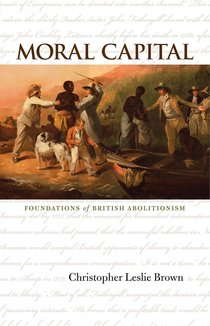
Moral Capital: Foundations of British Abolitionism (Published for the Omohundro Institute of Early American History and Culture)
Author:
Christopher Leslie Brown
Revisiting the origins of the British antislavery movement of the late eighteenth century, Christopher Leslie Brown challenges prevailing scholarly arguments that locate the roots of abolitionism in economic determinism or bourgeois humanitarianism. Brown instead connects the shift from sentiment to action to changing views of empire and nation in Britain at the time, particularly the anxieties and dislocations spurred by the American Revolution.
Revisiting the origins of the British antislavery movement of the late eighteenth century, Christopher Leslie Brown challenges prevailing scholarly arguments that locate the roots of abolitionism in economic determinism or bourgeois humanitarianism. Brown instead connects the shift from sentiment to action to changing views of empire and nation in Britain at the time, particularly the anxieties and dislocations spurred by the American Revolution. The debate over the political rights of the North American colonies pushed slavery to the fore, Brown argues, giving antislavery organizing the moral legitimacy in Britain it had never had before. The first emancipation schemes were dependent on efforts to strengthen the role of the imperial state in an era of weakening overseas authority. By looking at the initial public contest over slavery, Brown connects disparate strands of the British Atlantic world and brings into focus shifting developments in British identity, attitudes toward Africa, definitions of imperial mission, the rise of Anglican evangelicalism, and Quaker activism. Demonstrating how challenges to the slave system could serve as a mark of virtue rather than evidence of eccentricity, Brown shows that the abolitionist movement derived its power from a profound yearning for moral worth in the aftermath of defeat and American independence. Thus abolitionism proved to be a cause for the abolitionists themselves as much as for enslaved Africans.
Find this book on:


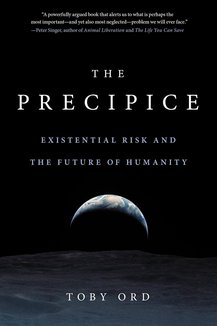
Precipice
Author:
Toby Ord
This urgent and eye-opening book makes the case that protecting humanity's future is the central challenge of our time. If all goes well, human history is just beginning.
This urgent and eye-opening book makes the case that protecting humanity's future is the central challenge of our time. If all goes well, human history is just beginning. Our species could survive for billions of years - enough time to end disease, poverty, and injustice, and to flourish in ways unimaginable today. But this vast future is at risk. With the advent of nuclear weapons, humanity entered a new age, where we face existential catastrophes - those from which we could never come back. Since then, these dangers have only multiplied, from climate change to engineered pathogens and artificial intelligence. If we do not act fast to reach a place of safety, it will soon be too late. Drawing on over a decade of research, The Precipice explores the cutting-edge science behind the risks we face. It puts them in the context of the greater story of humanity: showing how ending these risks is among the most pressing moral issues of our time. And it points the way forward, to the actions and strategies that can safeguard humanity. An Oxford philosopher committed to putting ideas into action, Toby Ord has advised the US National Intelligence Council, the UK Prime Minister's Office, and the World Bank on the biggest questions facing humanity. In The Precipice , he offers a startling reassessment of human history, the future we are failing to protect, and the steps we must take to ensure that our generation is not the last. "A book that seems made for the present moment." — N ew Yorker
Find this book on:
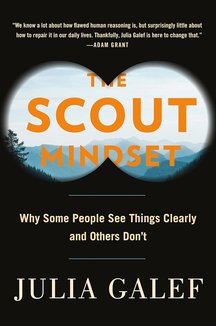
The Scout Mindset: Why Some People See Things Clearly and Others Don't
Author:
Julia Galef
"...an engaging and enlightening account from which we all can benefit."— The Wall Street Journal A better way to combat knee-jerk biases and make smarter decisions, from Julia Galef, the acclaimed expert on rational decision-making. When it comes to what we believe, humans see what they want to see.
"...an engaging and enlightening account from which we all can benefit."— The Wall Street Journal A better way to combat knee-jerk biases and make smarter decisions, from Julia Galef, the acclaimed expert on rational decision-making. When it comes to what we believe, humans see what they want to see. In other words, we have what Julia Galef calls a "soldier" mindset. From tribalism and wishful thinking, to rationalizing in our personal lives and everything in between, we are driven to defend the ideas we most want to believe—and shoot down those we don't. But if we want to get things right more often, argues Galef, we should train ourselves to have a "scout" mindset. Unlike the soldier, a scout's goal isn't to defend one side over the other. It's to go out, survey the territory, and come back with as accurate a map as possible. Regardless of what they hope to be the case, above all, the scout wants to know what's actually true. In The Scout Mindset , Galef shows that what makes scouts better at getting things right isn't that they're smarter or more knowledgeable than everyone else. It's a handful of emotional skills, habits, and ways of looking at the world—which anyone can learn. With fascinating examples ranging from how to survive being stranded in the middle of the ocean, to how Jeff Bezos avoids overconfidence, to how superforecasters outperform CIA operatives, to Reddit threads and modern partisan politics, Galef explores why our brains deceive us and what we can do to change the way we think.
Find this book on:
Episode overview
Today’s show is built around three simple sentences: “Future people count. There could be a lot of them. And we can make their lives better.” Those sentences form the foundation of an ethical framework known as “longtermism.” They might sound obvious, but to take them seriously is a truly radical endeavor — one with the power to change the world and even your life.
That second sentence is where things start to get wild. It’s possible that there could be tens of trillions of future people, that future people could outnumber current people by a ratio of something like a million to one. And if that’s the case, then suddenly most of the things we spend most of our time arguing about shrink in importance compared with the things that will affect humanity’s long-term future.
William MacAskill is a professor of philosophy at Oxford University, the director of the Forethought Foundation for Global Priorities Research and the author of the forthcoming book, “What We Owe the Future,” which is the best distillation of the longtermist worldview I’ve read. So this is a conversation about what it means to take the moral weight of the future seriously and the way that everything — from our political priorities to career choices to definitions of heroism — changes when you do.
We also cover the host of questions that longtermism raises: How should we weigh the concerns of future generations against those of living people? What are we doing today that future generations will view in the same way we look back on moral atrocities like slavery?Who are the “moral weirdos” of our time we should be paying more attention to? What are the areas we should focus on, the policies we should push, the careers we should choose if we want to guarantee a better future for our posterity?
And much more.