
From this episode
Recommended books
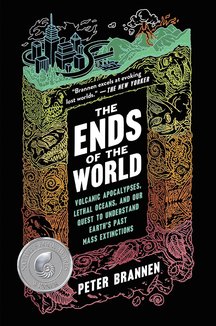
One of Vox’s Most Important Books of the Decade New York Times Editors' Choice 2017 Forbes Top 10 Best Environment, Climate, and Conservation Book of 2017 As new groundbreaking research suggests that climate change played a major role in the most extreme catastrophes in the planet's history, award-winning science journalist Peter Brannen takes us on a wild ride through the planet's five mass extinctions and, in the process, offers us a glimpse of our increasingly dangerous future Our world has ended five times: it has been broiled, frozen, poison-gassed, smothered, and pelted by asteroids. In The Ends of the World , Peter Brannen dives into deep time, exploring Earth’s past dead ends, and in the process, offers us a glimpse of our possible future.
One of Vox’s Most Important Books of the Decade New York Times Editors' Choice 2017 Forbes Top 10 Best Environment, Climate, and Conservation Book of 2017 As new groundbreaking research suggests that climate change played a major role in the most extreme catastrophes in the planet's history, award-winning science journalist Peter Brannen takes us on a wild ride through the planet's five mass extinctions and, in the process, offers us a glimpse of our increasingly dangerous future Our world has ended five times: it has been broiled, frozen, poison-gassed, smothered, and pelted by asteroids. In The Ends of the World , Peter Brannen dives into deep time, exploring Earth’s past dead ends, and in the process, offers us a glimpse of our possible future. Many scientists now believe that the climate shifts of the twenty-first century have analogs in these five extinctions. Using the visible clues these devastations have left behind in the fossil record, The Ends of the World takes us inside “scenes of the crime,” from South Africa to the New York Palisades, to tell the story of each extinction. Brannen examines the fossil record—which is rife with creatures like dragonflies the size of sea gulls and guillotine-mouthed fish—and introduces us to the researchers on the front lines who, using the forensic tools of modern science, are piecing together what really happened at the crime scenes of the Earth’s biggest whodunits. Part road trip, part history, and part cautionary tale, The Ends of the World takes us on a tour of the ways that our planet has clawed itself back from the grave, and casts our future in a completely new light.
Find this book on:


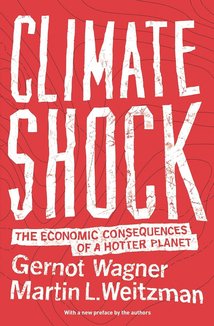
Climate Shock: The Economic Consequences of a Hotter Planet
Authors:
Gernot Wagner,
Martin L. Weitzman
How knowing the extreme risks of climate change can help us prepare for an uncertain future If you had a 10 percent chance of having a fatal car accident, you'd take necessary precautions. If your finances had a 10 percent chance of suffering a severe loss, you'd reevaluate your assets.
How knowing the extreme risks of climate change can help us prepare for an uncertain future If you had a 10 percent chance of having a fatal car accident, you'd take necessary precautions. If your finances had a 10 percent chance of suffering a severe loss, you'd reevaluate your assets. So if we know the world is warming and there's a 10 percent chance this might eventually lead to a catastrophe beyond anything we could imagine, why aren't we doing more about climate change right now? We insure our lives against an uncertain future―why not our planet? In Climate Shock , Gernot Wagner and Martin Weitzman explore in lively, clear terms the likely repercussions of a hotter planet, drawing on and expanding from work previously unavailable to general audiences. They show that the longer we wait to act, the more likely an extreme event will happen. A city might go underwater. A rogue nation might shoot particles into the Earth's atmosphere, geoengineering cooler temperatures. Zeroing in on the unknown extreme risks that may yet dwarf all else, the authors look at how economic forces that make sensible climate policies difficult to enact, make radical would-be fixes like geoengineering all the more probable. What we know about climate change is alarming enough. What we don't know about the extreme risks could be far more dangerous. Wagner and Weitzman help readers understand that we need to think about climate change in the same way that we think about insurance―as a risk management problem, only here on a global scale. With a new preface addressing recent developments Wagner and Weitzman demonstrate that climate change can and should be dealt with―and what could happen if we don't do so―tackling the defining environmental and public policy issue of our time.
Find this book on:
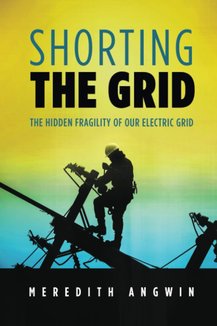
Shorting the Grid: The Hidden Fragility of Our Electric Grid
Author:
Meredith Angwin
When rolling blackouts come to the electric grid, they will be old news to the grid insiders. Only the electricity customers will be surprised.
When rolling blackouts come to the electric grid, they will be old news to the grid insiders. Only the electricity customers will be surprised. Grid insiders know how fragile the grid is becoming. Unfortunately, they have no incentive to solve the problems because near-misses increase their profits. Meredith Angwin describes how closed meetings, arcane auction rules, and five-minute planning horizons will topple the reliability of our electric grid. Shorting the Grid shines light on our vulnerable grid. It also suggests actions that can support the grid that supports all of us.
Find this book on:
Episode overview
The Inflation Reduction Act was the largest piece of climate legislation ever passed in the United States, setting aside hundreds of billions of dollars for decarbonizing the economy. But the money was always just a first step. The fate of the act’s goals hinges on whether those investments can build the energy system of the future — everything from transmission lines and wind farms to electric vehicle factories and green hydrogen hubs.
It’s now been almost a year since the I.R.A.’s passage. So, how’s it going? Are we on track for a decarbonized economy?
Robinson Meyer is a contributing writer to Times Opinion and the founding executive editor of Heatmap, a new publication covering the ins-and-outs of decarbonization in America. We discuss why estimates of the I.R.A.’s investments vary so drastically, whether the Biden administration is being too timid in how it gives out the money, the collision between the investments we need to decarbonize and the laws intended to protect the environment, why permitting has proved to be such a debilitating obstacle, why red states are projected to attract almost double the I.R.A. investments compared to blue states (and how that could pose a thorny political problem for the Biden administration), whether the country can decarbonize while competing with China and much more.