From this episode
Recommended books
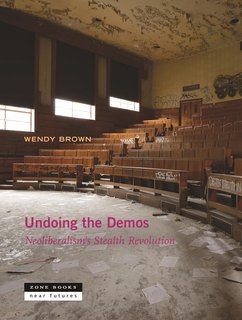
Undoing the Demos: Neoliberalism’s Stealth Revolution (Near Future Series)
Author:
Wendy Brown
Neoliberal rationality ― ubiquitous today in statecraft and the workplace, in jurisprudence, education, and culture ― remakes everything and everyone in the image of homo oeconomicus . What happens when this rationality transposes the constituent elements of democracy into an economic register?
Neoliberal rationality ― ubiquitous today in statecraft and the workplace, in jurisprudence, education, and culture ― remakes everything and everyone in the image of homo oeconomicus . What happens when this rationality transposes the constituent elements of democracy into an economic register? In vivid detail, Wendy Brown explains how democracy itself is imperiled. The demos disintegrates into bits of human capital; concerns with justice cede to the mandates of growth rates, credit ratings, and investment climates; liberty submits to the imperative of human capital appreciation; equality dissolves into market competition; and popular sovereignty grows incoherent. Liberal democratic practices may not survive these transformations. Radical democratic dreams may not either. In an original and compelling theoretical argument, Brown explains how and why neoliberal reason undoes the political form and political imaginary it falsely promises to secure and reinvigorate. Through meticulous analyses of neoliberalized law, political practices, governance, and education, she charts the new common sense. Undoing the Demos makes clear that, far from being the lodestar of the twenty-first century, a future for democracy depends upon it becoming an object of struggle and rethinking.
Find this book on:


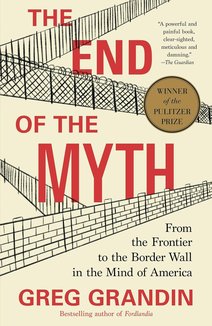
The End of the Myth: From the Frontier to the Border Wall in the Mind of America
Author:
Greg Grandin
WINNER OF THE PULITZER PRIZE A new and eye-opening interpretation of the meaning of the frontier, from early westward expansion to Trump’s border wall. Ever since this nation’s inception, the idea of an open and ever-expanding frontier has been central to American identity.
WINNER OF THE PULITZER PRIZE A new and eye-opening interpretation of the meaning of the frontier, from early westward expansion to Trump’s border wall. Ever since this nation’s inception, the idea of an open and ever-expanding frontier has been central to American identity. Symbolizing a future of endless promise, it was the foundation of the United States’ belief in itself as an exceptional nation – democratic, individualistic, forward-looking. Today, though, America hasa new symbol: the border wall. In The End of the Myth , acclaimed historian Greg Grandin explores the meaning of the frontier throughout the full sweep of U.S. history – from the American Revolution to the War of 1898, the New Deal to the election of 2016. For centuries, he shows, America’s constant expansion – fighting wars and opening markets – served as a “gate of escape,” helping to deflect domestic political and economic conflicts outward. But this deflection meant that the country’s problems, from racism to inequality, were never confronted directly. And now, the combined catastrophe of the 2008 financial meltdown and our unwinnable wars in the Middle East have slammed this gate shut, bringing political passions that had long been directed elsewhere back home. It is this new reality, Grandin says, that explains the rise of reactionary populism and racist nationalism, the extreme anger and polarization that catapulted Trump to the presidency. The border wall may or may not be built, but it will survive as a rallying point, an allegorical tombstone marking the end of American exceptionalism.
Find this book on:

Difference without Domination: Pursuing Justice in Diverse Democracies
Authors:
Danielle Allen,
Rohini Somanathan
Around the globe, democracy appears broken. With political and socioeconomic inequality on the rise, we are faced with the urgent question of how to better distribute power, opportunity, and wealth in diverse modern societies.
Around the globe, democracy appears broken. With political and socioeconomic inequality on the rise, we are faced with the urgent question of how to better distribute power, opportunity, and wealth in diverse modern societies. This volume confronts the dilemma head-on, exploring new ways to combat current social hierarchies of domination. Using examples from the United States, India, Germany, and Cameroon, the contributors offer paradigm-changing approaches to the concepts of justice, identity, and social groups while also taking a fresh look at the idea that the demographic make-up of institutions should mirror the make-up of a populace as a whole. After laying out the conceptual framework, the volume turns to a number of provocative topics, among them the pernicious tenacity of implicit bias, the logical contradictions inherent to the idea of universal human dignity, and the paradoxes and problems surrounding affirmative action. A stimulating blend of empirical and interpretive analyses, Difference without Domination urges us to reconsider the idea of representation and to challenge what it means to measure equality and inequality.
Find this book on:
Episode overview
President Biden’s economic policy isn’t what you would have expected from his long career. That’s true in the legislation he’s backing, which is bigger and bolder than anything we’ve seen from him before, but it’s even truer in the appointments he’s making and the theories he’s embracing. On everything from antitrust to inflation to employment to power, Biden is reflecting a new strain of progressive economics thoughts — one that wants to direct markets, not just correct them.
Felicia Wong is the chief executive of the Roosevelt Institute, one of the think tanks that’s been central to building the new progressive economics that Biden has picked up. She joined me for a conversation on Biden’s theory of the economy, how antitrust thinking has changed, whether Jerome Powell should be reappointed chair of the Federal Reserve, whether progressives need to reckon with Amazon’s wild popularity, what kind of inflation problem we have and much more.