
From this episode
Recommended books

Christie Malry's Own Double-Entry
Author:
B.S. Johnson
A disaffected young man, Christie Malry, is a simple man who learns the principles of double-entry book-keeping while taking an evening class in accountancy and working in the local bank. He begins to apply these principles to his own life, revenging himself against society in an increasingly violent manner for perceived 'debits'.
A disaffected young man, Christie Malry, is a simple man who learns the principles of double-entry book-keeping while taking an evening class in accountancy and working in the local bank. He begins to apply these principles to his own life, revenging himself against society in an increasingly violent manner for perceived 'debits'. Debit: the unpleasantness of the bank manager is the first on an ever-growing list; Credit: scratching the façade of the office block. All accounts are settled in the most alarming way. Christie Malry is a simple person. Born into a family without money, he realised early along in the game that the best way to come by money was to place himself next to it. So he took a job as a very junior bank clerk in a very stuffy bank. It was at the bank that Christie discovered the principles of double-entry book keeping, from which he evolved his Great Idea. For every offence Christy henceforth received at the hands of a society with which he was clearly out of step, a debit must be noted; after which, society would have to be paid back appropriately, so that the paper credit would accrue to Christy's account. Now made into a film starring Nick Moran of Lock, Stock and Two Smoking Barrels fame. Acerbic yet funny, this is a novel which, even as it provokes laughter, will alarm and disturb as well.
Find this book on:


Madame de Pompadour (New York Review Books Classics)
Authors:
Nancy Mitford,
Amanda Foreman
When Madame de Pompadour became the mistress of Louis XV, no one expected her to retain his affections for long. A member of the bourgeoisie rather than an aristocrat, she was physically too cold for the carnal Bourbon king, and had so many enemies that she could not travel publicly without risking a pelting of mud and stones.
When Madame de Pompadour became the mistress of Louis XV, no one expected her to retain his affections for long. A member of the bourgeoisie rather than an aristocrat, she was physically too cold for the carnal Bourbon king, and had so many enemies that she could not travel publicly without risking a pelting of mud and stones. History has loved her little better.Nancy Mitford's delightfully candid biography re-creates the spirit of eighteenth-century Versailles with its love of pleasure and treachery. We learn that the Queen was a "bore," the Dauphin a "prig," and see France increasingly overcome with class conflict. With a fiction writer's felicity, Mitford restores the royal mistress and celebrates her as a survivor, unsurpassed in "the art of living," who reigned as the most powerful woman in France for nearly twenty years.
Find this book on:
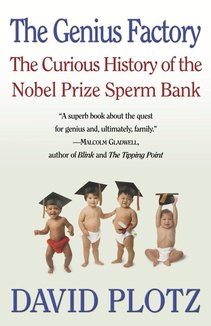
The Genius Factory: The Curious History of the Nobel Prize Sperm Bank
Author:
David Plotz
From the former editor of Slate and CEO of Atlas Obscura comes the unbelievable story of “the Nobel Prize sperm bank” and the children it produced—“a superb book about the quest for genius and, ultimately, family” (Malcolm Gladwell, author of The Tipping Point and Talking to Strangers ). NAMED ONE OF THE BEST BOOKS OF THE YEAR BY ROCKY MOUNTAIN NEWS It was the most radical human-breeding experiment in American history.
From the former editor of Slate and CEO of Atlas Obscura comes the unbelievable story of “the Nobel Prize sperm bank” and the children it produced—“a superb book about the quest for genius and, ultimately, family” (Malcolm Gladwell, author of The Tipping Point and Talking to Strangers ). NAMED ONE OF THE BEST BOOKS OF THE YEAR BY ROCKY MOUNTAIN NEWS It was the most radical human-breeding experiment in American history. The Repository for Germinal Choice—nicknamed “the Nobel Prize sperm bank”—opened to notorious fanfare in 1980, and for two decades women flocked to it from all over the country to choose a sperm donor from its roster of Nobel-laureate scientists, mathematical prodigies, successful businessmen, and star athletes. But the bank quietly closed its doors in 1999—its founder dead, its confidential records sealed, and the fate of its children and donors unknown. Crisscrossing the country and tracking down previously unknown family members, award-winning Slate columnist David Plotz unfolds the full and astonishing story of the Nobel Prize sperm bank and its founder’s radical scheme to change our world. Praise for The Genius Factory “[David] Plotz’s wonderful history of the Nobel sperm bank is filled with wit, pathos and insight. . . . [He acts] as narrator, ethnographer, historian, social critic and even go-between, brokering reunions between children and their genitors.” — Chicago Tribune “Perfectly pitched—blithe, smart, skeptical, yet entranced by its subject.” — The New York Times “By turns personal, confounding, creepy, defiant of expectations and touching . . . The Genius Factory isn’t merely curious, it’s useful.” — San Francisco Chronicle “Tense, hilarious, and touching . . . wonderfully readable and eye-opening.” — The Wall Street Journal “Terrific . . . [a] lively account.” — The Washington Post Book World
Find this book on:
Episode overview
A new masculinist movement has gone mainstream on the right.
The prominent voices in this movement yearn for an earlier time, when men were men and women were women. Sometimes that time seems to be the 1950s, like when Tucker Carlson extols a world where men go to work and women stay at home. But sometimes it goes way farther back. The pastor Doug Wilson advocates household voting, in which men vote for their wives. And Costin Vlad Alamariu, better known as Bronze Age Pervert, harks back to the Bronze Age — specifically the ancient Hittite and Mitanni Empires.
Helen Lewis wrote a recent cover story for The Atlantic about this new antifeminist backlash, which she calls “the single most important force holding together the American right.” So I wanted to have her on the show to talk about these ideas, the political program of this movement and how seriously we should take it.
Lewis is a staff writer at The Atlantic and the author of “Difficult Women: A History of Feminism in 11 Fights” and “The Genius Myth.”
This episode contains strong language.