
From this episode
Recommended books
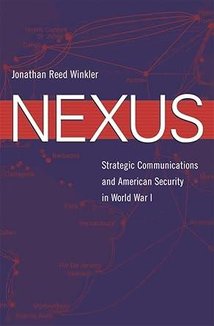
Nexus: Strategic Communications and American Security in World War I (Harvard Historical Studies)
Author:
Jonathan Reed Winkler
In an illuminating study that blends diplomatic, military, technology, and business history, Jonathan Reed Winkler shows how U.S. officials during World War I discovered the enormous value of global communications.
In an illuminating study that blends diplomatic, military, technology, and business history, Jonathan Reed Winkler shows how U.S. officials during World War I discovered the enormous value of global communications. At the outbreak of war in 1914, British control of the cable network affected the Americans’ ability to communicate internationally, and the development of radio worried the Navy about hemispheric security. The benefits of a U.S. network became evident during the war, especially in the gathering of intelligence. This led to the creation of a peacetime intelligence operation, later termed the “Black Chamber,” that was the forerunner of the National Security Agency. After the war, U.S. companies worked to expand network service around the world but faced industrial limitations. Focused on security concerns, the Wilson administration objected to any collaboration with British companies that might alleviate this problem. Indeed, they went so far as to create a radio monopoly and use warships to block the landing of a cable at Miami. These efforts set important precedents for later developments in telephony, shortwave radio, satellites―even the internet. In this absorbing history, Winkler sheds light on the early stages of the global infrastructure that helped launch the United States as the predominant power of the century.
Find this book on:


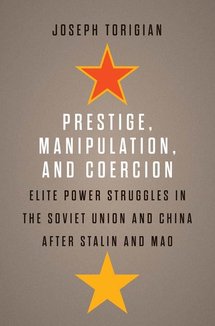
How succession in authoritarian regimes was less a competition of visions for the future and more a settling of scores “Joseph Torigian’s stellar research and personal interviews have produced a brilliant, meticulous study. It fundamentally undermines what political scientists have presumed to be the way Chinese Communist and Soviet politics operate.”—Dorothy J.
How succession in authoritarian regimes was less a competition of visions for the future and more a settling of scores “Joseph Torigian’s stellar research and personal interviews have produced a brilliant, meticulous study. It fundamentally undermines what political scientists have presumed to be the way Chinese Communist and Soviet politics operate.”—Dorothy J. Solinger, University of California, Irvine “[Torigian’s] work is absolutely outstanding.”—Stephen Kotkin, ChinaTalk The political successions in the Soviet Union and China after Stalin and Mao, respectively, are often explained as triumphs of inner-party democracy, leading to a victory of “reformers” over “conservatives” or “radicals.” In traditional thinking, Leninist institutions provide competitors a mechanism for debating policy and making promises, stipulate rules for leadership selection, and prevent the military and secret police from playing a coercive role. Here, Joseph Torigian argues that the post-cult of personality power struggles in history’s two greatest Leninist regimes were instead shaped by the politics of personal prestige, historical antagonisms, backhanded political maneuvering, and violence. Mining newly discovered material from Russia and China, Torigian challenges the established historiography and suggests a new way of thinking about the nature of power in authoritarian regimes.
Find this book on:
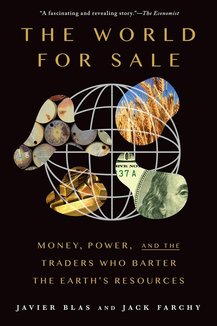
The World for Sale: Money, Power, and the Traders Who Barter the Earth's Resources
Authors:
Javier Blas,
Jack Farchy
Shortlisted for the Financial Times & McKinsey Business Book of the Year Award An Economist Book of the Year The modern world is built on commodities - from the oil that fuels our cars to the metals that power our smartphones. We rarely stop to consider where they have come from.
Shortlisted for the Financial Times & McKinsey Business Book of the Year Award An Economist Book of the Year The modern world is built on commodities - from the oil that fuels our cars to the metals that power our smartphones. We rarely stop to consider where they have come from. But we should. The World for Sale lifts the lid on one of the least scrutinized corners of the world economy: the billionaire commodity traders who buy, hoard, and sell the earth's resources. It is the story of how a handful of swashbuckling businessmen became indispensable cogs in global markets, enabling an enormous expansion in international trade and connecting resource-rich countries - no matter how corrupt or war-torn - with the world's financial centers. The result is an eye-opening tour through the wildest frontiers of the global economy, as well as a revelatory guide to how capitalism really works.
Find this book on:
Episode overview
“We rarely think about chips, yet they’ve created the modern world,” writes the historian Chris Miller.
He’s not exaggerating. Semiconductors don’t just power our phones and computers; they also enable our cars, planes and home appliances to function. They are essential to everything from developing advanced military equipment to training artificial intelligence systems. Chips are the foundation of modern economic prosperity, military strength and geopolitical power.
But semiconductors are also part of one of the most concentrated supply chains of any technology today. One Taiwanese company, TSMC, produces 90 percent of the most advanced chips. A single Dutch firm, ASML, produces all of the world’s EUV lithography machines, which are essential to produce leading-edge chips. The entire industry is built like this.
That doesn’t just make the chip supply chain vulnerable to external shocks; it also makes it easily weaponizable by the powers that control it. In October, the Biden administration banned exports of advanced chips — and the equipment needed to produce those chips — to China. In August, President Biden signed into law the bipartisan CHIPS and Science Act, which includes a $52 billion investment to on-shore U.S. chip manufacturing. China has invested tens of billions of dollars over the past decade to build a domestic semiconductor industry of its own. Chips have become to the geopolitics of the 21st century what oil was to the geopolitics of the 20th.
There is no better or more timely explanation of the semiconductor industry — and the geopolitics that have formed around them — than Miller’s new book, “Chip War: The Fight for the World’s Most Critical Technology.” So I asked him on the show to talk me through what semiconductors are, why they matter and how they are shaping everything from U.S.-China relations and the Russia-Ukraine war to the Biden policy agenda and the future of A.I.