
From this episode
Recommended books
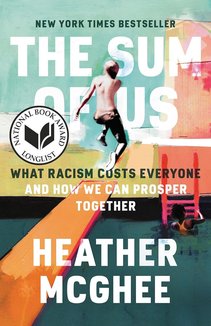
The Sum of Us: What Racism Costs Everyone and How We Can Prosper Together
Author:
Heather McGhee
NEW YORK TIMES BESTSELLER • LONGLISTED FOR THE NATIONAL BOOK AWARD • One of today’s most insightful and influential thinkers offers a powerful exploration of inequality and the lesson that generations of Americans have failed to learn: Racism has a cost for everyone—not just for people of color. WINNER OF THE PORCHLIGHT BUSINESS BOOK AWARD • ONE OF THE BEST BOOKS OF THE YEAR: Time, The Washington Post, St.
NEW YORK TIMES BESTSELLER • LONGLISTED FOR THE NATIONAL BOOK AWARD • One of today’s most insightful and influential thinkers offers a powerful exploration of inequality and the lesson that generations of Americans have failed to learn: Racism has a cost for everyone—not just for people of color. WINNER OF THE PORCHLIGHT BUSINESS BOOK AWARD • ONE OF THE BEST BOOKS OF THE YEAR: Time, The Washington Post, St. Louis Post-Dispatch, Ms. magazine, BookRiot , Library Journal “This is the book I’ve been waiting for.”—Ibram X. Kendi, #1 New York Times bestselling author of How to Be an Antiracist Look for the author’s podcast, The Sum of Us, based on this book! Heather McGhee’s specialty is the American economy—and the mystery of why it so often fails the American public. From the financial crisis of 2008 to rising student debt to collapsing public infrastructure, she found a root problem: racism in our politics and policymaking. But not just in the most obvious indignities for people of color. Racism has costs for white people, too. It is the common denominator of our most vexing public problems, the core dysfunction of our democracy and constitutive of the spiritual and moral crises that grip us all. But how did this happen? And is there a way out? McGhee embarks on a deeply personal journey across the country from Maine to Mississippi to California, tallying what we lose when we buy into the zero-sum paradigm—the idea that progress for some of us must come at the expense of others. Along the way, she meets white people who confide in her about losing their homes, their dreams, and their shot at better jobs to the toxic mix of American racism and greed. This is the story of how public goods in this country—from parks and pools to functioning schools—have become private luxuries; of how unions collapsed, wages stagnated, and inequality increased; and of how this country, unique among the world’s advanced economies, has thwarted universal healthcare. But in unlikely places of worship and work, McGhee finds proof of what she calls the Solidarity Dividend: the benefits we gain when people come together across race to accomplish what we simply can’t do on our own. The Sum of Us is not only a brilliant analysis of how we arrived here but also a heartfelt message, delivered with startling empathy, from a black woman to a multiracial America. It leaves us with a new vision for a future in which we finally realize that life can be more than a zero-sum game. LONGLISTED FOR THE ANDREW CARNEGIE MEDAL
Find this book on:


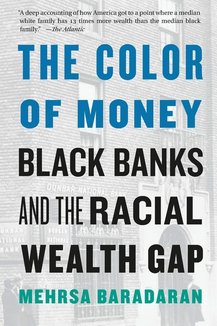
The Color of Money: Black Banks and the Racial Wealth Gap
Author:
Mehrsa Baradaran
“Read this book. It explains so much about the moment…Beautiful, heartbreaking work.” ―Ta-Nehisi Coates “A deep accounting of how America got to a point where a median white family has 13 times more wealth than the median black family.” ― The Atlantic “Extraordinary…Baradaran focuses on a part of the American story that’s often ignored: the way African Americans were locked out of the financial engines that create wealth in America.” ―Ezra Klein When the Emancipation Proclamation was signed in 1863, the black community owned less than 1 percent of the total wealth in America.
“Read this book. It explains so much about the moment…Beautiful, heartbreaking work.” ―Ta-Nehisi Coates “A deep accounting of how America got to a point where a median white family has 13 times more wealth than the median black family.” ― The Atlantic “Extraordinary…Baradaran focuses on a part of the American story that’s often ignored: the way African Americans were locked out of the financial engines that create wealth in America.” ―Ezra Klein When the Emancipation Proclamation was signed in 1863, the black community owned less than 1 percent of the total wealth in America. More than 150 years later, that number has barely budged. The Color of Money seeks to explain the stubborn persistence of this racial wealth gap by focusing on the generators of wealth in the black community: black banks. With the civil rights movement in full swing, President Nixon promoted “black capitalism,” a plan to support black banks and minority-owned businesses. But the catch-22 of black banking is that the very institutions needed to help communities escape the deep poverty caused by discrimination and segregation inevitably became victims of that same poverty. In this timely and eye-opening account, Baradaran challenges the long-standing belief that black communities could ever really hope to accumulate wealth in a segregated economy. “Black capitalism has not improved the economic lives of black people, and Baradaran deftly explains the reasons why.” ― Los Angeles Review of Books “A must read for anyone interested in closing America’s racial wealth gap.” ― Black Perspectives
Find this book on:
Over seven million Americans are either incarcerated, on probation, or on parole, with their criminal records often following them for life and affecting access to higher education, jobs, and housing. Court-ordered monetary sanctions that compel criminal defendants to pay fines, fees, surcharges, and restitution further inhibit their ability to reenter society.
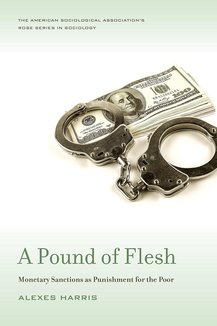
Over seven million Americans are either incarcerated, on probation, or on parole, with their criminal records often following them for life and affecting access to higher education, jobs, and housing. Court-ordered monetary sanctions that compel criminal defendants to pay fines, fees, surcharges, and restitution further inhibit their ability to reenter society. In A Pound of Flesh , sociologist Alexes Harris analyzes the rise of monetary sanctions in the criminal justice system and shows how they permanently penalize and marginalize the poor. She exposes the damaging effects of a little-understood component of criminal sentencing and shows how it further perpetuates racial and economic inequality. Harris draws from extensive sentencing data, legal documents, observations of court hearings, and interviews with defendants, judges, prosecutors, and other court officials. She documents how low-income defendants are affected by monetary sanctions, which include fees for public defenders and a variety of processing charges. Until these debts are paid in full, individuals remain under judicial supervision, subject to court summons, warrants, and jail stays. As a result of interest and surcharges that accumulate on unpaid financial penalties, these monetary sanctions often become insurmountable legal debts which many offenders carry for the remainder of their lives. Harris finds that such fiscal sentences, which are imposed disproportionately on low-income minorities, help create a permanent economic underclass and deepen social stratification. A Pound of Flesh delves into the court practices of five counties in Washington State to illustrate the ways in which subjective sentencing shapes the practice of monetary sanctions. Judges and court clerks hold a considerable degree of discretion in the sentencing and monitoring of monetary sanctions and rely on individual values—such as personal responsibility, meritocracy, and paternalism—to determine how much and when offenders should pay. Harris shows that monetary sanctions are imposed at different rates across jurisdictions, with little or no state government oversight. Local officials’ reliance on their own values and beliefs can also push offenders further into debt—for example, when judges charge defendants who lack the means to pay their fines with contempt of court and penalize them with additional fines or jail time. A Pound of Flesh provides a timely examination of how monetary sanctions permanently bind poor offenders to the judicial system. Harris concludes that in letting monetary sanctions go unchecked, we have created a two-tiered legal system that imposes additional burdens on already-marginalized groups.
Find this book on:
Episode overview
Public policy in the United States often overlooks wealth. We tend to design, debate and measure our economic policies with regard to income alone, which blinds us to the ways prosperity and precarity tangibly function in people’s lives. And that blind spot can ultimately prevent us from addressing social inequality at its roots.
Take the debate over student loan cancellation. Cancellation is often framed as an economically regressive policy — an elite giveaway of sorts — with the majority of benefits going to individuals toward the top end of the income distribution. But that distributive picture flips when you look at wealth instead of income. One recent paper found that if the federal government decided to forgive up to $50,000 in student loan debt, the average person in the 20th to 40th percentiles for household assets would receive more than four times as much debt cancellation as the average person in the top 10 percent.
Louise Seamster is a sociologist at the University of Iowa whose work focuses on the intersection of wealth, race, education and inequality. She’s one of the sharpest minds studying the way systems of wealth creation and depletion shape everything from the benefits of higher education to the barriers to racial equality to the nature of democratic citizenship. And her cutting-edge research on the student debt crisis and the racial wealth gap served as a major source of inspiration for Senator Elizabeth Warren’s $50,000 loan forgiveness plan.
This conversation begins with a discussion of the student debt crisis in particular: what it’s like to live with crushing levels of debt, the debate over whether cancellation is fair to those who have paid off their loans, why you can’t truly understand the student debt crisis without understanding the wealth dynamics that undergird it, how loan forgiveness would alter the racial wealth gap, what an entirely different model for funding higher education would look like and more.
But this discussion is also more broadly about what it means to think in terms of wealth — and its inverse, debt — and what a radically different picture that reveals about the American economy and society.