
From this episode
Recommended books
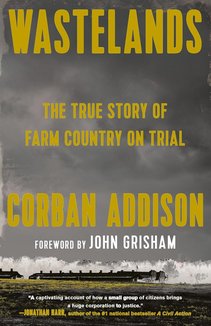
Wastelands: The True Story of Farm Country on Trial
Authors:
Corban Addison,
John Grisham
"Beautifully written, impeccably researched, and told with the air of suspense that few writers can handle, Wastelands is a story I wish I had written." —From the Foreword by John Grisham The once idyllic coastal plain of North Carolina is home to a close-knit, rural community that for more than a generation has battled the polluting practices of large-scale farming taking place in its own backyard. After years of frustration and futility, an impassioned cadre of local residents, led by a team of intrepid and dedicated lawyers, filed a lawsuit against one of the world’s most powerful companies—and, miraculously, they won.
"Beautifully written, impeccably researched, and told with the air of suspense that few writers can handle, Wastelands is a story I wish I had written." —From the Foreword by John Grisham The once idyllic coastal plain of North Carolina is home to a close-knit, rural community that for more than a generation has battled the polluting practices of large-scale farming taking place in its own backyard. After years of frustration and futility, an impassioned cadre of local residents, led by a team of intrepid and dedicated lawyers, filed a lawsuit against one of the world’s most powerful companies—and, miraculously, they won. As vivid and fast-paced as a thriller, Wastelands takes us into the heart of a legal battle over the future of America’s farmland and into the lives of the people who found the courage to fight. There is Elsie Herring, the most outspoken of the neighbors, who has endured racial slurs and the threat of a restraining order to tell the story of the waste raining down on her rooftop from the hog operation next door. There is Don Webb, a larger-than-life hog farmer turned grassroots crusader, and Rick Dove, a riverkeeper and erstwhile military judge who has pioneered the use of aerial photography to document the scale of the pollution. There is Woodell McGowan, a quiet man whose quest to redeem his family’s ancestral land encourages him to become a better neighbor, and Dr. Steve Wing, a groundbreaking epidemiologist whose work on the health effects of hog waste exposure translates the neighbors’ stories into the argot of science. And there is Tom Butler, an environmental savant and hog industry insider whose whistleblowing testimony electrifies the jury. Fighting alongside them in the courtroom is Mona Lisa Wallace, who broke the gender barrier in her small southern town and built a storied legal career out of vanquishing corporate giants, and Mike Kaeske, whose trial skills are second to none. With journalistic rigor and a novelist’s instinct for story, Corban Addison's Wastelands captures the inspiring struggle to bring a modern-day monopoly to its knees, to force a once-invincible corporation to change, and to preserve the rights—and restore the heritage—of a long-suffering community.
Find this book on:


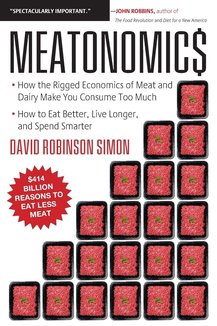
Stop Being Manipulated by the Animal Foods Industry Stop the meat industry from eating into your wallet. Few Americans are aware of the realities of the economic system that supports our country's supply of animal foods.
Stop Being Manipulated by the Animal Foods Industry Stop the meat industry from eating into your wallet. Few Americans are aware of the realities of the economic system that supports our country's supply of animal foods. Yet these forces affect us in ways we can hardly imagine. Though we only fork over a few dollars per pound of meat products at the grocery store, we end up paying much more than that in tax dollar-fueled government subsidies—$38 billion more, to be exact. And that's just one layer of hidden costs. But with the help of sustainability advocate and author David Robinson Simon's Meatonomics , we can come up with informed, lasting solutions. Improve your health, your life—and the world. Animal food producers influence our buying choices with artificially low prices, misleading messages, and heavy legislation and regulation control. But learning how these forces work can help you improve both your personal life and the world in so many important ways. Life-changing foods like those in a plant-based diet will do more than just improve your waistline. The information in Meatonomics can help you save money, lose weight, live longer, boost your health, protect animals and the planet from abuse, and preserve rural communities worldwide. Learn to make better, more informed decisions on what to buy and how to eat. In Meatonomics , Dr. David Robinson Simon uses his excellent truth-finding skills, garnered from his expertise as a lawyer, to show you: How government marketing is influencing what we think of as healthy eating Just how much of our money is being burnt through by the meat production industry What we can do to change ourselves and our country for the better If you were fascinated by sustainable food and healthy eating books like Proteinaholic , Eating Animals , or How Not to Die , you'll be empowered to overcome the meat industry's manipulation with Meatonomics .
Find this book on:
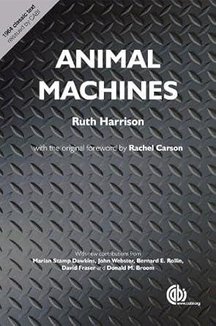
Animal Machines: The New Factory Farming Industry
Authors:
Ruth Harrison,
M. S. Dawkins
First published in 1964, Ruth Harrison's book Animal Machines had a profound and lasting impact on world agriculture, public opinion and the quality of life of millions of farmed animals. Concerned with welfare standards at a time when animal production was increasing in scale and mechanization, Ruth Harrison set about investigating the situation in a fair and even-handed way.
First published in 1964, Ruth Harrison's book Animal Machines had a profound and lasting impact on world agriculture, public opinion and the quality of life of millions of farmed animals. Concerned with welfare standards at a time when animal production was increasing in scale and mechanization, Ruth Harrison set about investigating the situation in a fair and even-handed way. Reporting her findings in this book, Harrison alerted the public to the undeniable suffering of calves living in veal crates and birds in battery cages. Written at the beginning of the intensive farming movement, which promised progress but in reality worsened conditions for domesticated animals, Animal Machines provides a fascinating insight into the system we are living with today and must continue with as the global population increases. Harrison's work brought about legal reforms, a greater understanding of farm conditions for animals and increased public awareness. Animal Machines is reprinted here in its entirety, accompanied by new chapters by world-renowned experts in animal welfare discussing the legacy and impact of Animal Machines 50 years on. These new essays are written by: Marian Stamp Dawkins, John Webster, Bernard E. Rollin, David Fraser and Donald M. Broom.
Find this book on:
Episode overview
About 50 years ago, beef cost more than $7 a pound in today’s dollars. Today, despite high inflation, beef is down to about $4.80 a pound, and chicken is just around $1.80 a pound. But those low prices hide the true costs of the meat we consume — costs that the meat and poultry industries have quietly offloaded onto not only the animals we consume but us humans, too.
Animal agriculture is responsible for at least 14.5 percent of total greenhouse gas emissions, with some estimates as high as 28 percent. It uses half the earth’s habitable land. Factory farms pose huge threats as potential sources of antibiotic resistance and future pandemics. And the current meat production system loads farmers with often insurmountable levels of debt. Our meat may look cheap at the grocery store, but we are all picking up the tab in ways we’re often starkly unaware of.
Leah Garcés is the chief executive and president of Mercy for Animals and the author of “Grilled: Turning Adversaries Into Allies to Change the Chicken Industry.” Few animal rights activists have her breadth of experience: For years, she’s been steeped in the experiences of farmers who raise animals, communities that live alongside industrial animal operations and, of course, the farmed animals that live shorter and more miserable lives. So I invited her on the show for a conversation about what meat really costs and how that perspective could help us build a healthier relationship to the animals we eat and the world we inhabit.
We discuss what it’s like to live next to a hog farm, factory farming’s role in growing antibiotic resistance, how the current system of contract farming saddles individual farmers with debt, the lengths the U.S. government — and taxpayers — goes to to subsidize industrial animal farming, the possibility that the next pandemic will emerge from a crowded factory farm, how high costs — like deforestation in the Amazon — are hidden from consumers at the grocery store, the challenge of helping children make sense of routinized cruelty, whether regenerative agriculture can help undo the damage done by industrial animal farming, the historic animal welfare case currently in front of the Supreme Court and more.