
From this episode
Recommended books
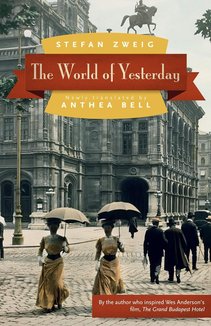
The World of Yesterday
Authors:
Stefan Zweig,
Anthea Bell
By the author who inspired Wes Anderson’s film, The Grand Budapest Hotel Written as both a recollection of the past and a warning for future generations, The World of Yesterday recalls the golden age of literary Vienna—its seeming permanence, its promise, and its devastating fall. Surrounded by the leading literary lights of the epoch, Stefan Zweig draws a vivid and intimate account of his life and travels through Vienna, Paris, Berlin, and London, touching on the very heart of European culture.
By the author who inspired Wes Anderson’s film, The Grand Budapest Hotel Written as both a recollection of the past and a warning for future generations, The World of Yesterday recalls the golden age of literary Vienna—its seeming permanence, its promise, and its devastating fall. Surrounded by the leading literary lights of the epoch, Stefan Zweig draws a vivid and intimate account of his life and travels through Vienna, Paris, Berlin, and London, touching on the very heart of European culture. His passionate, evocative prose paints a stunning portrait of an era that danced brilliantly on the edge of extinction. This new translation by award-winning Anthea Bell captures the spirit of Zweig’s writing in arguably his most revealing work.
Find this book on:


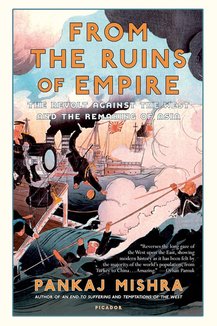
From the Ruins of Empire: The Revolt Against the West and the Remaking of Asia
Author:
Pankaj Mishra
Pankaj Mishra's From the Ruins of Empire offers a surprising, gripping narrative depicting the thinkers whose ideas shaped contemporary China, India, and the Muslim world. A little more than a century ago, independent thinkers across Asia sought to frame a distinct intellectual tradition that would inspire the continent's rise to dominance.
Pankaj Mishra's From the Ruins of Empire offers a surprising, gripping narrative depicting the thinkers whose ideas shaped contemporary China, India, and the Muslim world. A little more than a century ago, independent thinkers across Asia sought to frame a distinct intellectual tradition that would inspire the continent's rise to dominance. Yet this did not come to pass, and today those thinkers―Tagore, Gandhi, and later Nehru in India; Liang Qichao and Sun Yat-sen in China; Jamal al-Din al-Afghani and Abdurreshi al Ibrahim of the Ottoman Empire―are seen as outsiders within the main anticolonial tradition. But as Mishra demonstrates in this enthralling portrait of like minds, Asia's revolt against the West is not the one led by faith-fired terrorists and thwarted peasants; rather, it is rooted in the ideas of these once renowned intellectuals. Now, when the ascendency of Asia seems possible as never before, From the Ruins of Empire is as necessary as it is timely―a book indispensable to our understanding of the world and our place in it.
Find this book on:
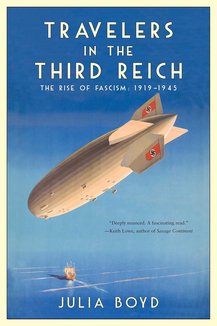
Travelers in the Third Reich: The Rise of Fascism: 1919-1945
Author:
Julia Boyd
This fascinating and shocking history of the rise of the Nazis draws together a multitude of expatriate voices - even Charles Lindbergh and Samuel Beckett - into a powerful narrative charting this extraordinary phenomenon. Travelers in the Third Reich is an extraordinary history of the rise of the Nazis based on fascinating first-hand accounts, drawing together a multitude of voices and stories, including politicians, musicians, diplomats, schoolchildren, communists, scholars, athletes, poets, fascists, artists, tourists, and even celebrities like Charles Lindbergh and Samuel Beckett.
This fascinating and shocking history of the rise of the Nazis draws together a multitude of expatriate voices - even Charles Lindbergh and Samuel Beckett - into a powerful narrative charting this extraordinary phenomenon. Travelers in the Third Reich is an extraordinary history of the rise of the Nazis based on fascinating first-hand accounts, drawing together a multitude of voices and stories, including politicians, musicians, diplomats, schoolchildren, communists, scholars, athletes, poets, fascists, artists, tourists, and even celebrities like Charles Lindbergh and Samuel Beckett. Their experiences create a remarkable three-dimensional picture of Germany under Hitler—one so palpable that the reader will feel, hear, even breathe the atmosphere.These are the accidental eyewitnesses to history. Disturbing, absurd, moving, and ranging from the deeply trivial to the deeply tragic, their tales give a fresh insight into the complexities of the Third Reich, its paradoxes, and its ultimate destruction.
Find this book on:
Episode overview
Two sitting heads of state, eight weeks apart.
On Saturday, February 28, the United States and Israel launched a massive military assault on Iran that resulted in the death of Ayatollah Ali Khamenei, along with much of his senior command. This came less than two months after the United States military captured Nicolás Maduro, the president of Venezuela, in an overnight raid.
The president seems to believe that he can decapitate these regimes and control their successors without events spinning out of his control. Is he right?
Ben Rhodes is a New York Times Opinion contributing writer and a co-host of “Pod Save the World.” He served as a senior adviser to President Barack Obama and worked on the Iran nuclear deal.
In this conversation, we discuss the ongoing conflict in Iran, how Democrats should respond, and whether Trump’s “head on a pike” approach to foreign policy underestimates the chaos of war.