From this episode
Recommended books
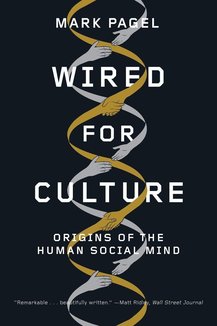
Wired for Culture: Origins of the Human Social Mind
Author:
Mark D. Pagel
“Does an excellent job of using evolutionary biology to discuss the origins of religion, music, art, and . .
“Does an excellent job of using evolutionary biology to discuss the origins of religion, music, art, and . . . morality.”― Publishers Weekly , starred review A unique trait of the human species is that our personalities, lifestyles, and worldviews are shaped by an accident of birth―namely, the culture into which we are born. It is our cultures and not our genes that determine which foods we eat, which languages we speak, which people we love and marry, and which people we kill in war. But how did our species develop a mind that is hardwired for culture―and why? Evolutionary biologist Mark Pagel tracks this intriguing question through the last 80,000 years of human evolution, revealing how an innate propensity to contribute and conform to the culture of our birth not only enabled human survival and progress in the past but also continues to influence our behavior today. Shedding light on our species’ defining attributes―from art, morality, and altruism to self-interest, deception, and prejudice― Wired for Culture offers surprising new insights into what it means to be human.
Find this book on:


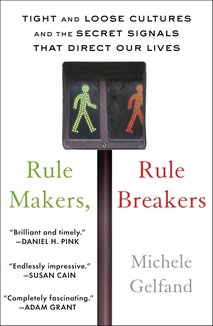
A celebrated social psychologist offers a radical new perspective on cultural differences that reveals why some countries, cultures, and individuals take rules more seriously and how following the rules influences the way we think and act. In Rule Makers, Rule Breakers , Michele Gelfand, “an engaging writer with intellectual range” ( The New York Times Book Review ), takes us on an epic journey through human cultures, offering a startling new view of the world and ourselves.
A celebrated social psychologist offers a radical new perspective on cultural differences that reveals why some countries, cultures, and individuals take rules more seriously and how following the rules influences the way we think and act. In Rule Makers, Rule Breakers , Michele Gelfand, “an engaging writer with intellectual range” ( The New York Times Book Review ), takes us on an epic journey through human cultures, offering a startling new view of the world and ourselves. With a mix of brilliantly conceived studies and surprising on-the-ground discoveries, she shows that much of the diversity in the way we think and act derives from a key difference—how tightly or loosely we adhere to social norms. Just as DNA affects everything from eye color to height, our tight-loose social coding influences much of what we do. Why are clocks in Germany so accurate while those in Brazil are frequently wrong? Why do New Zealand’s women have the highest number of sexual partners? Why are red and blue states really so divided? Why was the Daimler-Chrysler merger ill-fated from the start? Why is the driver of a Jaguar more likely to run a red light than the driver of a plumber’s van? Why does one spouse prize running a tight ship while the other refuses to sweat the small stuff? In search of a common answer, Gelfand spent two decades conducting research in more than fifty countries. Across all age groups, family variations, social classes, businesses, states, and nationalities, she has identified a primal pattern that can trigger cooperation or conflict. Her fascinating conclusion: behavior is highly influenced by the perception of threat. “A useful and engaging take on human behavior” ( Kirkus Reviews ) with an approach that is consistently riveting, Rule Makers, Ruler Breakers thrusts many of the puzzling attitudes and actions we observe into sudden and surprising clarity.
Find this book on:
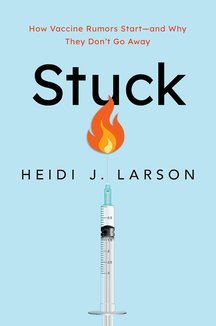
Stuck: How Vaccine Rumors Start -- and Why They Don't Go Away
Authors:
Heidi Larson,
Heidi J. Larson
Vaccine reluctance and refusal are no longer limited to the margins of society. Debates around vaccines' necessity -- along with questions around their side effects -- have gone mainstream, blending with geopolitical conflicts, political campaigns, celebrity causes, and "natural" lifestyles to win a growing number of hearts and minds.
Vaccine reluctance and refusal are no longer limited to the margins of society. Debates around vaccines' necessity -- along with questions around their side effects -- have gone mainstream, blending with geopolitical conflicts, political campaigns, celebrity causes, and "natural" lifestyles to win a growing number of hearts and minds. Today's anti-vaccine positions find audiences where they've never existed previously. Stuck examines how the issues surrounding vaccine hesitancy are, more than anything, about people feeling left out of the conversation. A new dialogue is long overdue, one that addresses the many types of vaccine hesitancy and the social factors that perpetuate them. To do this, Stuck provides a clear-eyed examination of the social vectors that transmit vaccine rumors, their manifestations around the globe, and how these individual threads are all connected.
Find this book on:
Episode overview
“The war has changed.” That’s what the leaked C.D.C. document says about the way the Delta variant has upended our coronavirus policies. Delta is astonishingly contagious. It can generate 1,000 times the viral load of the original coronavirus strain, and it spreads with the ease of chickenpox. The vaccinated can no longer assume immunity. The unvaccinated are at more risk than ever. Masks are back. New York City is essentially imposing a vaccine mandate.
I have so many questions about the war we’re now in. What do we actually know about Delta? If you’re vaccinated, is it more or less likely to kill you than the flu? Is it more serious for children? Are we re-masking to protect the unvaccinated, or is this also for the vaccinated? What are the risks of long Covid for the vaccinated? I could go on.
Luckily, Dr. Céline Gounder has answers. Gounder is an epidemiologist at N.Y.U. medical school, a CNN medical analyst and host of the Covid podcast “Epidemic.” I’m not sure if this conversation will make you feel better about the war we’re now in. But it will, if nothing else, make it much, much clearer.