
From this episode
Recommended books
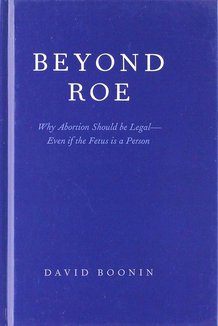
Beyond Roe: Why Abortion Should be Legal--Even if the Fetus is a Person
Author:
David Boonin
Most arguments for or against abortion focus on one question: is the fetus a person? In this provocative and important book, David Boonin defends the claim that even if the fetus is a person with the same right to life you and I have, abortion should still be legal, and most current restrictions on abortion should be abolished.
Most arguments for or against abortion focus on one question: is the fetus a person? In this provocative and important book, David Boonin defends the claim that even if the fetus is a person with the same right to life you and I have, abortion should still be legal, and most current restrictions on abortion should be abolished. Beyond Roe points to a key legal precedent: McFall v. Shimp . In 1978, an ailing Robert McFall sued his cousin, David Shimp, asking the court to order Shimp to provide McFall with the bone marrow he needed. The court ruled in Shimp's favor and McFall soon died. Boonin extracts a compelling lesson from the case of McFall v. Shimp --that having a right to life does not give a person the right to use another person's body even if they need to use that person's body to go on living-and he uses this principle to support his claim that abortion should be legal and far less restricted than it currently is, regardless of whether the fetus is a person. By taking the analysis of the right to life that Judith Jarvis Thomson pioneered in a moral context and applying it in a legal context in this novel way, Boonin offers a fresh perspective that is grounded in assumptions that should be accepted by both sides of the abortion debate. Written in a lively, conversational style, and offering a case study of the value of reason in analyzing complex social issues, Beyond Roe will be of interest to students and scholars in a variety of fields, and to anyone interested in the debate over whether government should restrict or prohibit abortion.
Find this book on:


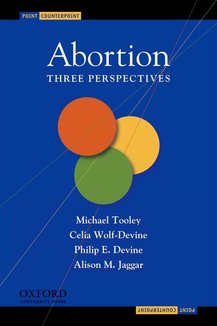
Abortion: Three Perspectives (Point/Counterpoint)
Authors:
Michael Tooley,
Celia Wolf-Devine,
Philip E. Devine,
Alison M. Jaggar
Moving beyond traditional "liberal versus conservative" arguments for and against abortion, Abortion: Three Perspectives is an up-to-date, accessible, and engaging exploration of this highly contentious issue. Featuring a triangular debate between four prominent moral and political philosophers, it presents three different political perspectives: Michael Tooley argues the "liberal" pro-choice approach; Philip E.
Moving beyond traditional "liberal versus conservative" arguments for and against abortion, Abortion: Three Perspectives is an up-to-date, accessible, and engaging exploration of this highly contentious issue. Featuring a triangular debate between four prominent moral and political philosophers, it presents three different political perspectives: Michael Tooley argues the "liberal" pro-choice approach; Philip E. Devine and Celia Wolf-Devine argue the "communitarian" pro-life approach; and Alison M. Jaggar argues the "gender justice" approach. However, each of the authors' self-identifications is also challenged by one or more of the other authors, who offer alternative interpretations of liberalism, communitarianism, and feminism, as well as of what it means to be pro-choice and pro-life. All of these viewpoints are controversial, among both philosophers and general readers. Furthermore, because the arguments do not rely on religious authority, they are directed at all readers, regardless of religious affiliation. Abortion: Three Perspectives is divided into two parts: the authors first develop their ideas in depth and then briefly critique the other positions. Drawing examples from real life, they also integrate logic and empirical data into their arguments and consider views of abortion across other disciplines. As philosophers, the authors possess expert skills in critical analysis; their debates provide students and other readers with a model of dialogue among those who very strongly disagree. Abortion: Three Perspectives is ideal for courses in contemporary moral problems, introduction to ethics, bioethics, medical ethics, and feminist philosophy.
Find this book on:
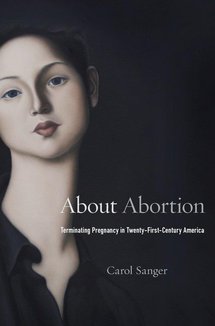
About Abortion: Terminating Pregnancy in Twenty-First-Century America
Author:
Carol Sanger
One of the most private decisions a woman can make, abortion is also one of the most contentious topics in American civic life. Protested at rallies and politicized in party platforms, terminating pregnancy is often characterized as a selfish decision by women who put their own interests above those of the fetus.
One of the most private decisions a woman can make, abortion is also one of the most contentious topics in American civic life. Protested at rallies and politicized in party platforms, terminating pregnancy is often characterized as a selfish decision by women who put their own interests above those of the fetus. This background of stigma and hostility has stifled women’s willingness to talk about abortion, which in turn distorts public and political discussion. To pry open the silence surrounding this public issue, Sanger distinguishes between abortion privacy, a form of nondisclosure based on a woman’s desire to control personal information, and abortion secrecy, a woman’s defense against the many harms of disclosure. Laws regulating abortion patients and providers treat abortion not as an acceptable medical decision―let alone a right―but as something disreputable, immoral, and chosen by mistake. Exploiting the emotional power of fetal imagery, laws require women to undergo ultrasound, a practice welcomed in wanted pregnancies but commandeered for use against women with unwanted pregnancies. Sanger takes these prejudicial views of women’s abortion decisions into the twenty-first century by uncovering new connections between abortion law and American culture and politics. New medical technologies, women’s increasing willingness to talk online and off, and the prospect of tighter judicial reins on state legislatures are shaking up the practice of abortion. As talk becomes more transparent and acceptable, women’s decisions about whether or not to become mothers will be treated more like those of other adults making significant personal choices.
Find this book on:
Episode overview
When Justice Samuel Alito’s draft opinion on Dobbs v. Jackson Women’s Health Organization leaked a few weeks ago, it signaled that Roe v. Wade appears likely to be overturned in a matter of weeks. If Roe falls, questions about the right to abortion will re-enter the realm of electoral politics in a way they haven’t for 50 years. States will be solely in charge of determining whether abortion is permitted, under what conditions it should be permitted, and what the appropriate thresholds are for making those decisions.
That means ordinary voters and their representatives will be forced to grapple with the moral — even metaphysical — quandaries at the heart of the abortion debate. What does it mean to belong to the human species, and when does that belonging begin? Is there a bright line at which an egg, a blastula, or a fetus attains the status of “person”? And how do we weigh the competing interests of mothers, families, and fetuses against one another? Those questions are the foundation on top of which abortion law and policy is built.
Kate Greasley is a law professor at the University of Oxford in the U.K., where she studies, among other things, the legal and moral philosophy of abortion. She’s the author of “Arguments About Abortion: Personhood, Morality, and Law,” and co-author of “Abortion Rights: For and Against” alongside Christopher Kaczor, a philosopher who opposes abortion. While Greasley ultimately believes in the right to choose, she does a remarkably comprehensive job of carefully and fairly considering all the arguments, contradictions and nuances of this issue.
We discuss why both progressives and conservatives should be open to questioning their preconceptions about abortion, what the Bible does — and doesn’t — suggest about abortion, why the status of fetal life is the central question at the heart of abortion ethics, whether life begins at conception or emerges later in fetal development, how the complex, messy moral intuitions that most of us have around questions of life and death don’t lend themselves neatly to either an abortion rights or anti-abortion camp, why late-term abortions pose particularly challenging moral questions, how the pregnant person’s bodily autonomy weighs against the fetus’s and more.