
From this episode
Recommended books
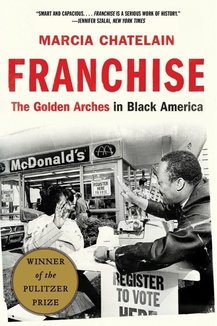
Franchise: The Golden Arches in Black America
Author:
Marcia Chatelain
WINNER • 2021 PULITZER PRIZE IN HISTORY Winner • 2022 James Beard Foundation Book Award [Writing] The “stunning” (David W. Blight) untold history of how fast food became one of the greatest generators of black wealth in America.
WINNER • 2021 PULITZER PRIZE IN HISTORY Winner • 2022 James Beard Foundation Book Award [Writing] The “stunning” (David W. Blight) untold history of how fast food became one of the greatest generators of black wealth in America. Just as The Color of Law provided a vital understanding of redlining and racial segregation, Marcia Chatelain’s Franchise investigates the complex interrelationship between black communities and America’s largest, most popular fast food chain. Taking us from the first McDonald’s drive-in in San Bernardino to the franchise on Florissant Avenue in Ferguson, Missouri, in the summer of 2014, Chatelain shows how fast food is a source of both power―economic and political―and despair for African Americans. As she contends, fast food is, more than ever before, a key battlefield in the fight for racial justice. 8 chapter openers
Find this book on:


Place of Greater Safety, A: A Novel
Author:
Hilary Mantel
It is 1789, and three young provincials have come to Paris to make their way. Georges-Jacques Danton, an ambitious young lawyer, is energetic, pragmatic, debt-ridden--and hugely but erotically ugly.
It is 1789, and three young provincials have come to Paris to make their way. Georges-Jacques Danton, an ambitious young lawyer, is energetic, pragmatic, debt-ridden--and hugely but erotically ugly. Maximilien Robespierre, also a lawyer, is slight, diligent, and terrified of violence. His dearest friend, Camille Desmoulins, is a conspirator and pamphleteer of genius. A charming gadfly, erratic and untrustworthy, bisexual and beautiful, Camille is obsessed by one woman and engaged to marry another, her daughter. In the swells of revolution, they each taste the addictive delights of power, and the price that must be paid for it.
Find this book on:
Nickel and Dimed: On (Not) Getting By in America (20th Anniversary Edition)
Author:
Barbara Ehrenreich
The New York Times bestselling work of undercover reportage from our sharpest and most original social critic, with a new foreword by Matthew Desmond, author of Evicted Millions of Americans work full time, year round, for poverty-level wages. In 1998, Barbara Ehrenreich decided to join them.
The New York Times bestselling work of undercover reportage from our sharpest and most original social critic, with a new foreword by Matthew Desmond, author of Evicted Millions of Americans work full time, year round, for poverty-level wages. In 1998, Barbara Ehrenreich decided to join them. She was inspired in part by the rhetoric surrounding welfare reform, which promised that a job―any job―can be the ticket to a better life. But how does anyone survive, let alone prosper, on $6 an hour? To find out, Ehrenreich left her home, took the cheapest lodgings she could find, and accepted whatever jobs she was offered. Moving from Florida to Maine to Minnesota, she worked as a waitress, a hotel maid, a cleaning woman, a nursing-home aide, and a Wal-Mart sales clerk. She lived in trailer parks and crumbling residential motels. Very quickly, she discovered that no job is truly "unskilled," that even the lowliest occupations require exhausting mental and muscular effort. She also learned that one job is not enough; you need at least two if you intend to live indoors. Nickel and Dimed reveals low-rent America in all its tenacity, anxiety, and surprising generosity―a land of Big Boxes, fast food, and a thousand desperate stratagems for survival. Read it for the smoldering clarity of Ehrenreich's perspective and for a rare view of how "prosperity" looks from the bottom. And now, in a new foreword, Matthew Desmond, author of Evicted: Poverty and Profit in the American City , explains why, twenty years on in America, Nickel and Dimed is more relevant than ever.
Find this book on:
Episode overview
There’s something weird happening with the economy. On a personal level, most Americans say they’re doing pretty well right now. And according to the data, that’s true. Wages have gone up faster than inflation. Unemployment is low, the stock market is generally up so far this year, and people are buying more stuff.
And yet in surveys, people keep saying the economy is bad. A recent Harris poll for The Guardian found that around half of Americans think the S. & P. 500 is down this year, and that unemployment is at a 50-year high. Fifty-six percent think we’re in a recession.
There are many theories about why this gap exists. Maybe political polarization is warping how people see the economy or it’s a failure of President Biden’s messaging, or there’s just something uniquely painful about inflation. And while there’s truth in all of these, it felt like a piece of the story was missing.
And for me, that missing piece was an article I read right before the pandemic. An Atlantic story from February 2020 called “The Great Affordability Crisis Breaking America.” It described how some of Americans’ biggest-ticket expenses — housing, health care, higher education and child care — which were already pricey, had been getting steadily pricier for decades.
At the time, prices weren’t the big topic in the economy; the focus was more on jobs and wages. So it was easier for this trend to slip notice, like a frog boiling in water, quietly, putting more and more strain on American budgets. But today, after years of high inflation, prices are the biggest topic in the economy. And I think that explains the anger people feel: They’re noticing the price of things all the time, and getting hammered with the reality of how expensive these things have become.
The author of that Atlantic piece is Annie Lowrey. She’s an economics reporter, the author of Give People Money, and also my wife. In this conversation, we discuss how the affordability crisis has collided with our post-pandemic inflationary world, the forces that shape our economic perceptions, why people keep spending as if prices aren’t a strain and what this might mean for the presidential election.