
From this episode
Recommended books
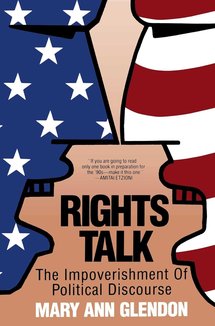
Rights Talk: The Impoverishment of Political Discourse
Author:
Mary Ann Glendon
Political speech in the United States is undergoing a crisis. Glendon's acclaimed book traces the evolution of the strident language of rights in America and shows how it has captured the nation's devotion to individualism and liberty, but omitted the American traditions of hospitality and care for the community.
Political speech in the United States is undergoing a crisis. Glendon's acclaimed book traces the evolution of the strident language of rights in America and shows how it has captured the nation's devotion to individualism and liberty, but omitted the American traditions of hospitality and care for the community.
Find this book on:


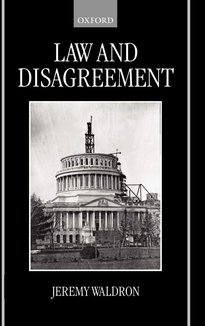
Law and Disagreement
Author:
Jeremy Waldron
When people disagree about justice and about individual rights, how should political decisions be made among them? How should they decide about issues like tax policy, welfare provision, criminal procedure, discrimination law, hate speech, pornography, political dissent and the limits of religious toleration?
When people disagree about justice and about individual rights, how should political decisions be made among them? How should they decide about issues like tax policy, welfare provision, criminal procedure, discrimination law, hate speech, pornography, political dissent and the limits of religious toleration? The most familiar answer is that these decisions should be made democratically, by majority voting among the people or their representatives. Often, however, this answer is qualified by adding ' providing that the majority decision does not violate individual rights.' In this book Jeremy Waldron has revisited and thoroughly revised thirteen of his most recent essays. He argues that the familiar answer is correct, but that the qualification about individual rights is incoherent. If rights are the very things we disagree about, then we are quarrelling precisely about what that qualification should amount to. At best, what it means is that disagreements about rights should be resolved by some other procedure, for example, by majority voting, not among the people or their representatives, but among judges in a court. This proposal - although initially attractive - seems much less agreeable when we consider that the judges too disagree about rights, and they disagree about them along exactly the same lines as the citizens. This book offers a comprehensive critique of the idea of the judicial review of legislation. The author argues that a belief in rights is not the same as a commitment to a Bill of Rights. He shows the flaws and difficulties in many common defenses of the 'democratic' character of judicial review. And he argues for an alternative approach to the problem of disagreement: when disagreements about rights arise, the respectful way to resolve them is by decision-making among the right-holders on a basis that reflects an equal respect for them as the holders of views about rights. This respect for ordinary right-holders, he argues, has been sadly lacking in the theories of justice, rights, and constitutionalism put forward in recent years by philosophers such as John Rawls and Donald Dworkin. But the book is not only about judicial review. The first tranche of essays is devoted to a theory of legislation, a theory which highlights the size, the scale and the diversity of modern legislative assemblies. Although legislation is often denigrated as a source of law, Waldron seeks to restore its tattered dignity. He deprecates the tendency to disparage legislatures and argues that such disparagement is often a way of bolstering the legitimacy of the courts, as if we had to transform our parliaments into something like the American Congress to justify importing American-style judicial reviews. Law and Disagreement redresses the balances in modern jurisprudence. It presents legislation by a representative assembly as a form of law making which is especially apt for a society whose members disagree with one another about fundamental issues of principle, for it is a form of law making that does not attempt to conceal the fact that our decisions are made and claim their authority in the midst of, not in spite of, our political and moral disagreements. This timely rights-based defense of majoritarian legislation will be welcomed by scholars of legal and political philosophy throughout the world.
Find this book on:
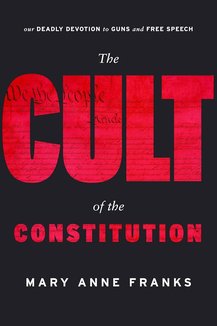
The Cult of the Constitution
Author:
Mary Anne Franks
In this controversial and provocative book, Mary Anne Franks examines the thin line between constitutional fidelity and constitutional fundamentalism. The Cult of the Constitution reveals how deep fundamentalist strains in both conservative and liberal American thought keep the Constitution in the service of white male supremacy.
In this controversial and provocative book, Mary Anne Franks examines the thin line between constitutional fidelity and constitutional fundamentalism. The Cult of the Constitution reveals how deep fundamentalist strains in both conservative and liberal American thought keep the Constitution in the service of white male supremacy. Constitutional fundamentalists read the Constitution selectively and self-servingly. Fundamentalist interpretations of the Constitution elevate certain constitutional rights above all others, benefit the most powerful members of society, and undermine the integrity of the document as a whole. The conservative fetish for the Second Amendment (enforced by groups such as the NRA) provides an obvious example of constitutional fundamentalism; the liberal fetish for the First Amendment (enforced by groups such as the ACLU) is less obvious but no less influential. Economic and civil libertarianism have increasingly merged to produce a deregulatory, "free-market" approach to constitutional rights that achieves fullest expression in the idealization of the Internet. The worship of guns, speech, and the Internet in the name of the Constitution has blurred the boundaries between conduct and speech and between veneration and violence. But the Constitution itself contains the antidote to fundamentalism. The Cult of the Constitution lays bare the dark, antidemocratic consequences of constitutional fundamentalism and urges readers to take the Constitution seriously, not selectively.
Find this book on:
Episode overview
On Friday, a Supreme Court majority voted to overturn Roe v. Wade. On Sunday, we released an episode with Dahlia Lithwick that goes through the court’s decision in detail, and we will continue to come out with new episodes on the ruling — and its vast implications — in the days and weeks to come.
Today, we’re re-airing an episode that we originally released in February of this year with Columbia Law professor Jamal Greene — a conversation that is even more relevant now than it was when we originally released it. The Dobbs ruling may be the most poignant example of how extreme the U.S. Supreme Court has become in recent years, but it’s certainly not the only one.
“Getting race wrong early has led courts to get everything else wrong since,” writes Greene in his book “How Rights Went Wrong.” But he probably doesn’t mean what you think he means.
“How Rights Went Wrong” is filled with examples of just how bizarre American Supreme Court outcomes have become. An information processing company claims the right to sell its patients’ data to drug companies — it wins. A group of San Antonio parents whose children attend a school with no air-conditioning, uncertified teachers and a falling apart school building sue for the right to an equal education — they lose. A man from Long Island claims the right to use his homemade nunchucks to teach the “Shafan Ha Lavan” karate style, which he made up, to his children — he wins.
Greene’s argument is that in America, for specific reasons rooted in our ugly past, the way we think about rights has gone terribly awry. We don’t do constitutional law the way other countries do it. Rather, we recognize too few rights, and we protect them too strongly. That’s created a race to get everything ruled as a right, because once it’s a right, it’s unassailable. And that’s made the stakes of our constitutional conflicts too high. “If only one side can win, it might as well be mine,” Greene writes. “Conflict over rights can encourage us to take aim at our political opponents instead of speaking to them. And we shoot to kill.”
It’s a grim diagnosis. But, for Greene, it’s a hopeful one, too. Because it doesn’t have to be this way. Supreme Court decisions don’t have to feel so existential. Rights like food and shelter and education need not be wholly ignored by the courts. Other countries do things differently, and so can we.
We also discuss the reason we have courts in the first place, why Greene thinks Germany’s approach to abortion rights could be a model for America, Greene’s case for appointing nearly 200 justices to the U.S. Supreme Court and much more.