
From this episode
Recommended books
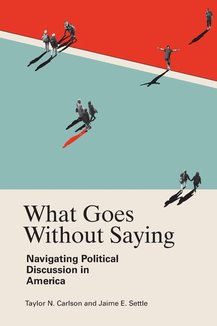
What Goes Without Saying
Author:
Taylor N. Carlson
Why are political conversations uncomfortable for so many people? The current literature focuses on the structure of people's discussion networks and the frequency with which they talk about politics, but not the dynamics of the conversations themselves.
Why are political conversations uncomfortable for so many people? The current literature focuses on the structure of people's discussion networks and the frequency with which they talk about politics, but not the dynamics of the conversations themselves. In What Goes Without Saying, Taylor N. Carlson and Jaime E. Settle investigate how Americans navigate these discussions in their daily lives, with particular attention to the decision-making process around when and how to broach politics. The authors use a multi-methods approach to unpack what they call the 4D Framework of political conversation: identifying the ways that people detect others' views, decide whether to talk, discuss their opinions honestly―or not, and determine whether they will repeat the experience in the future. In developing a framework for studying and explaining political discussion as a social process, What Goes Without Saying will set the agenda for research in political science, psychology, communication, and sociology for decades to come.
Find this book on:

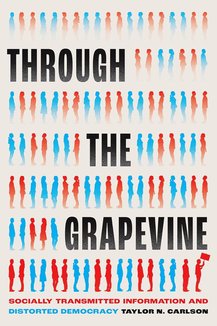
An enlightening examination of what it means when Americans rely on family and friends to stay on top of politics. Accurate information is at the heart of democratic functioning.
An enlightening examination of what it means when Americans rely on family and friends to stay on top of politics. Accurate information is at the heart of democratic functioning. For decades, researchers interested in how information is disseminated have focused on mass media, but the reality is that many Americans today do not learn about politics from direct engagement with the news. Rather, about one-third of Americans learn chiefly from information shared by their peers in conversation or on social media. How does this socially transmitted information differ from that communicated by traditional media? What are the consequences for political attitudes and behavior? Drawing on evidence from experiments, surveys, and social media, Taylor N. Carlson finds that, as information flows first from the media then person to person, it becomes sparse, more biased, less accurate, and more mobilizing. The result is what Carlson calls distorted democracy . Although socially transmitted information does not necessarily render democracy dysfunctional, Through the Grapevine shows how it contributes to a public that is at once underinformed, polarized, and engaged.
Find this book on:

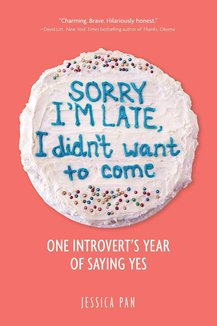
Sorry I'm Late, I Didn't Want to Come: One Introvert's Year of Saying Yes
Author:
Jessica Pan
An introvert spends a year trying to live like an extrovert with hilarious results and advice for readers along the way. What would happen if a shy introvert lived like a gregarious extrovert for one year?
An introvert spends a year trying to live like an extrovert with hilarious results and advice for readers along the way. What would happen if a shy introvert lived like a gregarious extrovert for one year? If she knowingly and willingly put herself in perilous social situations that she’d normally avoid at all costs? Writer Jessica Pan intends to find out. With the help of various extrovert mentors, Jessica sets up a series of personal challenges (talk to strangers, perform stand-up comedy, host a dinner party, travel alone, make friends on the road, and much, much worse) to explore whether living like an extrovert can teach her lessons that might improve the quality of her life. Chronicling the author’s hilarious and painful year of misadventures, this book explores what happens when one introvert fights her natural tendencies, takes the plunge, and tries (and sometimes fails) to be a little bit braver.
Find this book on:
Episode overview
The biggest divide in our politics isn’t between Democrats and Republicans, or even left and right. It’s between people who follow politics closely, and those who pay almost no attention to it. If you’re in the former camp — and if you’re reading this, you probably are — the latter camp can seem inscrutable. These people hardly ever look at political news. They hate discussing politics. But they do care about issues and candidates, and they often vote.
As the 2024 election takes shape, this bloc appears crucial to determining who wins the presidency. An NBC News poll from April found that 15 percent of voters don’t follow political news, and Donald Trump was winning them by 26 points.
Yanna Krupnikov studies exactly this kind of voter. She’s a professor of communication and media at the University of Michigan and an author, with John Barry Ryan, of “The Other Divide: Polarization and Disengagement in American Politics.” The book examines how the chasm between the deeply involved and the less involved shapes politics in America. I’ve found it to be a helpful guide for understanding one of the most crucial dynamics emerging in this year’s election: the swing to Trump from President Biden among disengaged voters.
In this conversation, we discuss how politically disengaged voters relate to politics; where they get their information about politics and how they form opinions; and whether major news events, like Trump’s recent conviction, might sway them.