
From this episode
Recommended books
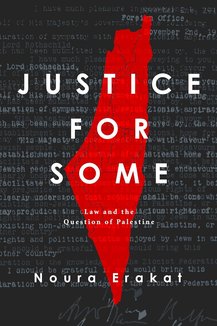
Justice for Some: Law and the Question of Palestine
Author:
Noura Erakat
Justice in the Question of Palestine is often framed as a question of law. Yet none of the Israel-Palestinian conflict's most vexing challenges have been resolved by judicial intervention.
Justice in the Question of Palestine is often framed as a question of law. Yet none of the Israel-Palestinian conflict's most vexing challenges have been resolved by judicial intervention. Occupation law has failed to stem Israel's settlement enterprise. Laws of war have permitted killing and destruction during Israel's military offensives in the Gaza Strip. The Oslo Accord's two-state solution is now dead letter. Justice for Some offers a new approach to understanding the Palestinian struggle for freedom, told through the power and control of international law. Focusing on key junctures―from the Balfour Declaration in 1917 to present-day wars in Gaza―Noura Erakat shows how the strategic deployment of law has shaped current conditions. Over the past century, the law has done more to advance Israel's interests than the Palestinians'. But, Erakat argues, this outcome was never inevitable. Law is politics, and its meaning and application depend on the political intervention of states and people alike. Within the law, change is possible. International law can serve the cause of freedom when it is mobilized in support of a political movement. Presenting the promise and risk of international law, Justice for Some calls for renewed action and attention to the Question of Palestine.
Find this book on:


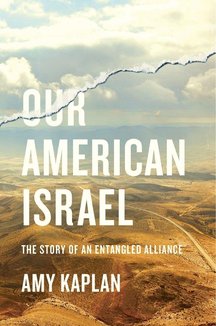
Our American Israel: The Story of an Entangled Alliance
Author:
Amy Kaplan
An essential account of America’s most controversial alliance that reveals how the United States came to see Israel as an extension of itself, and how that strong and divisive partnership plays out in our own time. Our American Israel tells the story of how a Jewish state in the Middle East came to resonate profoundly with a broad range of Americans in the twentieth century.
An essential account of America’s most controversial alliance that reveals how the United States came to see Israel as an extension of itself, and how that strong and divisive partnership plays out in our own time. Our American Israel tells the story of how a Jewish state in the Middle East came to resonate profoundly with a broad range of Americans in the twentieth century. Beginning with debates about Zionism after World War II, Israel’s identity has been entangled with America’s belief in its own exceptional nature. Now, in the twenty-first century, Amy Kaplan challenges the associations underlying this special alliance. Through popular narratives expressed in news media, fiction, and film, a shared sense of identity emerged from the two nations’ histories as settler societies. Americans projected their own origin myths onto Israel: the biblical promised land, the open frontier, the refuge for immigrants, the revolt against colonialism. Israel assumed a mantle of moral authority, based on its image as an “invincible victim,” a nation of intrepid warriors and concentration camp survivors. This paradox persisted long after the Six-Day War, when the United States rallied behind a story of the Israeli David subduing the Arab Goliath. The image of the underdog shattered when Israel invaded Lebanon and Palestinians rose up against the occupation. Israel’s military was strongly censured around the world, including notes of dissent in the United States. Rather than a symbol of justice, Israel became a model of military strength and technological ingenuity. In America today, Israel’s political realities pose difficult challenges. Turning a critical eye on the turbulent history that bound the two nations together, Kaplan unearths the roots of present controversies that may well divide them in the future.
Find this book on:

The Unspoken Alliance: Israel's Secret Relationship with Apartheid South Africa
Author:
Sasha Polakow-Suransky
Prior to the Six-Day War, Israel was a darling of the international left, vocally opposed to apartheid and devoted to building alliances with black leaders in newly independent African nations. South Africa, for its part, was controlled by a regime of Afrikaner nationalists who had enthusiastically supported Hitler during World War II.
Prior to the Six-Day War, Israel was a darling of the international left, vocally opposed to apartheid and devoted to building alliances with black leaders in newly independent African nations. South Africa, for its part, was controlled by a regime of Afrikaner nationalists who had enthusiastically supported Hitler during World War II. But after Israel’s occupation of Palestinian territories in 1967, the country found itself estranged from former allies and threatened anew by old enemies. As both states became international pariahs, a covert—and lucrative—military relationship blossomed between these seemingly unlikely allies. Based on extensive archival research and exclusive interviews with former generals and high-level government officials in both countries, The Unspoken Alliance tells a troubling story of Cold War paranoia, moral compromises, and startling secrets.
Find this book on:
Episode overview
In his new book of essays, “The Message,” Ta-Nehisi Coates writes about a trip he took to Israel and the West Bank in May 2023. “I felt lied to,” he told me. “I felt lied to by my craft. I felt lied to by major media organizations.”
Coates’s essay is a searing portrait of Palestinian life under Israeli rule. It has also been criticized for leaving much out: Hamas is never mentioned. Nor is Oct. 7. Nor are any of the peace processes. So I asked him on the show to discuss what he saw when he was there and what he chose to leave outside the frame.