From this episode
Recommended books

Rights Talk: The Impoverishment of Political Discourse
Author:
Mary Ann Glendon
Political speech in the United States is undergoing a crisis. Glendon's acclaimed book traces the evolution of the strident language of rights in America and shows how it has captured the nation's devotion to individualism and liberty, but omitted the American traditions of hospitality and care for the community.
Political speech in the United States is undergoing a crisis. Glendon's acclaimed book traces the evolution of the strident language of rights in America and shows how it has captured the nation's devotion to individualism and liberty, but omitted the American traditions of hospitality and care for the community.
Find this book on:


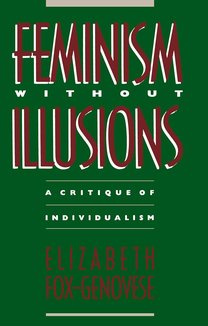
Feminism Without Illusions: A Critique of Individualism
Author:
Elizabeth Fox-Genovese
In arguing that feminism has neither adequately acknowledged its ties to individualism nor squarely faced the extent to which many of its campaigns for social justice are based on the insistence of rights for the individual over good of the community, this study analyzes current political theory and its application to affirmative action, comparative worth and abortion rights. The author also examines the debate over feminist history and the relationship between feminism and postmodernism.
In arguing that feminism has neither adequately acknowledged its ties to individualism nor squarely faced the extent to which many of its campaigns for social justice are based on the insistence of rights for the individual over good of the community, this study analyzes current political theory and its application to affirmative action, comparative worth and abortion rights. The author also examines the debate over feminist history and the relationship between feminism and postmodernism.
Find this book on:
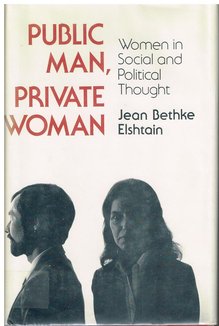
Public Man, Private Woman: Women in Social and Political Thought
Author:
Jean Bethke Elshtain
Focusing on the Western philosophical tradition and the work of contemporary feminists, Jean Elshtain explores the general tendency to assert the primacy of the public world--the political sphere dominated by men--and to denigrate the private world--the familial sphere dominated by women. She offers her own positive reconstruction of the public and the private in a feminist theory that reaffirms the importance of the family and envisions an "ethical polity."
Focusing on the Western philosophical tradition and the work of contemporary feminists, Jean Elshtain explores the general tendency to assert the primacy of the public world--the political sphere dominated by men--and to denigrate the private world--the familial sphere dominated by women. She offers her own positive reconstruction of the public and the private in a feminist theory that reaffirms the importance of the family and envisions an "ethical polity."
Find this book on:
Episode overview
For decades, the conservative position on abortion has been simple: Appoint justices who will overturn Roe V. Wade. That aspiration is now likely to become reality. The question of abortion rights will re-enter the realm of electoral politics in a way it hasn’t for 50 years. And that means Republicans will need to develop a new politics of abortion — a politics that may appeal not only to their anti-abortion base but to some of the many Americans who believe Roe should stand.
One place those Republicans may look for inspiration is to the work of the legal scholar Erika Bachiochi. She is a fellow at the Ethics and Public Policy Center, director of the Wollstonecraft Project at the Abigail Adams Institute and the author of “The Rights of Women: Reclaiming a Lost Vision,” where she argues for a “dignitarian feminism.” Bachiochi embraces women’s gains in professional and civic life but holds that techno-pharmacological birth control, the sexual revolution and the legalization of abortion have created a sexual and family culture that has ultimately been devastating to women’s well-being.
In hopes of improving that status quo, Bachiochi puts forward a policy agenda that could very well become the post-Roe playbook for some Republicans: tighter abortion restrictions combined with a robust slate of family policies — some of which would be even bolder than the Biden administration’s proposals to date. Hers is not an argument I agree with, but it’s one that I imagine will become increasingly salient in a post-Roe America.
In the third episode of our series “The Rising Right,” we discuss Bachiochi’s views on why the “gender revolution” has stalled; her belief that market logic has come to dominate our understandings of family, parenting, sex and feminism; her critique of modern “hookup” culture; and her pro-family economic agenda. And we debate whether it’s realistic to encourage the use of natural fertility regulation over hormonal contraception, how abortion relates to single motherhood and poverty, whether stricter abortion laws might benefit or hurt poor women, what role the law should play in teaching moral behavior, whether progressives have become too “Lockean” in their understanding of bodily autonomy, whether the sexual revolution gave people too much choice and more.