
From this episode
Recommended books
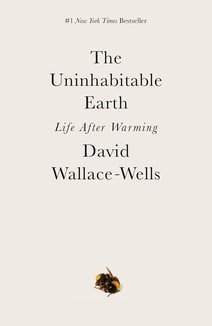
The Uninhabitable Earth: Life After Warming
Author:
David Wallace-Wells
#1 NEW YORK TIMES BESTSELLER • “ The Uninhabitable Earth hits you like a comet, with an overflow of insanely lyrical prose about our pending Armageddon.”—Andrew Solomon, author of The Noonday Demon With a new afterword It is worse, much worse, than you think. If your anxiety about global warming is dominated by fears of sea-level rise, you are barely scratching the surface of what terrors are possible—food shortages, refugee emergencies, climate wars and economic devastation.
#1 NEW YORK TIMES BESTSELLER • “ The Uninhabitable Earth hits you like a comet, with an overflow of insanely lyrical prose about our pending Armageddon.”—Andrew Solomon, author of The Noonday Demon With a new afterword It is worse, much worse, than you think. If your anxiety about global warming is dominated by fears of sea-level rise, you are barely scratching the surface of what terrors are possible—food shortages, refugee emergencies, climate wars and economic devastation. An “epoch-defining book” ( The Guardian ) and “this generation’s Silent Spring ” ( The Washington Post ), The Uninhabitable Earth is both a travelogue of the near future and a meditation on how that future will look to those living through it—the ways that warming promises to transform global politics, the meaning of technology and nature in the modern world, the sustainability of capitalism and the trajectory of human progress. The Uninhabitable Earth is also an impassioned call to action. For just as the world was brought to the brink of catastrophe within the span of a lifetime, the responsibility to avoid it now belongs to a single generation—today’s. Praise for The Uninhabitable Earth “The Uninhabitable Earth is the most terrifying book I have ever read. Its subject is climate change, and its method is scientific, but its mode is Old Testament. The book is a meticulously documented, white-knuckled tour through the cascading catastrophes that will soon engulf our warming planet.” —Farhad Manjoo, The New York Times “Riveting. . . . Some readers will find Mr. Wallace-Wells’s outline of possible futures alarmist. He is indeed alarmed. You should be, too.” —The Economist “Potent and evocative. . . . Wallace-Wells has resolved to offer something other than the standard narrative of climate change. . . . He avoids the ‘eerily banal language of climatology’ in favor of lush, rolling prose.” —Jennifer Szalai, The New York Times “The book has potential to be this generation’s Silent Spring .” —The Washington Post “ The Uninhabitable Earth, which has become a best seller, taps into the underlying emotion of the day: fear. . . . I encourage people to read this book.” —Alan Weisman, The New York Review of Books
Find this book on:


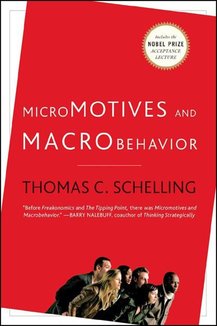
Micromotives and Macrobehavior
Author:
Thomas C. Schelling
Before Freakonomics and The Tipping Point there was this classic by the 2005 Nobel Laureate in Economics. "Schelling here offers an early analysis of 'tipping' in social situations involving a large number of individuals." ―official citation for the 2005 Nobel Prize Micromotives and Macrobehavior was originally published over twenty-five years ago, yet the stories it tells feel just as fresh today.
Before Freakonomics and The Tipping Point there was this classic by the 2005 Nobel Laureate in Economics. "Schelling here offers an early analysis of 'tipping' in social situations involving a large number of individuals." ―official citation for the 2005 Nobel Prize Micromotives and Macrobehavior was originally published over twenty-five years ago, yet the stories it tells feel just as fresh today. And the subject of these stories―how small and seemingly meaningless decisions and actions by individuals often lead to significant unintended consequences for a large group―is more important than ever. In one famous example, Thomas C. Schelling shows that a slight-but-not-malicious preference to have neighbors of the same race eventually leads to completely segregated populations. The updated edition of this landmark book contains a new preface and the author's Nobel Prize acceptance speech.
Find this book on: