From this episode
Recommended books
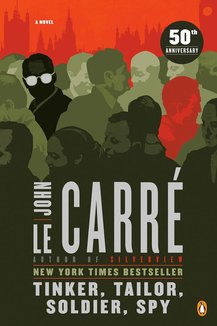
Tinker, Tailor, Soldier, Spy: A George Smiley Novel
Author:
John le Carré
From the New York Times bestselling author of A Legacy of Spies . The man he knew as "Control" is dead, and the young Turks who forced him out now run the Circus.
From the New York Times bestselling author of A Legacy of Spies . The man he knew as "Control" is dead, and the young Turks who forced him out now run the Circus. But George Smiley isn't quite ready for retirement—especially when a pretty, would-be defector surfaces with a shocking accusation: a Soviet mole has penetrated the highest level of British Intelligence. Relying only on his wits and a small, loyal cadre, Smiley recognizes the hand of Karla—his Moscow Centre nemesis—and sets a trap to catch the traitor. The Oscar-nominated feature film adaptation of Tinker Tailor Soldier Spy is directed by Tomas Alfredson ( Let the Right One In ) and features Gary Oldman as Smiley, Academy Award winner Colin Firth ( The King's Speech ), and Tom Hardy ( Inception ). With an introduction by the author.
Find this book on:


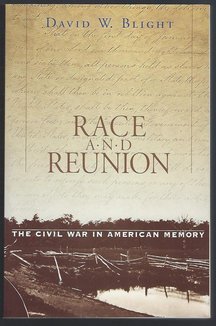
Race and Reunion: The Civil War in American Memory
Author:
David W. Blight
Winner of the Bancroft Prize Winner of the Gilder Lehrman Lincoln Prize Winner of the Merle Curti award Winner of the Frederick Douglass Prize No historical event has left as deep an imprint on America's collective memory as the Civil War. In the war's aftermath, Americans had to embrace and cast off a traumatic past.
Winner of the Bancroft Prize Winner of the Gilder Lehrman Lincoln Prize Winner of the Merle Curti award Winner of the Frederick Douglass Prize No historical event has left as deep an imprint on America's collective memory as the Civil War. In the war's aftermath, Americans had to embrace and cast off a traumatic past. David Blight explores the perilous path of remembering and forgetting, and reveals its tragic costs to race relations and America's national reunion.In 1865, confronted with a ravaged landscape and a torn America, the North and South began a slow and painful process of reconciliation. The ensuing decades witnessed the triumph of a culture of reunion, which downplayed sectional division and emphasized the heroics of a battle between noble men of the Blue and the Gray. Nearly lost in national culture were the moral crusades over slavery that ignited the war, the presence and participation of African Americans throughout the war, and the promise of emancipation that emerged from the war. Race and Reunion is a history of how the unity of white America was purchased through the increasing segregation of black and white memory of the Civil War. Blight delves deeply into the shifting meanings of death and sacrifice, Reconstruction, the romanticized South of literature, soldiers' reminiscences of battle, the idea of the Lost Cause, and the ritual of Memorial Day. He resurrects the variety of African-American voices and memories of the war and the efforts to preserve the emancipationist legacy in the midst of a culture built on its denial. Blight's sweeping narrative of triumph and tragedy, romance and realism, is a compelling tale of the politics of memory, of how a nation healed from civil war without justice. By the early twentieth century, the problems of race and reunion were locked in mutual dependence, a painful legacy that continues to haunt us today.
Find this book on:
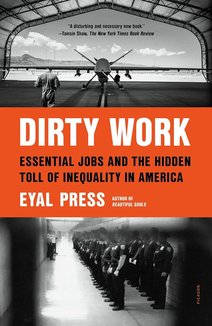
Dirty Work
Author:
Eyal Press
Winner of the 2022 Hillman Prize for Book Journalism A groundbreaking, urgent report from the front lines of "dirty work"―the work that society considers essential but morally compromised Drone pilots who carry out targeted assassinations. Undocumented immigrants who man the “kill floors” of industrial slaughterhouses.
Winner of the 2022 Hillman Prize for Book Journalism A groundbreaking, urgent report from the front lines of "dirty work"―the work that society considers essential but morally compromised Drone pilots who carry out targeted assassinations. Undocumented immigrants who man the “kill floors” of industrial slaughterhouses. Guards who patrol the wards of the United States’ most violent and abusive prisons. In Dirty Work , Eyal Press offers a paradigm-shifting view of the moral landscape of contemporary America through the stories of people who perform society’s most ethically troubling jobs. As Press shows, we are increasingly shielded and distanced from an array of morally questionable activities that other, less privileged people perform in our name. The COVID-19 pandemic has drawn unprecedented attention to essential workers, and to the health and safety risks to which workers in prisons and slaughterhouses are exposed. But Dirty Work examines a less familiar set of occupational hazards: psychological and emotional hardships such as stigma, shame, PTSD, and moral injury. These burdens fall disproportionately on low-income workers, undocumented immigrants, women, and people of color. Illuminating the moving, sometimes harrowing stories of the people doing society’s dirty work, and incisively examining the structures of power and complicity that shape their lives, Press reveals fundamental truths about the moral dimensions of work and the hidden costs of inequality in America.
Find this book on:
Episode overview
The insurrection at the Capitol on Jan. 6 failed. Donald Trump is not the president. But at the state level, the Republican war on elections is posting startling wins. They are trying to do what Trump failed to do: neuter elections as a check on Republican power.
A new report by three voting rights groups found that 24 laws have been passed in 14 states this year that will allow state legislatures to “politicize, criminalize and interfere in election administration.” And a May analysis from the Brennan Center found that Republican-controlled legislatures in 14 states have passed 22 laws that made voting harder, with dozens of others currently moving through the legislative process.
This is an example of what I’ve sometimes referred to as the “doom loop of democracy”: highly gerrymandered Republican state legislatures in key swing states passing legislation that gives them more power to discourage Democratic-leaning groups from voting, throw out legitimate votes and overturn election results — all of it backed up by Republican-dominated courts.
Ari Berman is a senior reporter at Mother Jones and the author of “Give Us the Ballot: The Modern Struggle for Voting Rights in America.” He’s done excellent coverage of these state bills. So I wanted to bring him on, in part, to understand these bills on a more detailed level: What do they actually do? What kind of impact will they have?
But we also discuss the Republican Party’s minoritarian path to power, potential nightmare 2024 election scenarios, how voting rights became a culture war issue, whether the United States is becoming a “competitive authoritarianism” political system, why the biggest scandal in American democracy is what’s legal and even expected, what HR1 — even if it had passed — would and wouldn’t have fixed and much more.
Mentioned in this episode:
“What Georgia’s Voting Law Really Does” by Nick Corasaniti and Reid J. Epstein
“The Insurrection Was Put Down. The GOP Plan for Minority Rule Marches On.” by Ari Berman
“Call it authoritarianism” by Zack Beauchamp
“Statement of Concern: The Threats to American Democracy and the Need for National Voting and Election Administration Standards” by multiple
“Advantage, GOP” by By Laura Bronner and Nathaniel Rakich
“2020 Census: What the Reapportionment Numbers Mean” by Dave Wasserman